



Domestic PC shipments in 2018 fell 6.9% year-over-year, with AI utilization on the rise.
 Published2019.02.12 10:47
| Laptop share expands across individual markets
Computing devices will evolve into WaaS.
Although domestic PC shipments declined in 2018 compared to the previous year, profitability improved.
According to a domestic PC market research analysis released by Korea IDC on the 11th, domestic PC shipments in 2018 decreased by 6.9% year-on-year to 1.94 million desktops, 2.31 million laptops, and 4.26 million total units.
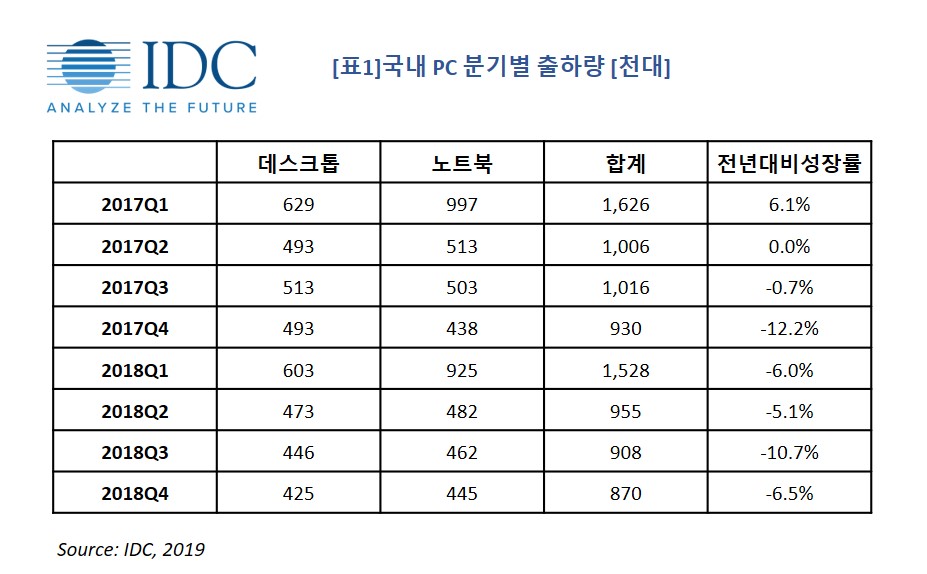
Domestic PC quarterly shipments
By product, convertible notebooks offering note-taking functions were particularly popular, while ultra-slim notebooks are becoming thinner and thinner thanks to low-power processors and improvements in design processes.
Gaming PCs recorded double-digit year-over-year growth, despite a shortage of graphics cards due to cryptocurrency mining at the beginning of the year and a shortage of Intel processors in the second half of the year, driven by the release of games requiring high graphics performance, including Battlegrounds, and the increasing number of gamers enjoying them.
The consumer sector shipped 2.35 million units, a 7.7% decrease year-on-year. However, the sales decline was 4.0%, lower than demand, due to the increased proportion of mainstream and premium products, and profitability per product is analyzed to have improved.
Domestic PC product shipments by product
The public sector expanded its investment in IT equipment retooling, including large-scale bidding and network separation, shipping 340,000 units, up 2.1% year-on-year. Meanwhile, the education sector saw a 12.7% drop in PC shipments, driven by a massive purchase of tablets for digital textbooks in the second half of the year. Nonetheless, the share of laptops in both public and educational settings increased year-on-year to 11.3% and 21.7%, respectively, indicating a shift toward adopting a mobility environment to increase productivity.
The corporate sector shipped 1.29 million units, a 7.4% decrease year-on-year, with the decline in desktops being particularly large due to reduced investment by small and medium-sized enterprises.
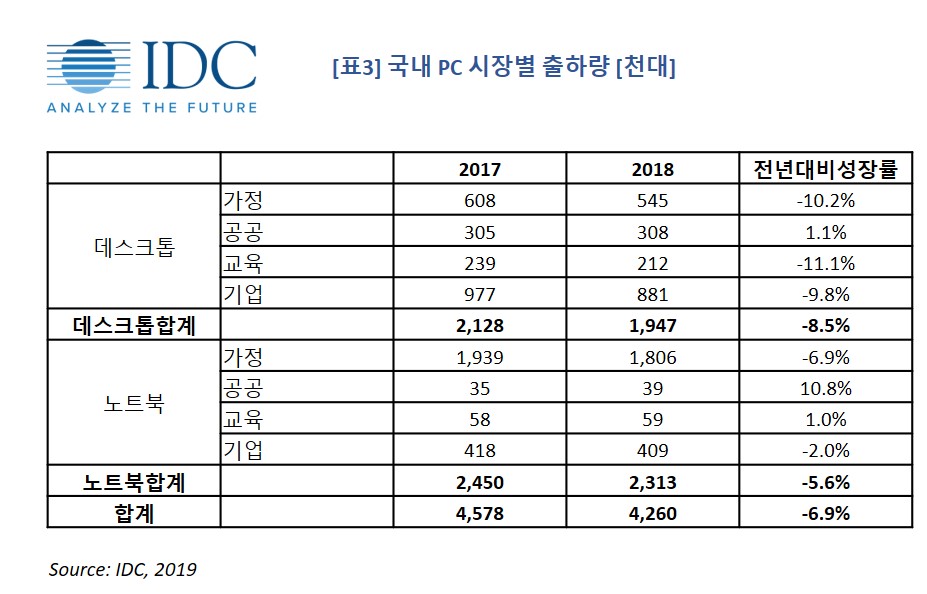
Domestic PC shipments by market
According to IDC Korea Device Research Director Kwon Sang-jun, “According to IDC’s ‘Future of Work Outlook,’ by 2020, more than half of the world’s workers will be reorganized into millennials who are accustomed to using digital devices,” and “In addition to desktops and laptops, various devices such as tablets, smartphones, AR/VR devices, and smart speakers are being used in the workplace, and the use of AI is increasing.”
Accordingly, he added, “Computing devices must also evolve to accommodate diverse work styles, and ultimately, from a workspace perspective, the concept of workspace as a service will evolve.”
Comments
Related news
.jpg)
Domestic PC shipments fell 5.1% year-over-year, but demand for new products increased.
According to Korea IDC's domestic PC market research and analysis, in Q2 2018, domestic PC shipments totaled 950,000 units, comprising 470,000 desktop units and 480,000 notebook units, representing a 5.1% decline compared to the previous year. However, the market size for gaming, ultraslim, and convertible PCs continues to grow.
2018.08.18by 이수민 기자

The global robotics systems and drone market is growing by over 20% annually.
IDC Korea released a worldwide robotics systems and drone spending guide. According to the guide, the market size for 2019 is projected at a total of $115.7 billion, representing a year-over-year increase of 17.6%. Additionally, through 2022, the market is expected to record a compound annual growth rate of 20.2%, reaching a total market size of $210.3 billion. While the robotics systems market size is larger than the drone market size, the drone market is expected to demonstrate a higher compound annual growth rate and grow at a faster pace.
2018.12.11by 이수민 기자
Global PC shipments in the fourth quarter of 2018 reached 68.6 million units, due to CPU shortages and economic uncertainty.
Global PC shipments in the fourth quarter of 2018 totaled 68.6 million units, representing a 4.3% decrease compared to the same period of the previous year. Full-year 2018 PC shipments surpassed 259.4 million units, declining 1.3% from 2017. CPU supply shortages and economic uncertainty across various countries were cited as contributing factors. Nevertheless, Windows 10 upgrades continued to drive demand in the business PC market.
2019.01.17by 이수민 기자

ESP32 Development Environment Selection and GPS Application Implementation
The ESP32 is a microcontroller that integrates Wi-Fi, Bluetooth, 12-bit ADC, capacitive touch, PWM, DAC, and UART in a single SoC. However, the abundance of features does not by itself solve the designer's problems. The real challenges lie in selecting the appropriate development environment, determining which pins can be used and which must be avoided, and converting raw data from modules into usable information. This document addresses ESP32 peripheral constraints (ADC2 and Wi-Fi coexistence limitation, UART1 occupancy, ADC non-linear regions), the trade-offs between Arduino IDE and ESP-IDF, and the process from connecting NEO-6M/NEO-M8N GPS modules to UART2, parsing NMEA sentences, and visualizing routes in Google Earth, all organized based on documented references.
2026.10.12by 편집부

MIPI CSI-2, DSI-2, C-PHY, D-PHY Test Solution Technical White Paper
The MIPI interface adopts a burst mode that transitions between low-power (LP) and high-speed (HS) states for low-power consumption, and in return, strict timing rules are imposed on state transitions. Additionally, the high-speed section operates as a packet-based protocol with headers, ECC, and CRC, so verification engineers must handle waveforms and protocols simultaneously. Traditional configurations combining general-purpose oscilloscopes and AWGs reveal limitations in setup complexity, measurement uncertainty, and lack of reproducibility when faced with these requirements. This white paper, based on webinar materials, organizes the structure of this problem and describes how the SV5C-DPTXCPTX generator for receiver testing and SV5C-DPRXCPRX analyzer for transmitter testing integrate state transition testing, stressed eye testing, and protocol analysis into a single bench, along with their application boundaries.
2026.10.12by 편집부











