



Five Challenges 5G NR Device Designers Must Overcome <4> OTA Testing on 5G mmWave Devices
 Published2019.03.01 09:01
Currently, designers conducting over-the-air (OTA) testing on 5G mmWave components and devices use cable connections to perform most sub-6 GHz RF performance tests. For 5G, low-frequency testing is similar to 4G, but mmWave requires a wireless test solution, including:
▲RF performance - minimum signal quality ▲Demodulation - data processing performance ▲Radio resource management (RRM) - initial access, handover, and mobility ▲Signaling - upper layer signaling procedures
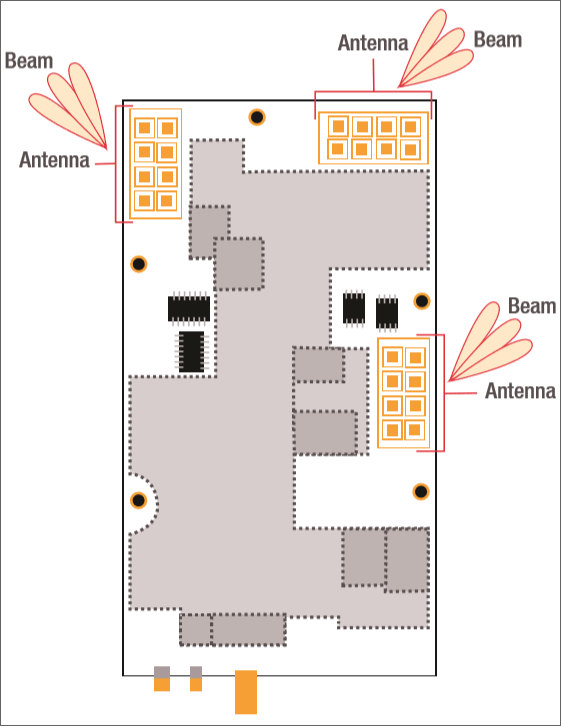
A prototype 5G NR smartphone with its antenna array positioned close to the outside.
Designers typically conduct near-field and far-field radiation testing of their devices. While far-field testing methods are traditionally the most comprehensive, they present several challenges at mmWave frequencies. As the operating frequency increases and the size of the radiating antenna increases, the distance increases, resulting in greater path loss, making it difficult to perform accurate radiation measurements.
For example, a 15cm radiating antenna operating at 28GHz has a long-range range of 4.2m and a path loss of 73dB. Due to the high operating frequency, conventional long-range testing methods require a large amount of space and suffer from high path loss, making accurate and repeatable over-the-air measurements unfeasible.
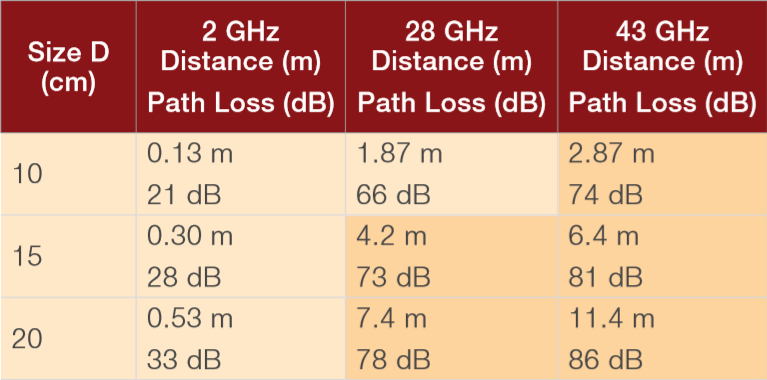
Long-distance test distance and path loss results during OTA measurements
Test vendors and 3GPP are studying Direct Far-Field (DFF), Indirect Far-Field (IFF), and Near-field to Far-field TransFormation (NFTF) test methodologies to determine the appropriate OTA test method for device and base station conformance testing.
Recently, 3GPP approved the Compact Antenna Test Range (CATR) for device RF performance testing. This OTA test method can perform measurements on the transmit power, transmit signal quality, and spurious emissions of a radiating transmitter with much lower path loss than traditional long-distance test chambers.
As 5G NR evolves, designers can reduce development time and the risk of costly rework by regularly reviewing 3GPP-approved OTA test methods and test vendor solutions.
In the next article, we will explore the fifth challenge: peaceful coexistence with LTE and other wireless communications.
▒See the 5 Challenges 5G NR Device Designers Must Overcome
<1> Utilizing variable slot duration
<2> Increase throughput at high frequencies and wide bandwidths
<3> Effective use of beam steering technology at mmWave frequencies
<4> OTA testing on 5G mmWave devices
<5> Peaceful coexistence with LTE and other wireless communications
Comments
Related news
5 Challenges 5G NR Device Designers Must Overcome <1> Utilizing Variable Slot Duration
5G NR refers to the wireless access technology between terminals and base stations on a 5G network. 3GPP established the NR standard with the goal of providing wireless access technology by integrating eMBB, URLLC, and mMTC, which are usage scenarios for IMT-2020 technology. Additionally, 5G NR Release-15 defined specifications to support eMBB and URLLC. In the ICT industry, the emergence of something new means that designers have more work to do. Design teams utilizing 5G NR face increasingly complex challenges and a greater number of issues. To implement 5G NR, device designers must overcome five key challenges.
2019.01.15by 이수민 기자
Five Challenges 5G NR Device Designers Must Overcome <2> Increasing Throughput at High Frequency and Wide Bandwidth
5G NR presents a new approach to utilizing spectrum in sub-6 GHz and mmWave frequencies. Sub-6 GHz focuses on expanding coverage and support for low-latency applications such as low-speed IoT applications, digital control systems, security cameras, autonomous vehicles, and pacemakers. mmWave frequencies provide wider channel bandwidth capable of supporting eMBB use cases, enabling data-intensive applications such as ultra-high-definition streaming. Designing optimized for mmWave frequencies up to 52.6 GHz is one of the most challenging aspects of 5G NR. Therefore, it is important to evaluate signal modulation characteristics by examining the IQ constellation and identifying potential waveform distortion errors.
2019.02.07by 이수민 기자

Five Challenges 5G NR Device Designers Must Overcome <3> Effectively Using Beam Steering Technology at mmWave Frequencies
Using mmWave frequencies with wide channel bandwidth can increase data throughput. However, mmWave frequency signals experience signal propagation issues such as increased path loss and reduced penetration through walls and windows. Beam steering and beamforming techniques can combine multiple antenna elements to generate high-gain directional beams that can be delivered to specific users. Multiple stages of testing are required during the design of 5G NR devices. Early in the design phase, designers must validate protocol procedures to verify that the device can connect to the network. This includes testing initial access and beam management operations as the device moves across the network. A network emulator simulates network commands during testing and captures the behavior generated from the device. Designers must also validate the RF performance of the device through simulation and hardware prototyping. In both models, designers must measure and optimize RF characteristics such as EVM and ACPR.
2019.02.11by 이수민 기자
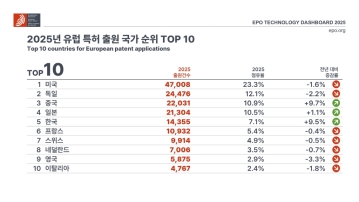
European Patent Applications Surpass 200,000 for the First Time… South Korea Maintains 5th Place, Led by Batteries and Telecommunications
According to the European Patent Office (EPO)'s 'Technology Dashboard 2025', European patent applications last year reached 201,974, surpassing 200,000 for the first time. Korean companies and inventors filed 14,355 applications, representing a 9.5% increase from the previous year and maintaining 5th place by country. Battery, digital communication, and semiconductor technologies led the growth, with Samsung ranking as the top EPO applicant for the second consecutive year and LG reaching 3rd place. The presence of major domestic cities such as Seoul, Suwon, and Yongin was also confirmed. It was also revealed that Korea's European patent strategy is expanding beyond individual technologies to span the entire industry.
2026.03.24by 명세환 기자

SK Telecom First Applies AI-Based Network Operations at Gwanghwamun K-Pop Concert
SK Telecom announced that it applied an AI-based network operation system for the first time at a large-scale K-pop concert held in the Gwanghwamun area of Seoul on March 21st, managing communication quality throughout the event. Mobile data usage during the three hours before and after the concert reached 12.15TB, approximately doubling compared to the same time slot the previous weekend. SK Telecom monitored traffic using the AI system 'A-One' in five-minute and 50-meter units to respond to potential overload situations, while also operating temporary communication facilities and on-site personnel in parallel. This case is interpreted as confirmation of the practical applicability of AI-based autonomous network operation in an environment where demand from dense events and foreign users increases simultaneously.
2026.03.23by 명세환 기자











