



MSIT and KISA to Achieve Transparent Donation Culture and Guarantee Reliability in Used Car Market via Blockchain
 Published2019.03.04 17:01
Creating a Transparent Donation Culture with Blockchain
Preventing Fraud by Securing Reliability in the Used Car Market
The Ministry of Science and ICT and the Korea Internet & Security Agency (KISA) announced on the 4th that they will launch a private-sector-led national project for the first time this year to create an initial market for blockchain, a core technology of the Fourth Industrial Revolution.

Blockchain is a technology in which network participants jointly record, verify, and store information such as transaction records. Since the content of information recorded on a blockchain cannot be arbitrarily altered by a third party, it can enhance data security and transaction efficiency.
This private-sector-led national project, promoted as part of the Ministry of Science and ICT's blockchain development strategy (2018), is a project that supports the development of blockchain services usable in real life and early commercialization based on creative ideas from the private sector.
The Ministry of Science and ICT conducted an open call for proposals from December 6, 2018, to January 31, 2019, and 24 consortia (80 companies) consisting of leading companies in sectors such as manufacturing, telecommunications, and finance, as well as blockchain-related ventures and startups, proposed various ideas.
Through an evaluation committee composed of private sector experts, feasibility and the degree of improvement resulting from the application of blockchain were thoroughly evaluated, and three consortia were selected as preferred bidders. A project worth a total of 8.7 billion won is scheduled to begin following technical negotiations and the signing of an agreement in mid-March.
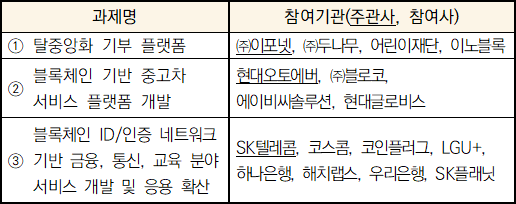
Private-led National Project Tasks and Participating Organizations
Kim Jeong-won, Director General of Internet Convergence Policy at the Ministry of Science and ICT, stated, “To secure Korea’s unique blockchain competitiveness, it is a top priority to create a private-sector-led blockchain industry ecosystem,” adding, “The government will act as a catalyst through policy support to create a virtuous cycle where technology, manpower, and companies grow together.”
The key details of each task of the three private-sector-led projects selected this year are as follows.
Decentralized donation platform
In Korea, the donation culture is not thriving due to low trust in the transparency of charitable organizations' financial management and donation records. Therefore, we plan to implement a donation platform that utilizes blockchain technology, which possesses properties that make stored data difficult to tamper with, to distribute and store data regarding fundraising, execution, and results, and to transparently disclose it.
The Children's Foundation plans to conduct a pilot donation campaign using the implemented platform starting at the end of this year. Through this, it is expected that the reliability of donation projects will be enhanced using blockchain technology, enabling anyone to participate in various donation campaigns and allowing many people to benefit.
Blockchain-based used car service platform
The used car market continues to grow due to factors such as the increasing burden of purchasing new cars and consumer trends prioritizing price-to-performance ratios; however, damages related to used car transactions, such as fraud, continue to occur.
The platform under development records key historical data (transaction information, condition evaluation, various history information, etc.) at each stage, from used car purchase to sale, on a blockchain to fundamentally prevent falsification or alteration of used car driving records and accident history.
The developed platform plans to establish an online transaction brokerage platform and conduct a pilot operation within this year. Once the platform is activated, it is expected to revitalize the used car market by reducing transaction costs resulting from information asymmetry between suppliers and buyers based on reliable data.
Development and application of services in the finance, telecommunications, and education sectors based on blockchain ID/authentication networks
Recently, cases of personal information leakage and misuse have been occurring due to the centralized ID management systems of internet companies. Furthermore, the abolition of accredited certificates has raised the need for new authentication methods.
By applying blockchain to ID/authentication platforms, users can manage their personal information directly without intermediaries or the need to expose it. ID/authentication platforms are linked with authentication networks in various fields and are used for services such as credential verification and certificate issuance.
ID/authentication-based services in the financial, telecommunications, and education sectors are scheduled to launch this year, and there are plans to conduct a pilot program for issuing certificates for three universities. It is expected to be utilized in certificate issuance and management services across various fields, as it enables identity verification and authentication in a simple and secure manner.
Comments
Related news
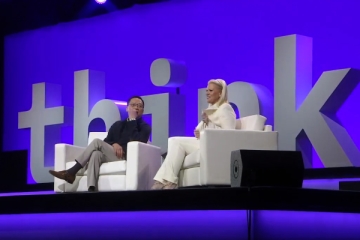
IBM Supports AI for Hyundai Card and Blockchain for Hyundai Commercial
Hyundai Card and Hyundai Commercial announced at IBM THINK 2019 that they are collaborating with IBM to leverage cloud-based AI and blockchain technologies. Since 2017, Hyundai Card introduced an AI-based chatbot to customer-facing services as the first in the domestic financial industry, and has been supporting over one million customers. Hyundai Commercial is cooperating with IBM to apply blockchain technology to innovate its business model.
2019.02.14by 이수민 기자
Akamai and a leading Japanese financial group have jointly launched a blockchain-based online payment network.
Akamai will establish GO-NET, a joint venture company with Japan's Mitsubishi UFJ Financial Group. Through this joint investment, both companies plan to not only expand their cooperative relationship but also provide a new blockchain-based online payment network that strengthens next-generation payment security and enhances scalability and response speed. Akamai has demonstrated BaaS technology through decades of experience accumulated in developing and building globally-scaled distributed systems, along with industry-leading performance and security services. Mitsubishi UFJ Financial Group leverages its global influence and expertise to provide financial services on a worldwide scale.
2019.02.18by 이수민 기자
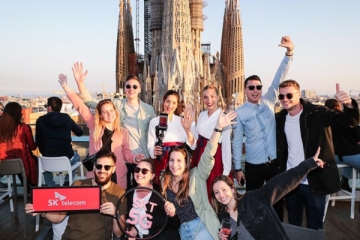
[5G! MWC19] SK Telecom Overcomes Spatial Limitations with 5G VR and Boosts Industrial Productivity with AI
SK Telecom showcases future lifestyles enabled by advanced technologies at the Barcelona venue, overcoming spatial limitations through 5G VR and enhancing industrial productivity with AI. SK Telecom has organized the exhibition space into four thematic zones: 5G Connected Space, 5G Connected Factory, 5G Connected Society, and 5G Connected Vehicle. Visitors to the exhibition hall can experience innovative services and solutions including VR, AI, smart factory, autonomous driving, blockchain, and quantum cryptography, all implemented through SK Telecom's 5G commercialized technologies.
2019.02.25by 이수민 기자
Nvidia invests $5 billion in Intel
NVIDIA and Intel, leaders in global AI computing technology, are now forging ahead in providing cutting-edge solutions through NVLink-based architecture integration. NVIDIA and Intel have officially announced a strategic partnership and stated that they will jointly develop customized data center and personal computing products to accelerate diverse applications and workloads ranging from hyperscale to enterprise and consumer markets, thereby laying the foundation for the next generation computing era.
2025.09.22by 배종인 기자
.jpg)
Applied Materials Launches Environmental Protection Campaign to Mark World Cleanup Day
Applied Materials Korea (CEO Park Kwang-seon) is carrying out environmental cleanup activities with employees and their families around the Dongtan Sinricheon area on the occasion of World Cleanup Day, evolving into a company that engages with the local community beyond technological innovation.
2025.09.22by 명세환 기자











