This page was machine-translated and may differ from the original. View original
LG Uplus and Hanyang University's 5G autonomous vehicle travels 8km through downtown Seoul... "Commercialization is still a long way off."

Live broadcast of the 5G autonomous vehicle A1 at Hanyang University
| Watch real-time VR content from a moving car
| 5G for accident information detection and real-time route changes
A self-driving car drove 8 kilometers on its own in downtown Seoul. 
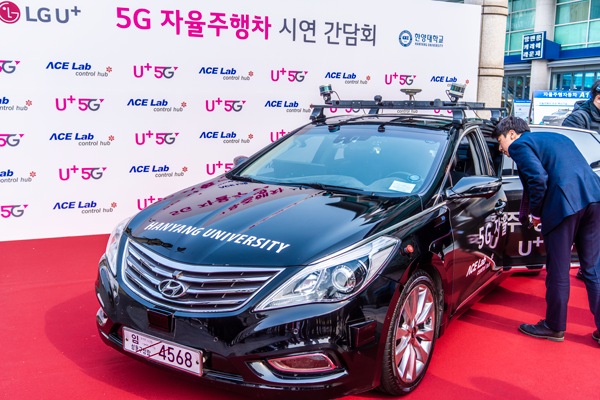
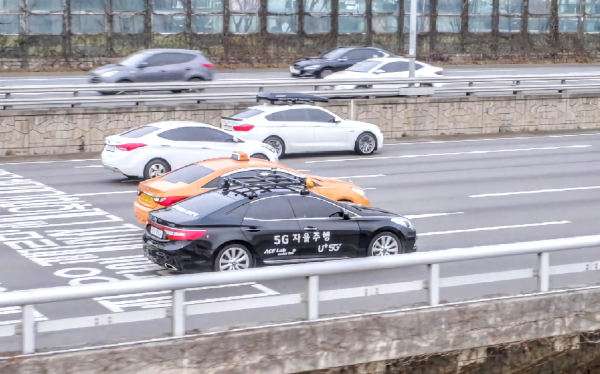
A 5G autonomous vehicle jointly developed by LG U+ and Hanyang University's Ace Lab.
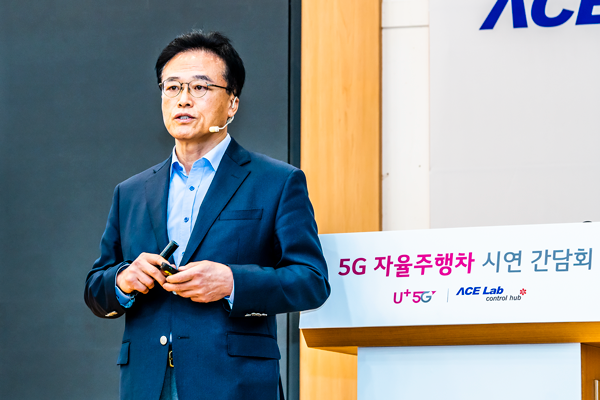
On the 11th, Hanyang University's Automotive Electronics Control Research Lab (ACE Lab) and LG U+ held a press conference at Hanyang University's Seoul campus and publicly demonstrated autonomous driving technology for urban roads based on 5G mobile communications.
To showcase advanced autonomous driving and communications technologies, Hanyang University and LG U+ chose a busy city road rather than a self-driving test city or a relatively car-free suburban area.
Professor Myung-ho Sunwoo of Ace Lab said, “5G autonomous vehicles are a culmination of 4th Industrial Revolution technologies that can greatly contribute to solving social problems such as relieving traffic congestion and preventing safety accidents.” He added, “We will continue to evolve the ability to help smooth traffic flow and respond to unexpected variables, ultimately unveiling Level 5 fully autonomous driving technology.”
The recently unveiled 5G autonomous vehicle, the "A1," is close to "highly autonomous" (Level 4) according to the Society of Automotive Engineers (SAE) classification. This refers to the level at which the vehicle can drive autonomously without driver intervention. Level 5, "full autonomous" refers to a driverless vehicle that can operate without a human passenger.
Self-driving cars, a core technology of the Fourth Industrial Revolution
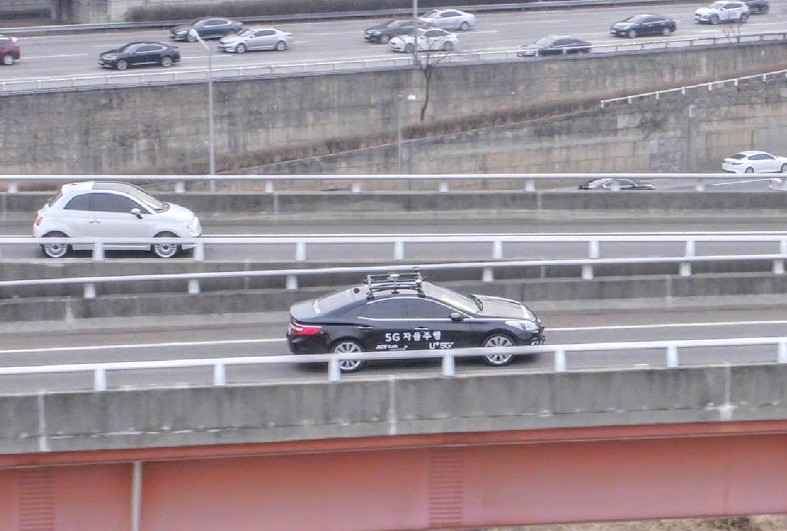
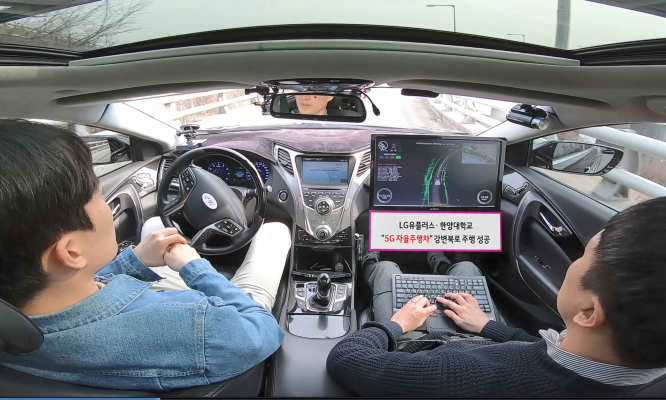
In the demonstration, the driver of the A1 pressed the "Autonomous Driving Mode ON" switch and took his or her hands and feet off the steering wheel, accelerator, and brakes until the vehicle arrived at its destination. Starting from the Han River Business Headquarters in Seongsu-dong, the A1 autonomously drove for approximately 25 minutes, traveling approximately 8 kilometers along Gangbyeonbuk-ro, Yeongdong Bridge, Olympic-daero, and Seongsu Bridge before arriving at the Seoul Forest Public Parking Lot.
Upon entering Gangbyeonbuk-ro, the A1 merged with the expressway, following the flow of regular vehicles traveling at around 60 km/h. A1 was equipped with autonomous vehicle control technology that maintained a certain distance from surrounding vehicles. The vehicle in front and behind controlled longitudinally, while the vehicles on either side controlled laterally, enhancing driving stability.
While driving along the Gangbyeonbuk-ro, A1 maintained a speed limit of 80 km/h or less. Furthermore, he read the speed limit signs posted on each road and reflected this in his actual driving speed. The vehicle spacing was maintained differently depending on the driving speed. 
A1 on display
On Yeongdong Bridge, a typical urban road, the system responded to the constant lane changes and cut-ins from vehicles in front, behind, and on either side with "AI-based driving environment recognition," a technology that responds in real time. This technology uses information from various sensors, including lidar, cameras, and radar, mounted on the vehicle to perceive the surroundings, predict future situations, and assess driving risks.
Ace Lab anticipates that its self-developed "deep learning-based AI technology" will play a role similar to AlphaGo in the autonomous vehicle field. The company explains that AI will continuously accumulate and analyze experience with road conditions and variables, enabling it to continuously evolve.
VR content enriches the autonomous vehicle experience.
As the era of autonomous driving fully unfolds, vehicle occupants will have greater opportunities to utilize their personal time. They will be able to apply makeup, read, or even watch media on the way to work. The event also featured a demonstration of watching content in a car.
While A1 ran along Olympic-daero, the demonstrator simultaneously worked and watched 5G streaming video. Wearing a dedicated VR headset, the demonstrator experienced high-capacity VR content, including the Grand Canyon, marine ecosystems, and idol practice, in real time without delay or loading. LG U+ announced that it plans to provide a large amount of VR content through a VR-only platform that it is preparing.
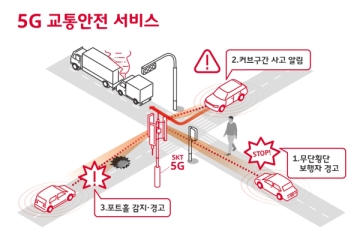
A1, which entered the northern end of Seongsu Bridge, recognized the surrounding road conditions and automatically adjusted its expected route. When the control center relayed information about an accident near its destination via a 5G network, a voice alert and a screen display appeared inside the vehicle. A1 changed its driving route and guided to the Seoul Forest public parking lot through the east entrance instead of the north entrance of Seoul Forest, which was originally planned to be entered.
An LG U+ official explained, “Once autonomous vehicles become popular, each vehicle will transmit the on-site traffic information it detects to the control center, and the control center will then provide the optimal driving route for each vehicle in real time based on this to help traffic flow smoothly.” He added, “In order to exchange large amounts of information with tens to hundreds of vehicles in real time, a 5G communication network, which can be called a ‘data highway,’ is essential.”
LG Uplus plans to research and develop communications, precision positioning, control, navigation, and infotainment services necessary for autonomous driving using 5G, a core technology for autonomous vehicles. 
Professor Seonwoo Myung-ho of Hanyang University's ACE Lab
Professor Seonwoo Myeong-ho of Hanyang University's ACE Lab explained, "Future autonomous vehicle models based on 5G are rapidly evolving through collaboration between academia, industry, and research." He added, "In particular, based on rapid convergence between the telecommunications and automobile industries, an era of fully autonomous vehicles without steering wheels or pedals will ultimately arrive."
LG Uplus FC Division Head Executive Director Lee Sang-min said, “The ultra-low latency of the 5G communication network is a key factor that will increase the stability of autonomous vehicles,” and “Based on the autonomous driving technology of Hanyang University ACE Lab and LG Uplus’ 5G communication network,“We plan to continue to pursue joint research,” he said.
Meanwhile, Hanyang University's ACE Lab conducted a demonstration of autonomous driving technology on the Gyeongbu Expressway in late 2017. At the time, the A1 traveled approximately 420 km in six hours, demonstrating the stability of its autonomous driving platform.
To secure global competitiveness in autonomous vehicles
The demonstration provided a glimpse into the potential commercialization of autonomous vehicles and autonomous driving services. While the related equipment has yet to be seamlessly integrated into the automotive system, the layout was somewhat disorganized. However, once commercialization is complete, this will likely be streamlined.
The question is timing. Variables include the level of autonomous driving technology desired by the market, the commercialization model, and price. Passenger safety must be the top priority for vehicles. To ensure the safety of autonomous vehicles, securing diverse and extensive road data is essential. Currently, only 60 autonomous vehicles are on the road in South Korea. Waymo in the US operates tens of thousands of autonomous vehicles, and Baidu in China operates in the thousands. This is far less than even a single company. 
A1 running through downtown Seoul
The lack of a clear business model is also problematic. If autonomous driving becomes possible, it remains unclear whether companies will sell complete vehicles with autonomous driving features as an option, launch a taxi business solely with autonomous vehicles, or install autonomous driving terminals in vehicles under a subscription service agreement. Accordingly, LG Uplus stated that it would focus on autonomous driving communications as it is not an automobile manufacturer.
Price is the biggest issue. The initial price of a self-driving car is expected to exceed 300 million won (approximately $250,000 USD). Few consumers will readily pay 300 million won for a vehicle with autonomous driving capabilities, making price sensibility a pressing issue. To lower prices, domestic components must be more competitive, but the industry believes that lidar and cameras, excluding radar, fall short of world-class standards.
Even introducing a single carpooling service has borne enormous social costs in our country. The executive and legislative branches, wary of the taxi industry, are hesitant to implement policies related to autonomous driving. If we cling to the status quo, striving to extinguish the immediate fire, we will not be able to move forward, or even remain stagnant.
| Watch real-time VR content from a moving car
| 5G for accident information detection and real-time route changes
A self-driving car drove 8 kilometers on its own in downtown Seoul.

A 5G autonomous vehicle jointly developed by LG U+ and Hanyang University's Ace Lab.
On the 11th, Hanyang University's Automotive Electronics Control Research Lab (ACE Lab) and LG U+ held a press conference at Hanyang University's Seoul campus and publicly demonstrated autonomous driving technology for urban roads based on 5G mobile communications.
To showcase advanced autonomous driving and communications technologies, Hanyang University and LG U+ chose a busy city road rather than a self-driving test city or a relatively car-free suburban area.
Professor Myung-ho Sunwoo of Ace Lab said, “5G autonomous vehicles are a culmination of 4th Industrial Revolution technologies that can greatly contribute to solving social problems such as relieving traffic congestion and preventing safety accidents.” He added, “We will continue to evolve the ability to help smooth traffic flow and respond to unexpected variables, ultimately unveiling Level 5 fully autonomous driving technology.”
600px; height: 400px;" />
5G autonomous vehicle A1
The recently unveiled 5G autonomous vehicle, the "A1," is close to "highly autonomous" (Level 4) according to the Society of Automotive Engineers (SAE) classification. This refers to the level at which the vehicle can drive autonomously without driver intervention. Level 5, "full autonomous" refers to a driverless vehicle that can operate without a human passenger.
Self-driving cars, a core technology of the Fourth Industrial Revolution
In the demonstration, the driver of the A1 pressed the "Autonomous Driving Mode ON" switch and took his or her hands and feet off the steering wheel, accelerator, and brakes until the vehicle arrived at its destination. Starting from the Han River Business Headquarters in Seongsu-dong, the A1 autonomously drove for approximately 25 minutes, traveling approximately 8 kilometers along Gangbyeonbuk-ro, Yeongdong Bridge, Olympic-daero, and Seongsu Bridge before arriving at the Seoul Forest Public Parking Lot.
Upon entering Gangbyeonbuk-ro, the A1 merged with the expressway, following the flow of regular vehicles traveling at around 60 km/h. A1 was equipped with autonomous vehicle control technology that maintained a certain distance from surrounding vehicles. The vehicle in front and behind controlled longitudinally, while the vehicles on either side controlled laterally, enhancing driving stability.
While driving along the Gangbyeonbuk-ro, A1 maintained a speed limit of 80 km/h or less. Furthermore, he read the speed limit signs posted on each road and reflected this in his actual driving speed. The vehicle spacing was maintained differently depending on the driving speed.

A1 on display
On Yeongdong Bridge, a typical urban road, the system responded to the constant lane changes and cut-ins from vehicles in front, behind, and on either side with "AI-based driving environment recognition," a technology that responds in real time. This technology uses information from various sensors, including lidar, cameras, and radar, mounted on the vehicle to perceive the surroundings, predict future situations, and assess driving risks.
Ace Lab anticipates that its self-developed "deep learning-based AI technology" will play a role similar to AlphaGo in the autonomous vehicle field. The company explains that AI will continuously accumulate and analyze experience with road conditions and variables, enabling it to continuously evolve.
VR content enriches the autonomous vehicle experience.
As the era of autonomous driving fully unfolds, vehicle occupants will have greater opportunities to utilize their personal time. They will be able to apply makeup, read, or even watch media on the way to work. The event also featured a demonstration of watching content in a car.
While A1 ran along Olympic-daero, the demonstrator simultaneously worked and watched 5G streaming video. Wearing a dedicated VR headset, the demonstrator experienced high-capacity VR content, including the Grand Canyon, marine ecosystems, and idol practice, in real time without delay or loading. LG U+ announced that it plans to provide a large amount of VR content through a VR-only platform that it is preparing.
A1, which entered the northern end of Seongsu Bridge, recognized the surrounding road conditions and automatically adjusted its expected route. When the control center relayed information about an accident near its destination via a 5G network, a voice alert and a screen display appeared inside the vehicle. A1 changed its driving route and guided to the Seoul Forest public parking lot through the east entrance instead of the north entrance of Seoul Forest, which was originally planned to be entered.
An LG U+ official explained, “Once autonomous vehicles become popular, each vehicle will transmit the on-site traffic information it detects to the control center, and the control center will then provide the optimal driving route for each vehicle in real time based on this to help traffic flow smoothly.” He added, “In order to exchange large amounts of information with tens to hundreds of vehicles in real time, a 5G communication network, which can be called a ‘data highway,’ is essential.”
LG Uplus plans to research and develop communications, precision positioning, control, navigation, and infotainment services necessary for autonomous driving using 5G, a core technology for autonomous vehicles.

Professor Seonwoo Myung-ho of Hanyang University's ACE Lab
Professor Seonwoo Myeong-ho of Hanyang University's ACE Lab explained, "Future autonomous vehicle models based on 5G are rapidly evolving through collaboration between academia, industry, and research." He added, "In particular, based on rapid convergence between the telecommunications and automobile industries, an era of fully autonomous vehicles without steering wheels or pedals will ultimately arrive."
LG Uplus FC Division Head Executive Director Lee Sang-min said, “The ultra-low latency of the 5G communication network is a key factor that will increase the stability of autonomous vehicles,” and “Based on the autonomous driving technology of Hanyang University ACE Lab and LG Uplus’ 5G communication network,“We plan to continue to pursue joint research,” he said.
Meanwhile, Hanyang University's ACE Lab conducted a demonstration of autonomous driving technology on the Gyeongbu Expressway in late 2017. At the time, the A1 traveled approximately 420 km in six hours, demonstrating the stability of its autonomous driving platform.
To secure global competitiveness in autonomous vehicles
The demonstration provided a glimpse into the potential commercialization of autonomous vehicles and autonomous driving services. While the related equipment has yet to be seamlessly integrated into the automotive system, the layout was somewhat disorganized. However, once commercialization is complete, this will likely be streamlined.
The question is timing. Variables include the level of autonomous driving technology desired by the market, the commercialization model, and price. Passenger safety must be the top priority for vehicles. To ensure the safety of autonomous vehicles, securing diverse and extensive road data is essential. Currently, only 60 autonomous vehicles are on the road in South Korea. Waymo in the US operates tens of thousands of autonomous vehicles, and Baidu in China operates in the thousands. This is far less than even a single company.

A1 running through downtown Seoul
The lack of a clear business model is also problematic. If autonomous driving becomes possible, it remains unclear whether companies will sell complete vehicles with autonomous driving features as an option, launch a taxi business solely with autonomous vehicles, or install autonomous driving terminals in vehicles under a subscription service agreement. Accordingly, LG Uplus stated that it would focus on autonomous driving communications as it is not an automobile manufacturer.
Price is the biggest issue. The initial price of a self-driving car is expected to exceed 300 million won (approximately $250,000 USD). Few consumers will readily pay 300 million won for a vehicle with autonomous driving capabilities, making price sensibility a pressing issue. To lower prices, domestic components must be more competitive, but the industry believes that lidar and cameras, excluding radar, fall short of world-class standards.
Even introducing a single carpooling service has borne enormous social costs in our country. The executive and legislative branches, wary of the taxi industry, are hesitant to implement policies related to autonomous driving. If we cling to the status quo, striving to extinguish the immediate fire, we will not be able to move forward, or even remain stagnant.
본 기사에 대한 정정·반론·추후보도 청구는 보도 청구 안내를, 그간 게재된 보도문은 정정·반론보도 모아보기를 참고해 주세요.