



Velodyne Launches LiDAR Solution for Autonomous Vehicles via NVIDIA DRIVE Platform
 Published2019.03.21 09:01
| Generating data to be fed into autonomous vehicles by mimicking sensors
| Level 2 ADAS enhancements such as AEB, ACC, and LKA are possible.
Velodyne Lidar announced today that it is launching a surround-view lidar solution for the NVIDIA DRIVE autonomous driving platform that collects rich perception data during testing and validation. This solution enables accurate localization and path planning through real-time 360-degree perception.
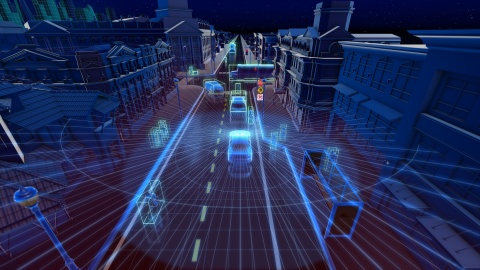
Velodyne's lidar helps autonomous vehicles determine the safest path.
Velodyne sensors are showcased on NVIDIA DRIVE Constellation, an open, scalable simulation platform that enables high-precision, large-scale in-the-loop hardware experiments. This solution's DRIVE Sim software emulates sensors such as lidar to create a highly reliable virtual world and generate data to be input into autonomous vehicles.
“Velodyne and NVIDIA are at the forefront of the development of high-resolution sensing and high-performance computing for autonomous driving,” said Mike Jellen, President and Chief Commercial Officer, Velodyne Lidar. “Velodyne’s intelligent Lyra sensors will provide the foundation for advanced vehicle autonomy, safety and driver assistance systems from leading global manufacturers.”
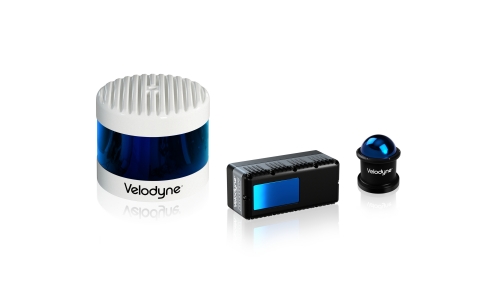
Velodyne provides lidar solutions for vehicle autonomy and driver assistance.
Velodyne offers a wide range of lidar products, covering the full spectrum of advanced driver assistance and autonomous driving systems required by automotive OEMs, truck OEMs, delivery manufacturers, and Tier 1 suppliers. Proven through millions of kilometers of driving, Velodyne sensors help autonomous vehicles choose the safest path. Adding Velodyne sensors can enhance Level 2 advanced driver assistance systems (ADAS) such as autonomous emergency braking (AEB), adaptive cruise control (ACC), and lane keeping assist (LKA).
“Velodyne’s lidar sensors detect more objects and provide vehicles with a more detailed view of their surroundings, providing the information they need to make autonomous driving systems and road safety a reality,” said Glen Schuster, director of sensor ecosystem development at NVIDIA.
Comments
Related news
Velodyne-YellowScan Leading Drone Survey Market for Highway Expansion Projects
Velodyne Lidar announced that YellowScan's YellowScan Surveyor has utilized Velodyne's sensor technology to collect precise mapping data for an infrastructure construction project on one of the busiest roads in Central Europe. The YellowScan Surveyor, an unmanned aerial vehicle (UAV) surveying system, collects precise and detailed topographic data through efficient methods, delivering superior results compared to time-intensive manual surveying work of the past. Ventus-Tech collected data from a 47-kilometer section of the M1 highway in northwestern Hungary using the YellowScan Surveyor.
2019.01.28by 이수민 기자
Velodyne Lidar supplies lidar sensors to Chinese HoloMatic, which developed autonomous valet parking solution
Velodyne Lidar has supplied lidar sensors to HoloMatic's smart valet parking solution, HoloParking, which eliminates the burden on drivers of spending time searching for parking spaces. Unlike parking assistance systems, HoloParking does not require the vehicle to be driven to the parking spot itself. When a vehicle uses HoloParking, it can find a parking space on its own and complete parking without human supervision.
2019.02.11by 이수민 기자
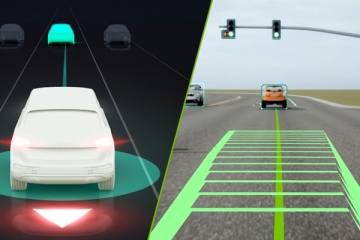
NVIDIA Unveils Drive AV Safety Force Field, "Mathematically Validated to Reduce Autonomous Vehicle Accident Rates."
Nvidia has strengthened its "Nvidia Drive AV autonomous vehicle software" product line by applying a control layer designed to implement safe and comfortable driving experiences. The key component of this software is Safety Force Field (SFF), a powerful driving policy that protects vehicles, passengers, and other road users. Rather than modeling the high complexity of real-world scenarios with limited statistics, SFF ensures that vehicles maintain safety based on mathematically verified zero-collision verification.
2019.03.20by 이수민 기자

[e4ds Tech Day 2026 ⑨] Sim Sang-gyu, Autocrypt CTO: "In the Physical AI Era, Automotive Security Must Extend Beyond the Vehicle"
At e4ds Tech Day 2026, Sim Sang-gyu, CTO of Autocrypt, explained automotive cybersecurity strategies in the era of Physical AI and SDV (Software-Defined Vehicle). Automobiles are evolving as part of an ecosystem connected to AI, cloud, chargers, IoT, and robots, and he emphasized that the scope of security must expand beyond the vehicle interior to the entire connected environment. In particular, AI model tampering, adversarial attacks, OTA updates, and EV charger hacking were identified as major threats. He explained that response measures require zero trust, AI model integrity protection, intrusion detection, Security by Design and Default, and full lifecycle security management, and that proactive security system establishment beyond regulatory compliance is critical for securing future mobility competitiveness.
2026.10.12by 배종인 기자

Practical HIL Construction Strategy for Automotive and Off-Highway Controller Validation
As vehicle E/E architecture transitions to zonal structures and shifts to software-defined vehicles (SDV), the number of controllers (ECUs) requiring validation and software complexity are surging dramatically. Meanwhile, real vehicle testing cannot provide repeated verification under identical conditions and entails lead time and safety concerns. This white paper explains the principles of HIL (Hardware-in-the-Loop) validation and the structure of the NI platform composed of PXI, SLSC, and VeriStand, and through two actual implementation cases—Camera Record & Replay HIL for In-Cabin Monitoring Controller (ICMU) and Forklift Controller (VCU) HILS—describes how controller-level regression testing becomes possible. Additionally, it explicitly states application boundaries and limitations, such as lack of A2B support.
2026.10.12by 편집부











