


Maxim Launches MAX20049, a 4-Channel PMIC That Gives Automotive Camera Modules a Boost
 Published2019.03.27 17:33
| Includes functions such as overvoltage protection and undervoltage protection
| Minimizing coaxial cable inrush current at startup
Maxim Integrated Korea has launched the 'MAX20049', an ultra-small automotive 4-channel PMIC (Power Management IC) that integrates four power devices into a small space.
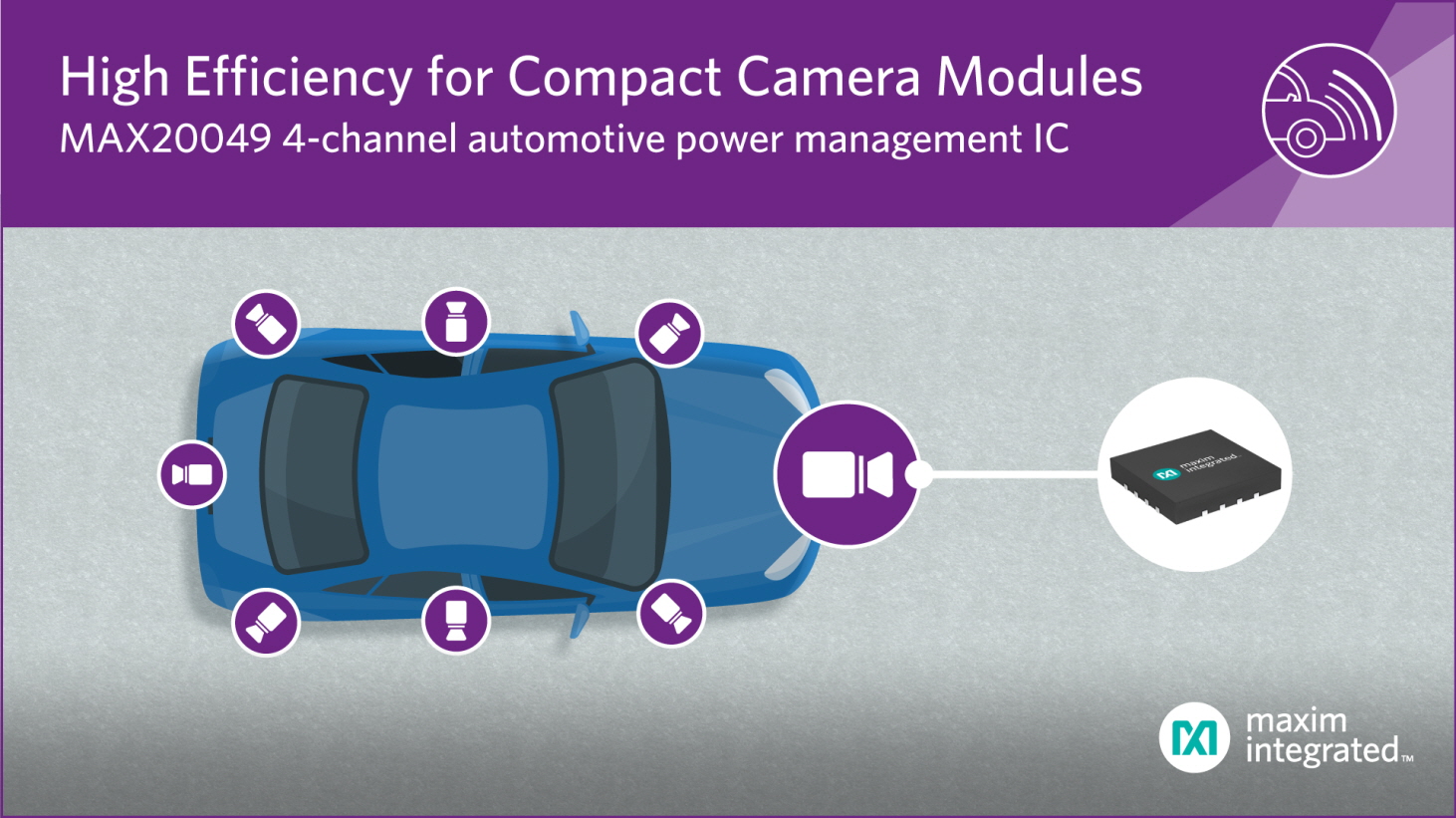
Maxim MAX20049
Due to size constraints, automotive camera modules require a power solution that integrates the necessary power and functionality into a small form factor. The 4-channel MAX20049 PMIC (38㎟) is approximately 30% smaller than the market average (53.3㎟) and offers the highest efficiency of any 4-channel power management IC in its class.
It provides four outputs (dual buck and dual LDO) in a 3mm x 3mm QFN package and achieves 74% system efficiency at full load. When applied to a standalone automotive solution, the system efficiency reaches 69%.
The MAX20049 supports modules that require a large number of output voltages for various combinations of sensors and serializers. This allows you to change the layout as needed or fine-tune the IC to suit specific application requirements.
It supports flexible sequencing and fixed output voltages to support various image sensors, and also includes overvoltage protection, undervoltage lockout (UVLO), external power good (PGOOD) signal, and cycle-by-cycle current limiting.
The dual buck converters and low-noise LDO support a wide voltage input range of 4 V to 17 V, enabling applications with 8 V to 10 V Power-over-Coax (PoC). An option is also available to use one buck converter as an intermediate supply between the sensor and serializer power rails, optimizing thermal performance and minimizing coaxial cable inrush current during startup. Spread spectrum and a 2.2 MHz switching frequency mitigate electromagnetic interference (EMI), meeting CISPR low-noise standards.
The MAX20049 provides fault mitigation features that flag output voltage failures and fluctuations to ensure proper camera operation. When an overvoltage or undervoltage signal is detected, the PGOOD pin is set low and when either output is disconnected, each converter performs cycle-by-cycle current limiting.
“We are continuously looking for integrated power devices that provide the power required for image sensors while minimizing size in vehicle-based imaging designs,” said Tsutomu Haruta, Deputy Senior General Manager, Sony Semiconductor Solutions Corporation. “Maxim’s power solutions will help us implement various camera functions and advanced driver safety systems in a small footprint.”
“Designers are faced with increasingly stringent constraints when designing tiny components inside cars, such as camera modules,” said Chintan Parikh, senior business manager, Automotive, Maxim Integrated.
“This is driving the need for more advanced power management ICs,” he continued. “The MAX20049 meets ADAS design criteria in terms of form factor, error mitigation, and power requirements, shortening design cycles and accelerating time to market.”
Comments
Related news
Maxim Launches Highly Integrated Single-Chip Security Solution for IoT
Maxim has launched the MAX36010 and MAX36011 highly integrated single-chip security solutions and security supervisors. IoT designers can implement robust anti-tamper functionality, encryption, and secure storage using the MAX36010 and MAX36011 solutions without requiring separate security expertise, thereby protecting sensitive information in a smart and secure manner. The MAX36010 and MAX36011 provide powerful security that can be easily applied at all stages of development. Even when applied late in the design phase, there is no need to change the platform. With high integration, these solutions reduce design time by 60% compared to competing solutions and reduce BOM costs by 20%.
2019.01.30by 이수민 기자

ADI Launches 'SHARC Audio Module Platform' to Accelerate Audio DSP Project Development
Analog Devices has released the SHARC Audio Module, a hardware/software platform that facilitates efficient product prototyping, development, and manufacturing of digital audio products. The SHARC Audio Module significantly reduces the product development cycle by providing an audio platform that combines a wide range of analog and digital I/O options with essential software packages and development environments. It can be used as a standalone system in its own right and also supports additional expansion, making it useful for developing customized I/O and control surfaces.
2019.02.27by 이수민 기자
Maxim Launches "USB-C" 3A Switch-Mode Buck Charger That Does Not Require a 'Host Controller'
Maxim has launched the MAX77860, a 3A switch-mode charger that simplifies design and software development. Portable electronics designers working with lithium-ion battery-powered devices can use the MAX77860 to add USB Type-C (USB-C) charging systems to their products more simply and flexibly. Traditionally, a host microprocessor was required in the design to sense current levels and set charger input current limits. However, the MAX77860 integrates a USB-C port controller and charger, eliminating the need for a separate host controller.
2019.03.20by 이수민 기자

Intel Unveils Next-Generation 'Core Ultra Series 3' and vPro Platform for Enterprise PCs
Intel has officially unveiled the "Intel Core Ultra Series 3" for next-generation enterprise PCs and the latest vPro platform, addressing a wide range of demands from enterprise notebooks to high-performance workstations.
2026.03.26by 배종인 기자

ROHM Launches ESD Protection Diode Compatible with High-Speed Interfaces of 10Gbps or Higher
Semiconductor specialist ROHM has developed the 'RESDxVx series' of ESD (electrostatic discharge) protection diodes capable of responding to next-generation high-speed data communication environments exceeding 10Gbps, simultaneously enhancing both signal quality maintenance required in high-speed interfaces and IC protection performance.
2026.03.26by 배종인 기자











