



Ministry of SMEs and Startups Recruits 5 Participating Companies for 2019 Labor-Friendly Smart Factory Construction Project
 Published2019.04.17 13:01
| Introduction of Collaborative Robots and Hazard Reduction Devices for Workers
| Strengthening consulting on process and work procedure improvements
The Ministry of SMEs and Startups announced on the 15th that it will implement the '2019 Labor-Friendly Pilot Smart Factory Construction Project' to expand people-centered smart factories that enhance corporate competitiveness while guaranteeing safety and rest for workers. The support scale is approximately five companies.

Companies that have implemented smart factories have been shown to achieve results in both the quantity and quality of jobs, including improved productivity and reduced defect rates, as well as a 22% reduction in industrial accidents and an increase of 2.2 employees.
Based on these considerations, the Labor-Friendly Pilot Factory is a new initiative designed to systematically support smart factories by re-evaluating them from the perspective of tangible benefits for workers, such as improved safety, reduced workload, and job security.
The relevant ministries plan to collaborate to support the establishment of smart factories by linking four related projects, including robotics and consulting.
The Ministry of SMEs and Startups supports 50% of the total project cost for the construction of the pilot factory, up to a maximum of 300 million won. Robot-assisted small and medium-sized manufacturing process innovation also supports 50% of the total project cost, up to a maximum of 300 million won.
However, the introduction of collaborative robots capable of working with employees should be prioritized, and in cases where hazardous tasks are replaced by automated equipment, job development and training will also be supported to enable existing workers to be assigned to new roles.
In addition, experts from large corporations with experience in smart factories (Smart Meisters) are dispatched for three months to transfer know-how, and consulting from specialized agencies is provided for up to 21 weeks to respond to changes in the workplace after the introduction of smart factories, such as human resources and organizational management.
It is expected that the burden on small and medium-sized enterprises (SMEs) will be reduced and business performance will be enhanced as they will be able to receive expert assistance starting from the business planning stage, which companies previously had to carry out themselves in the existing smart factory initiatives.
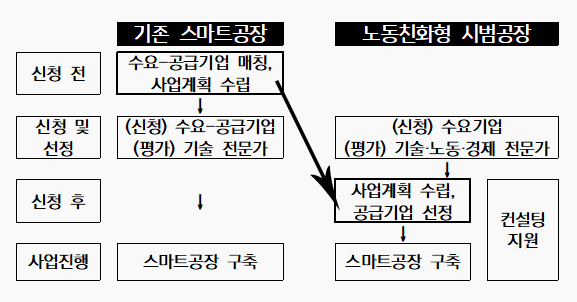
In addition, it supports partnership activities that can coordinate matters between labor and management. This is because close cooperation between labor and management is necessary to build a smart factory that satisfies both the company and the workers. The Ministry of Employment and Labor supports 90% of the total project cost, up to a maximum of 30 million won, for the labor-management partnership program.
Small and medium-sized enterprises (SMEs) and middle-sized companies wishing to apply for the program can do so through the Smart Factory Support Program Comprehensive Management System ( it.smplatform.go.kr ). Further details can be obtained by contacting the Korea Technology Information Promotion Agency for SMEs (1644-1736). The application period runs from today until 5:00 PM on April 26.
Comments
Related news
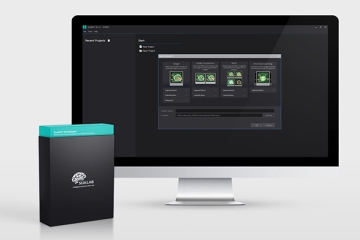
Suaralab Demonstrates Machine Vision Defect Inspection SW "Suakit" at 'Smart Factory & Automation Industry Exhibition 2019'
Sualab will participate in the Smart Factory & Automation Industry Exhibition 2019 being held for three days at Seoul COEX. At this exhibition, Sualab will not only display its flagship product SuaKit but also introduce the product in greater detail to visitors through demonstration equipment and videos. SuaKit is a deep learning-based machine vision defect inspection software that can detect irregular and unpredictable defects using deep learning, which could not be detected by conventional machine vision inspection. It is applicable to product inspection across diverse industrial sectors ranging from electrical and electronic industries such as display, semiconductor, and solar power to automotive and food and beverage industries.
2019.03.25by 이수민 기자
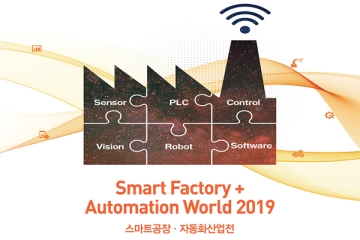
Drawing the Big Picture of Digital Transformation and Manufacturing Innovation: "Smart Factory & Automation Industry Exhibition 2019" Held
Smart Factory & Automation Industry Expo 2019 will be held for four days from the 27th to the 29th at the entire COEX venue in Samsung-dong, Seoul, under the theme of digital transformation in the manufacturing industry. The exhibition will showcase domestic and international smart manufacturing technological achievements including smart factory solutions and equipment, IIoT, and 5G, and is being held as an event to generate public interest in smart manufacturing innovation, marking its third edition this year. The exhibition area has been expanded by 25% compared to the previous year, and it will be held at record-breaking scale with 490 companies including Siemens and Hyundai Heavy Industries setting up 1,750 booths.
2019.03.26by 이수민 기자
.jpg)
Enhancing Smart Factory Production Efficiency with Factory-Customized IIoT Solutions
The rapid digitalization of smart factories, smart buildings, data centers, and energy grids provides the potential for enterprises to convert various data they own into business opportunities. Accordingly, Schneider Electric showcased integrated solution technology capabilities in the smart factory sector with its architecture platform EcoStruxure as the main concept at the Smart Factory and Automation Industry Exhibition 2019. Pro-face, Tricon CX, Process Safety Advisor, and Panel Comprehensive Monitoring Solution, among others, captured the attention of visitors as customized solutions suited to individual factory circumstances.
2019.04.15by 이수민 기자
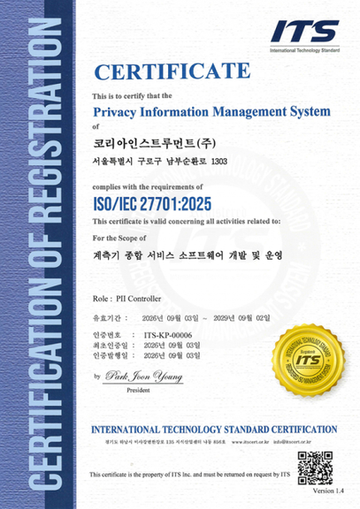
Korea Instrument, KOLAS Accredited Calibration Agency First to Simultaneously Acquire ISO/IEC 27,001·27,701
Korea Instrument has become the first among KOLAS accredited calibration agencies to simultaneously acquire ISO/IEC 27,001 and ISO/IEC 27,701 certifications. Through its proprietary platforms CWIZ Enterprise and CWIZ Partners, the company has embedded information security and personal data protection requirements across all business processes including customer information, equipment data, and calibration reports, with plans to continuously advance its management system through regular audits and security inspections.
2026.10.12by 배종인 기자
TeamViewer One, IT Incident Automation Workflow and Resolution Center Enhanced
TeamViewer has added IT incident automation capabilities and an advanced Resolution Center to its integrated digital workplace management platform 'TeamViewer ONE'. Recurrent service disruptions, configuration errors, and capacity shortages are automatically handled according to preset policies, and device status verification through script deployment can be managed in a unified interface, significantly reducing repetitive tasks for IT teams.
2026.10.12by 배종인 기자











