



The Ministry of Science and ICT held a 'Public Hearing on Fostering the Drone Industry' and promoted inter-ministerial cooperation in initiatives such as the 'Call for Drone Projects Linked to Public Innovation Procurement.'
 Published2019.04.19 10:34
Call for Proposals for 7 Drone Development Projects Linked to Public Innovation Procurement
The Ministry of Science and ICT (MSIT) held a 'Public Hearing on Regulatory Improvement for Innovative Growth Engines' on the 16th together with the Korea Institute of Public Administration (KIPA), the Korea Institute of Science and Technology Planning and Evaluation (KISTEP), and others.
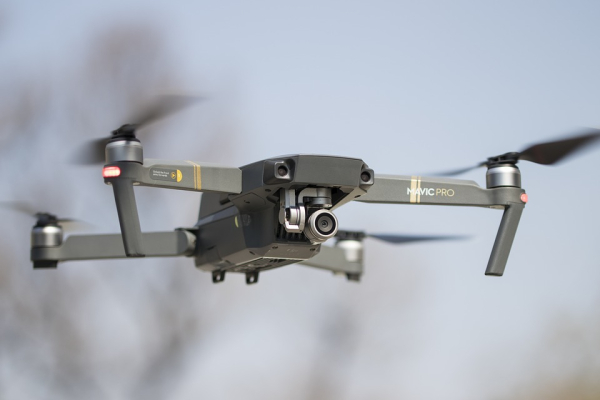
Last year, the Ministry of Science and ICT announced a roadmap for regulatory improvement through the 'Implementation Plan for Innovative Growth Engines' and the 'National R&D Innovation Plan.' Among the 13 innovative growth engines, the drone sector was selected as a top priority because it falls under the early commercialization category, offers high added value, and can create various new service models, and the Ministry has been cooperating with relevant organizations to improve it.
This public hearing was conducted in the format of a panel discussion involving experts from industry, academia, and research institutes, following a presentation on the topic of “Comprehensive Strategy for Improving the Regulatory Environment to Revitalize Business Models in the Drone Sector.” In particular, discussions were held on comprehensive strategies and measures to improve the regulatory environment for the development of future drone business models, taking into account the rapidly evolving technological landscape.
As most regulatory improvement efforts have focused on the demonstration phase prior to commercialization, companies have frequently faced new, unforeseen regulatory issues during the actual execution of their businesses.
In this proactive regulatory improvement strategy, the focus was on improving regulations that could act as obstacles to commercialization for future business models, and regulatory improvement measures were reviewed for 27 business models across 4 sectors.
In particular, the 'Regulatory Innovation Radar,' presented as a roadmap for the proactive identification and improvement of regulations and systems, diagrams the timing of regulatory and institutional improvements (including technology and infrastructure) in accordance with the development of business models.
Through this, it is expected that government ministries (regulatory agencies) will prepare for preemptive regulatory and institutional improvements regarding upcoming regulations, and that industry, academia, and research institutions will recognize and prepare for the timing of regulatory and institutional changes in advance, thereby contributing to the formulation of comprehensive strategies for improving the regulatory environment to create new industries.
Professor Kim Do-hoon of Sogang University, who served as the panel chair, said, “This public hearing is significant in that it foresaw the potential commercialization timing and key technological elements for various future business models in the drone industry, and explored ways to improve the regulatory environment in connection with this,” adding, “I hope this serves as an opportunity for continued discussions on proactive and comprehensive regulatory environment improvements in various innovative growth sectors in the future.”
Lim Dae-sik, Head of the Science and Technology Innovation Headquarters at the Ministry of Science and ICT, stated, “With the Framework Act on Administrative Regulations—the final bill among the ‘1+4 laws’ for the regulatory sandbox—passing the National Assembly on March 28, preemptive regulations in the field of innovative growth engines"The reform movement will get on track in earnest," they stated, adding, "In the future, the Science and Technology Innovation Headquarters plans to pursue preemptive and comprehensive regulatory improvements by expanding its scope to fields such as big data, AI, and smart cities in cooperation with the Office of Government Policy Coordination, as well as relevant ministries, industry, academia, and research institutes."
Supporting the growth of the drone sector through drone development projects tailored to the needs of public institutions
The Ministry of Science and ICT, together with the Ministry of Trade, Industry and Energy (MOTIE), the Ministry of Land, Infrastructure and Transport (MOLIT), and the Public Procurement Service, is also accepting applications for 7 new projects worth 5 billion won for the development of unmanned vehicles and software platforms linked to public innovation procurement from the 19th to May 21st.
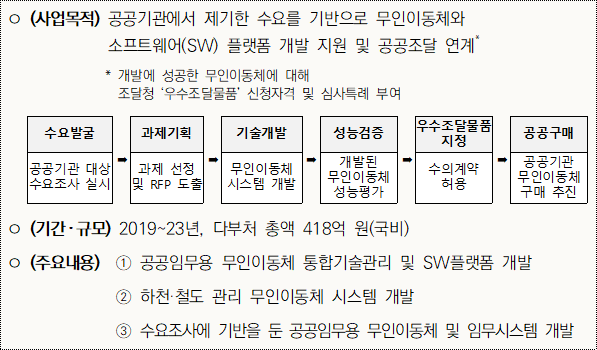
This project is being carried out through collaboration among relevant ministries to ensure that research and development results in the drone sector, one of the government's eight leading projects, are linked to public procurement, and that institutional improvements and the growth of related industries can continue seamlessly.
In the field of integrated technology management and SW platforms, we first support the performance testing and evaluation of unmanned vehicles for public missions, and develop software for system development and operation.
It oversees the overall project to ensure that the deliverables of each task are linked to public innovation procurement, and supports the development of a test and evaluation system for the design conformity, basic performance, mission performance, and environmental suitability of unmanned vehicles for public missions. In addition, there are plans to develop mission software development tools and operation software for unmanned vehicles for public missions, and to distribute them to relevant development companies and drone operators in public institutions.
In the field of unmanned vehicles for land, infrastructure, and transport management, there are also plans to develop unmanned vehicles for river surveying and monitoring, as well as railway facility inspection.
It supports the development of a specialized drone platform for river surveys, including the development of depth LiDAR payloads for riverbed measurement and real-time analysis and prediction technologies for river physical quantities utilizing IoT. In addition, it supports the development of unmanned vehicle control systems and condition diagnosis automation systems to automate the periodic inspections of inaccessible railway structures currently performed by workers.
In the field of demand-tailored unmanned vehicles, research and development and demonstration are supported for domestic small and medium-sized enterprises in two stages (competitive research method) for projects selected based on the results of demand surveys targeting central administrative agencies, local governments, and public institutions.
The Ministry of Science and ICT selected three final projects from a total of 31 requests from 22 institutions through expert evaluation, taking into account factors such as redundancy, marketability, potential for technological development, and ripple effects. These are the Korea Forest Service's drone for responding to forest fires during nighttime hours, the Busan Port Security Corporation's drone for preventing safety accidents in indoor and outdoor multi-use facilities (such as international passenger terminals) at ports, and the Korea Post's project to develop mail delivery drones using 4G and 5G communication networks.
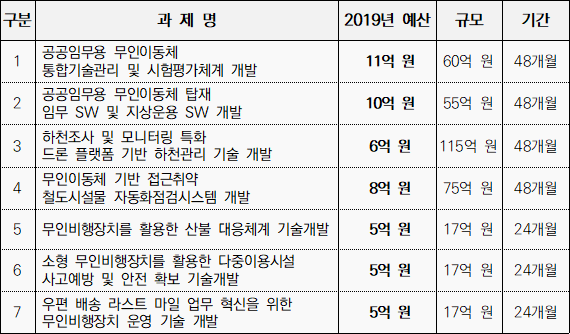
Detailed information regarding the project announcement can be found through the call for new projects for the 'Development of Unmanned Vehicles and SW Platforms Linked to Public Innovation Procurement' posted on the websites of the Ministry of Science and ICT and the Korea Institute of Construction Technology.
Meanwhile, to actively encourage participation from companies interested in this project, a business briefing session will be held at 2:00 PM on the 26th at the Korea Institute of Construction Technology in Gwanyang-dong, Anyang-si, for drone-related company officials and others.
Ko Seo-gon, Director General of Basic and Original Research Policy at the Ministry of Science and ICT, said, “Through this project, domestic "It is expected that this will create a stable demand base for the industry and, at the same time, lay the foundation for domestic drone companies to enter domestic and international markets based on operational track records obtained from utilization in public institutions," they stated.
Comments
Related news
Velodyne-YellowScan Leading Drone Survey Market for Highway Expansion Projects
Velodyne Lidar announced that YellowScan's YellowScan Surveyor has utilized Velodyne's sensor technology to collect precise mapping data for an infrastructure construction project on one of the busiest roads in Central Europe. The YellowScan Surveyor, an unmanned aerial vehicle (UAV) surveying system, collects precise and detailed topographic data through efficient methods, delivering superior results compared to time-intensive manual surveying work of the past. Ventus-Tech collected data from a 47-kilometer section of the M1 highway in northwestern Hungary using the YellowScan Surveyor.
2019.01.28by 이수민 기자
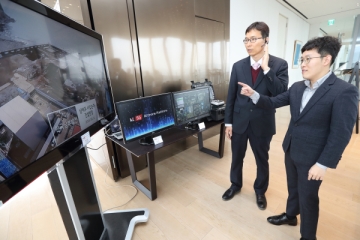
KT Creates a Smart Power Generation Environment with Intelligent 5G Drone Infrastructure
KT has signed an MOU with Korea Southern Power Co., Ltd., Uri Airlines, and Sync Space for "joint cooperation to create a safe smart power generation environment, including security infrastructure enhancement through intelligent drones." Through this agreement, the four companies plan to lead the creation of a safe smart power generation environment by developing continuous and stable drone operation infrastructure based on ICT technologies including AI and IoT with drones, developing intelligent drones, and discovering convergence security areas utilizing AI-IoT-optical infrastructure.
2019.03.14by 이수민 기자
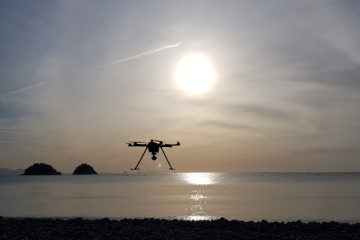
LG U+ Demonstrates Military Drone Maritime Operation Capabilities
LG Uplus conducted a demonstration of maritime operations based on military drones for approximately 10 minutes with the 31st Infantry Division near Jukdo and Hyeoldo islands, located 1.6km west of Musulmok in Yeosu City, Jeollanam-do. The maritime operations demonstration, which took place in the afternoon on the 16th, showcased real-time response to maritime situations through U+ Smart Drone, coastal search and reconnaissance, rapid infiltration response, building interior search, outpost surveillance, and aerial search within cordoned areas, presenting various drone utilization methods. LG Uplus plans to continue expanding drone applications by integrating AI and big data into the control system and through civil-military-defense cooperation going forward.
2019.04.17by 이수민 기자

Korea Instrument, KOLAS Accredited Calibration Agency First to Simultaneously Acquire ISO/IEC 27,001·27,701
Korea Instrument has become the first among KOLAS accredited calibration agencies to simultaneously acquire ISO/IEC 27,001 and ISO/IEC 27,701 certifications. Through its proprietary platforms CWIZ Enterprise and CWIZ Partners, the company has embedded information security and personal data protection requirements across all business processes including customer information, equipment data, and calibration reports, with plans to continuously advance its management system through regular audits and security inspections.
2026.10.12by 배종인 기자
TeamViewer One, IT Incident Automation Workflow and Resolution Center Enhanced
TeamViewer has added IT incident automation capabilities and an advanced Resolution Center to its integrated digital workplace management platform 'TeamViewer ONE'. Recurrent service disruptions, configuration errors, and capacity shortages are automatically handled according to preset policies, and device status verification through script deployment can be managed in a unified interface, significantly reducing repetitive tasks for IT teams.
2026.10.12by 배종인 기자











