


ETRI, Develops 5G-WiFi-Wired Combination Technology… Accommodates 40 Times More Traffic Than LTE
 Published2019.05.12 07:01
| Heterogeneous wired and wireless connection environments integrated into one network
| Efforts to preempt the market through international standardization by developing original technologies
A domestic research team has developed a technology to increase service speed by combining wireless and wired networks in a 5G mobile communication network.
The Electronics and Telecommunications Research Institute (ETRI) announced on the 9th that it has succeeded in developing a source technology that enables a large-capacity Internet service of up to 40 Gbps by combining 5G, Wi-Fi, and wired Internet networks through joint research with domestic small and medium-sized enterprises such as KT, Lanbird Technology, and Snet ICT.
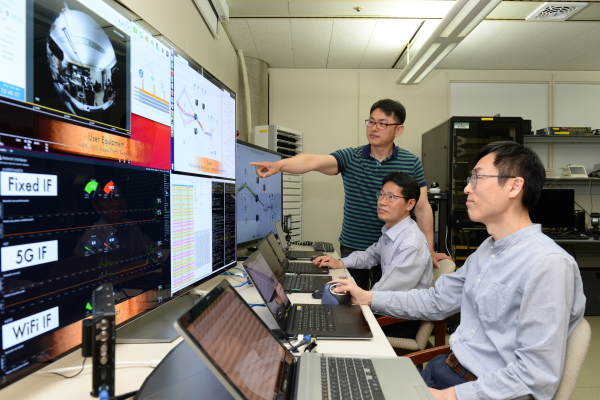
From left, Kim Jae-ho, Kim Chang-gi, and Ha Jeong-rak, senior researchers
The technology developed by the research team is a multi-access traffic aggregation technology that combines three networks into one. It controls different wired and wireless access environments in a single 5G core network, making it possible to accommodate 40 times more traffic than 4G.
With this technology, when 5G, Wi-Fi, and wired internet are used simultaneously, it can theoretically achieve a transmission speed of up to 40 Gbps by combining 5G's 20 Gbps, which is up to 20 times faster than LTE, the next-generation Wi-Fi (802.11ax) peak speed of 10 Gbps, and wired internet 10 Gbps. At this time, the access network status can be immediately controlled, providing the user with an optimal connection environment.
While the existing LTE and Wi-Fi combination technology was controlled from outside the mobile network, the difference with this technology is that when combining 5G, Wi-Fi, and wired Internet networks, control is done from within the 5G mobile network.
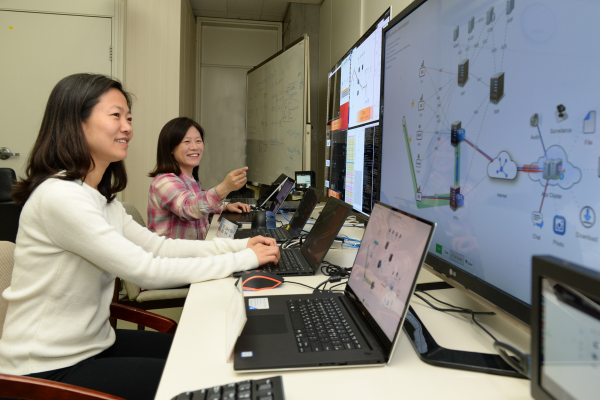
From left, Research Director Kang Yu-hwa and Senior Researcher Jeon Seon-mi
This technology can be applied to providing large-capacity, high-speed services such as VR/AR and ultra-high-definition media (4K UHD) in 5G mobile communication networks. This technology development is expected to open the way to discovering and applying various new services by enabling large-capacity services and traffic control through the integration of wired and wireless infrastructure. It also provides users with an optimal connection environment by providing inexpensive high-speed data.
The research team implemented the technology about a year ahead of the scheduled date for completion of international standardization by 3GPP, an international standards body that defines functions for managing multi-access traffic in different access network environments.
The international standard currently in progress is promoting the use of MPTCP (Multi-Path TCP) as a technology to increase transmission speed and link 5G and Wi-Fi.
ETRI has developed a source technology to directly apply MPTCP to 5G mobile communication networks, enabling the provision of large-capacity data transmission services by combining 5G wireless networks, Wi-Fi, and wired Internet networks, going one step further than international standards.
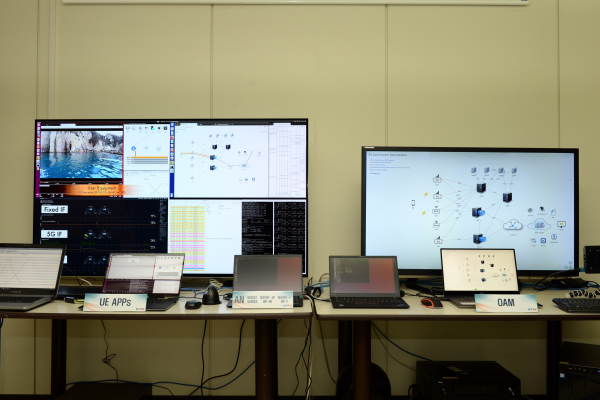
It is developed to comply with the 3GPP standard for connecting different wired and wireless access networks to a single 5G core network, and to place the MPTCP server within the 5G mobile communications network.
In the future, when evolved LTE access is connected to the 5G core, it can also be expanded to a multi-access traffic aggregation technology that combines up to LTE.
Dr. Kim Chang-ki of ETRI’s Network Research Center said, “It is possible to stably provide services that reflect various user requirements through access network integration,” and “This is expected to reduce the investment burden on telecommunications companies and secure efficiency in the use of network resources.”
This machineThe project, titled 'Development of Non-dependent 5G Core Technology for Wired and Wireless Access' by the Ministry of Science and ICT, has been ongoing since 2015, and has applied for around 40 patents at home and abroad.
Meanwhile, ETRI is preparing to transfer already developed 5G core network technologies, including multi-access combining technology, to joint research institutes and network equipment manufacturers, and plans to support domestic companies in commercializing 5G core network equipment early through this.
Comments
Related news
ETRI Improves QLED Efficiency with Quantum Dot Surface Substitution Technology
While OLED utilizes organic materials, QLED leverages semiconductors, specifically quantum dots, instead of organic materials. Through the development of QLED hole injection improvement technology, ETRI has developed core technology that can enhance the brightness, current, and power efficiency of QLEDs by modifying the molecular sieves that constitute the quantum dot surface. In the device that comprises a QLED display, electrons and holes injected from both electrodes meet at the quantum dots to emit light. However, while electrons move freely up and down, holes face difficulty in movement due to slower energy transfer between the electrode and quantum dots. This electron-hole imbalance problem degrades the performance of quantum dot light-emitting diodes and shortens the device lifespan, necessitating research to address this issue.
2019.04.17by 이수민 기자
.jpg)
ETRI Successfully Develops Nanocrystal Metamaterial Perfect Absorber: "Reflective Displays Now Sharper"
ETRI has successfully developed nanocrystalline-based broadband metamaterial perfect absorber technology. The research team fabricated a metamaterial perfect absorber in August of last year. However, absorption occurred only in a narrow band within the visible light wavelength range, making it difficult to achieve vivid reflected colors. The researchers resolved this issue by modifying the elements of the layers that comprise the metamaterial perfect absorber. The team formed layers using nanocrystalline metamaterial materials instead of conventional metals. As a result, they were able to increase optical loss and broaden the absorption bandwidth. While conventional metal-based absorbers had an absorption bandwidth of 28 nm, the nanocrystalline absorber extended up to 300 nm, more than 10 times greater, enabling the implementation of clearer reflected colors.
2019.04.24by 이수민 기자
KETI Fosters Specialists in Industrial AI-Based Smart Manufacturing
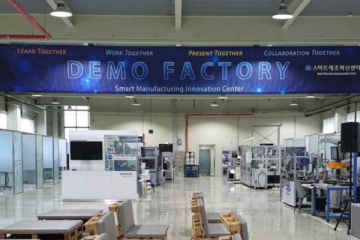
Industrial artificial intelligence refers to technologies that apply AI to the manufacturing industry and its related upstream and downstream service industries, creating new added value through the advancement of manufacturing. KETI announced that it will cultivate specialized personnel in industrial artificial intelligence to lead future smart manufacturing innovation. The industrial artificial intelligence specialized personnel development project, for which KETI has been selected as the lead organization, is a program that develops master's and doctoral level specialists in industrial artificial intelligence by utilizing the infrastructure of the Smart Manufacturing Innovation Center operated by KETI, in collaboration with Pohang University of Science and Technology and Korea University. The plan is to nurture global leaders in the industrial artificial intelligence field through the establishment of an industrial data education platform for problem-solving education at manufacturing sites, hosting smart manufacturing hackathon competitions, and development of industrial artificial intelligence curricula.
2019.04.29by 이수민 기자
European Patent Applications Surpass 200,000 for the First Time… South Korea Maintains 5th Place, Led by Batteries and Telecommunications
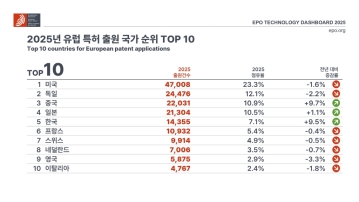
According to the European Patent Office (EPO)'s 'Technology Dashboard 2025', European patent applications last year reached 201,974, surpassing 200,000 for the first time. Korean companies and inventors filed 14,355 applications, representing a 9.5% increase from the previous year and maintaining 5th place by country. Battery, digital communication, and semiconductor technologies led the growth, with Samsung ranking as the top EPO applicant for the second consecutive year and LG reaching 3rd place. The presence of major domestic cities such as Seoul, Suwon, and Yongin was also confirmed. It was also revealed that Korea's European patent strategy is expanding beyond individual technologies to span the entire industry.
2026.03.24by 명세환 기자

SK Telecom First Applies AI-Based Network Operations at Gwanghwamun K-Pop Concert
SK Telecom announced that it applied an AI-based network operation system for the first time at a large-scale K-pop concert held in the Gwanghwamun area of Seoul on March 21st, managing communication quality throughout the event. Mobile data usage during the three hours before and after the concert reached 12.15TB, approximately doubling compared to the same time slot the previous weekend. SK Telecom monitored traffic using the AI system 'A-One' in five-minute and 50-meter units to respond to potential overload situations, while also operating temporary communication facilities and on-site personnel in parallel. This case is interpreted as confirmation of the practical applicability of AI-based autonomous network operation in an environment where demand from dense events and foreign users increases simultaneously.
2026.03.23by 명세환 기자











