



Cambridge Consultants unveils Hank, a robot with the sensitivity of a human hand, supporting full logistics automation.
 Published2019.05.23 10:12
| Will be valuable in the fields of agricultural and logistics automation.
| After determining the location of the object and adjusting the position of your fingers, grasp the object.
Cambridge Consultants unveiled 'Hank', a robot that moves like a human finger, on the 21st.
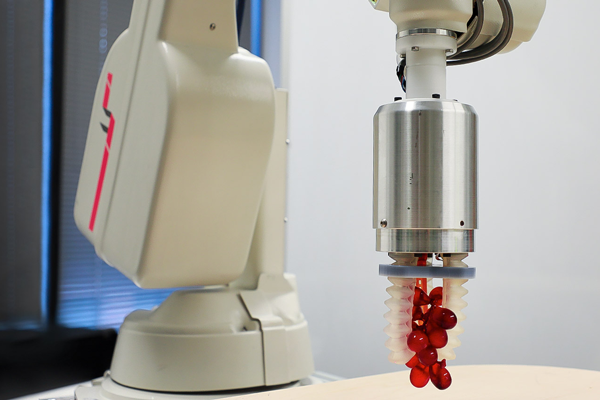
Hank is a pneumatic finger robot with a sophisticated tactile and slip-sensing sensory system that allows it to mimic the human hand's ability to delicately grasp and hold objects using just the right amount of pressure.
Hank is expected to find value in agricultural and logistics automation, where handling small, irregularly sized, and fragile objects is challenging.
While logistics automation has made significant progress over the past decade, robots still fall short of the precision of human hands in picking individual items from large containers.
E-commerce giants are competing to deliver goods faster and cheaper, but they still require human contact.
Cambridge Consultants has given robots a sensory system similar to that of humans, allowing them to perceive objects, use appropriate force to grasp them, and adjust their movements or put the object down if it slips.
In logistics automationJointed robots used in various applications require complex 'grasping algorithms' and expensive sensor devices and visual sensors to accurately position the end effector (fingers) and grasp objects.
Hank can bend and apply force using robotic fingers controlled by pneumatic pressure, and each finger is individually controlled by tactile sensors.
Hank's fingers don't require millimeter-precise positioning to grasp an object; they simply reach out and touch the object, much like a human hand would.
Once you know the location of the object, you adjust the position of your fingers to match that location and then grab the object.
In particular, if you sense that an object is slipping, you can increase the force of your fingers and immediately recognize if an object falls.
Going a step further than conventional approaches that use grippers and suction devices to grasp objects, this approach significantly expands the types and number of objects that robots can grasp or package.
The inside of the silicone material of the Hank is hollow, with the newly applied sensors embedded in the finger-shaped silicone molding process, and an air chamber running through the center.
Hank's finger surface is flexible, food-safe, and wipeable. It was also developed to be replaceable at low cost even if damaged or worn out.
“The logistics industry has always had issues with staffing and shortages because it relies heavily on human labor for picking and packing,” said Bruce Ackman, business leader for Cambridge Consultants’ logistics practice. “Automating this part of the logistics chain has lagged behind large-scale automation.”
“Hank’s sensory system is a game changer for the logistics industry, enabling end-to-end fulfillment of object sorting tasks and automated orders,” he continued. “The sensory perception of tactile and slippery sensations generated by a single, low-cost sensor means Hank can bring efficiencies to large distribution centers.”
Comments
Related news
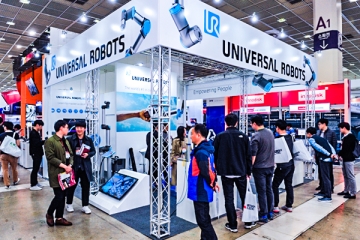
Universal Robots to Participate in Smart Factory + Automation World 2019, Showcasing the e-Series
Universal Robots is participating in Smart Factory + Automation World 2019, the nation's largest industrial automation and smart factory specialized exhibition. Universal Robots will conduct a showcase of its e-Series collaborative robots, which were launched last year. Universal Robots is focusing on strengthening communication with domestic customers this year. Beginning on the 7th of this month in Seoul, the company is conducting a nationwide tour of collaborative robot seminars. Additionally, through participation in this event, which is the company's first major exhibition of 2019, Universal Robots is actively strengthening contact points with industry professionals and buyers while introducing innovative automation technology.
2019.03.23by 이수민 기자
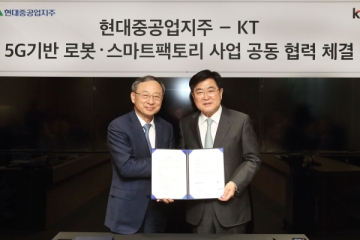
KT-Hyundai Heavy Industries Holdings to Cooperate on 5G-Based Robot and Smart Factory Business
KT has signed an MOU with Hyundai Heavy Industries Holdings for joint cooperation in 5G-based robotics and smart factory business. This business agreement concretizes previous collaborative efforts and covers the following key areas: development of 5G connected robots, development of service robots, joint development of smart factory platforms, joint R&D in machine vision and AI fields, commercialization of jointly developed solutions, and joint sales promotion. Through this cooperation, both companies aim to jointly pioneer the smart factory market and expand their business to the global market. KT will provide communication infrastructure and ICT platforms including 5G, AI, and Cloud, while Hyundai Heavy Industries Holdings will provide robots, automation equipment, and smart factory platforms, thereby cooperating in the development of 5G-based smart factory solutions.
2019.05.13by 이수민 기자
Cambridge Consultants, "Helping Technology Come to Life," Presents a Series of AI Product Development Consulting Case Studies
Cambridge Consultants held a press conference on the theme of providing solutions to technical limitations through AI utilization. Dr. Miles Upton, Regional Director for Asia, introduced Cambridge Consultants' distinctive business model, which provides product development consulting to clients while transferring all intellectual property acquired through projects to the clients. He also explained the company's approach to identifying industry-specific appeals and trends, and to technologies that transcend boundaries between industries. Subsequently, he demonstrated DeepRay, an AI-based real-time image and video restoration technology unveiled at CES 2019 last January on-site, and introduced Turbo Clean, an autonomous dishwashing system that combines machine vision, robotics, and AI technology, and Mamut, an autonomous agricultural technology robot based on automatic data collection. In particular, he emphasized the applicability of Cambridge Consultants' AI technology across diverse fields including smart factories, autonomous driving, and the medical sector.
2019.05.14by 이수민 기자
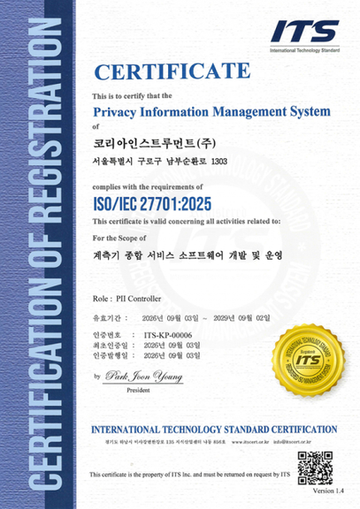
Korea Instrument, KOLAS Accredited Calibration Agency First to Simultaneously Acquire ISO/IEC 27,001·27,701
Korea Instrument has become the first among KOLAS accredited calibration agencies to simultaneously acquire ISO/IEC 27,001 and ISO/IEC 27,701 certifications. Through its proprietary platforms CWIZ Enterprise and CWIZ Partners, the company has embedded information security and personal data protection requirements across all business processes including customer information, equipment data, and calibration reports, with plans to continuously advance its management system through regular audits and security inspections.
2026.10.12by 배종인 기자
TeamViewer One, IT Incident Automation Workflow and Resolution Center Enhanced
TeamViewer has added IT incident automation capabilities and an advanced Resolution Center to its integrated digital workplace management platform 'TeamViewer ONE'. Recurrent service disruptions, configuration errors, and capacity shortages are automatically handled according to preset policies, and device status verification through script deployment can be managed in a unified interface, significantly reducing repetitive tasks for IT teams.
2026.10.12by 배종인 기자











