


SKT and Seoul Metropolitan Government Usher in the Era of Fully Autonomous Driving with 5G and AI
 Published2019.05.26 12:01
1,700 Seoul public transportation vehicles to be equipped with 5G-based ADAS.
ADAS collects traffic data, analyzes it with AI, and updates it with 5G.
SK Telecom and the Seoul Metropolitan Government are evolving Seoul city buses and taxis into 5G-based public transportation.
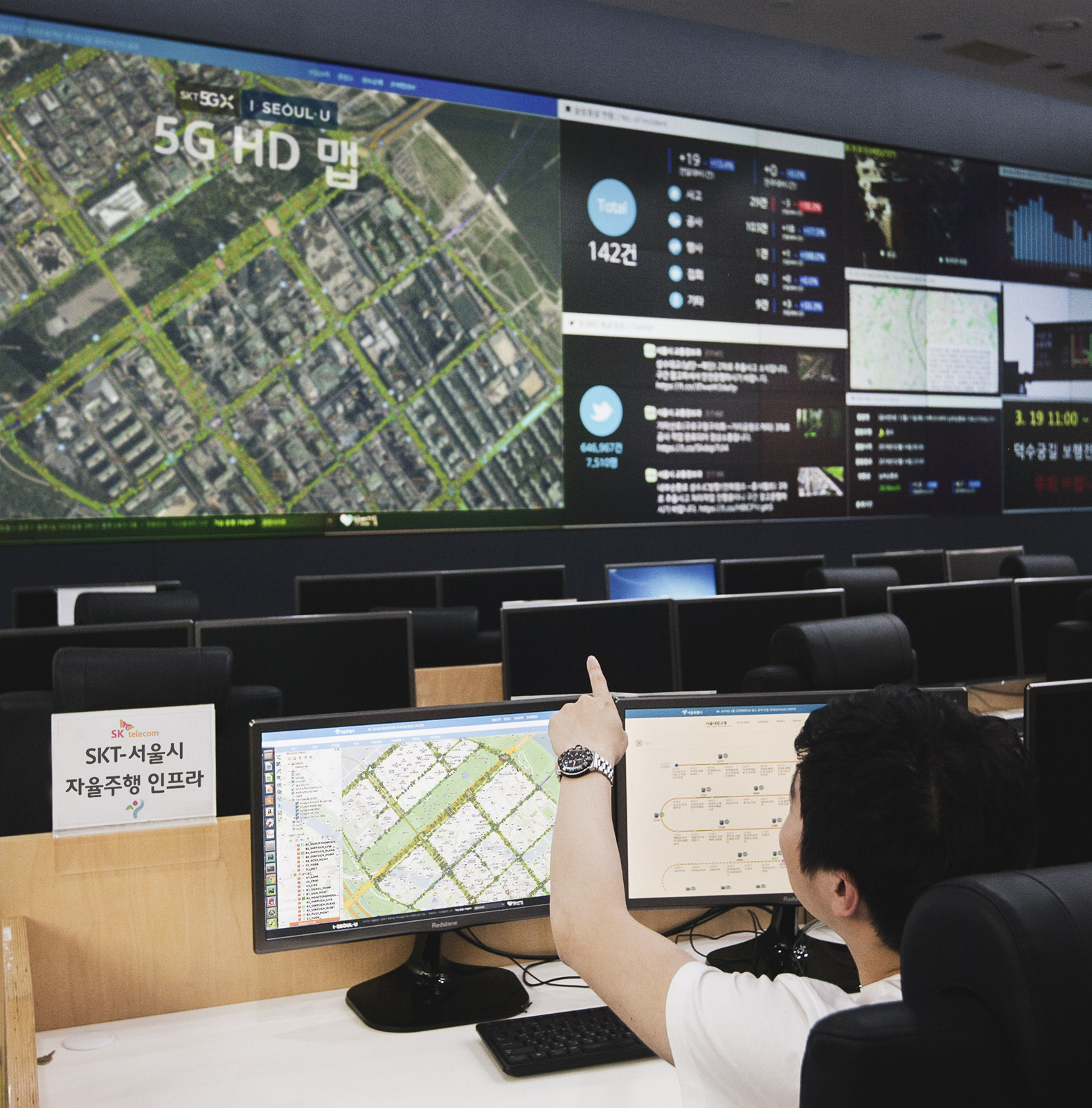
We are checking the real-time update status of 5G-based HD maps.
SK Telecom B2B Business Division Director Choi Il-gyu and Seoul Metropolitan Government Urban Transportation Division Director Koh Hong-seok signed an agreement on the ‘Development and Verification of Precision Road Map Technology for the Autonomous Driving Era’ at the SK Telecom building in Euljiro, Jung-gu, Seoul on the 23rd.
The two sides agreed to cooperate in developing real-time HD map update technology for the next-generation intelligent transportation system (C-ITS) demonstration project section by equipping 1,700 city buses and taxis with 5G ADAS. Based on this, we plan to develop road facility management systems and traffic safety services.
The C-ITS project is a project to build core infrastructure necessary for the future transportation era, such as autonomous driving and connected cars, including 5G networks and vehicle-to-everything (V2X) communication, on major roads in Seoul. SK Telecom won the contract for the C-ITS project in January and is currently building 5G infrastructure.
HD map (high-definition map) is a high-precision map that provides all spatial information, such as lane information, road slope, speed limit, and road surface conditions, with centimeter-level accuracy, and is a representative core infrastructure for autonomous driving.
With this agreement, Seoul will become the first city in the world to implement 5G technology in public transportation. Overseas, Singapore is expected to introduce 5G-based buses featuring autonomous driving technology, including city buses, as early as 2020.
1,700 Seoul city buses and taxis to be equipped with 5G ADAS.
Starting in the second half of the year, 1,700 buses and taxis equipped with 5G ADAS will operate on regular roads in Seoul, rather than autonomous driving test sites. SK Telecom and the Seoul Metropolitan Government will initially install 5G ADAS on 1,600 buses and 100 regular taxis along the 121.4km C-ITS test section, which encompasses major roads in Seoul, including Sejong-daero, Gangnam-daero, Namsan Tunnels 1 and 2, and Sinchon-ro. The two parties plan to expand the ADAS installation to 5,000 vehicles in the future, updating road traffic information throughout Seoul.
5G ADAS is a system that helps drivers drive safely by providing features such as lane departure warning and forward collision prevention. According to an analysis by the National Transportation Safety Board (NTBS), vehicles equipped with ADAS can prevent 93.7% of fatal accidents, allowing citizens to use public transportation more safely.
Furthermore, buses equipped with 5G ADAS are expected to operate more efficiently and quickly than before, as they will enable two-way communication between vehicles and objects (Vehicle to Everything (V2X)). While existing city buses only provide location information using GPS, buses equipped with 5G ADAS will be able to communicate with various elements on the road, including vehicle-to-vehicle (V2V) and vehicle-to-infrastructure (V2I) communication.
To this end, SK Telecom plans to complete the construction of 5G infrastructure optimized for autonomous driving across all C-ITS sections by the second half of the year.
Road traffic information collected by ADAS, analyzed by AI, and updated in real time via 5G.
The two sides plan to utilize road traffic information collected by 1,700 buses and taxis, utilizing 5G, AI, cloud, and big data technologies, to ▲develop ultra-precision navigation, ▲automate management of road and other traffic facilities, ▲analyze traffic information big data, and ▲enhance C-ITS.
First, a vast amount of road traffic data, categorized into 124 categories, including signs, road markings, construction information, and potholes, will be collected by the 5G ADAS vision sensors. This information will be analyzed by AI and reflected in real-time on HD maps via the 5G network.
A vision sensor is a sensor that collects and processes visual information, such as the size and shape of objects around a moving vehicle.
Real-time update technology significantly reduces the cost and time required to update HD maps. Until now, HD map construction and updates have been carried out only with dedicated vehicles, making it difficult to immediately update changes in spatial information.
Opening autonomous driving infrastructure to foster a collaborative industry-academia-research and autonomous driving ecosystem.
SK Telecom and the Seoul Metropolitan Government will collaborate to foster an autonomous driving ecosystem by opening up autonomous driving infrastructure, including data collected through 5G ADAS and HD maps, to relevant industries. SK Telecom will utilize the data to develop and enhance HD map technology, while the Seoul Metropolitan Government, in consultation with the Ministry of Land, Infrastructure and Transport, plans to distribute the information to autonomous driving venture companies, academia, and other relevant organizations.
SK Telecom B2B Business Division Head Choi Il-kyu said, “Connected cars generate a huge amount of data, so a 5G network that enables ultra-high speed, ultra-low latency, and hyper-connectivity is essential,” and added, “SK Telecom will combine 5G and ADAS to make Seoul a ‘5G mobility hub.’”
Koh Hong-seok, head of Seoul Metropolitan Government’s Urban Transportation Bureau, said, “Real-time HD map update technology is the cornerstone of new industries such as smart mobility that we have never experienced before,” and added, “We will strengthen cooperation with SKT to prepare for Seoul to become a leading global city in the era of future transportation.”
Comments
Related news
Samsung Electronics Obtains International Standard Certification for Automotive Semiconductor Functional Safety
Samsung Electronics has obtained certification for 'ISO 26262 Functional Safety Management,' an international standard for automotive functional safety, from TÜV Rheinland, a global testing and certification body based in Germany. This signifies that Samsung Electronics' automotive semiconductor development and management processes meet the requirements of ISO 26262, enabling the company to develop and supply automotive semiconductors that satisfy the functional safety requirements demanded by global customers. ISO 26262 is an international automotive functional safety standard established by ISO in 2011 to prevent accidents caused by failures in electrical and electronic systems installed in vehicles. As semiconductor safety in autonomous driving systems has been emphasized, semiconductor application guidelines were added in 2018.
2019.05.13by 이수민 기자

Why the electronics industry is paying attention to international automotive standards
With automotive electrification, the evolution of infotainment, the full-scale implementation of autonomous driving technology, and expanding vehicle security requirements, automobiles have now become genuine wheeled electronic products. Samsung Electronics obtained international automotive standard certifications to manufacture automotive semiconductors, and numerous other companies have either joined or are leading this trend. Industry players are discussing ISO 26262, ASIL, IATF 16949, and AEC-Q100. This article explores why the electronics industry is paying close attention to these standards.
2019.05.15by 이수민 기자
Public-private meeting held to discuss fostering 5G V2X, autonomous vehicles, and smart cities
Vice Minister Moon Won-gi of the Ministry of Science and ICT held a private-public consultation meeting on fostering measures for 5G V2X among the 10 core industries of the 5G+ strategy and autonomous vehicles and smart cities among the 5 core services. This consultation meeting was a follow-up measure to the 5G+ strategy announced on April 8th, and was prepared to strengthen private-public cooperation for securing technological and service competitiveness in the 5G V2X, autonomous vehicles, and smart cities sectors based on on-site opinions. The consultation meeting proceeded in the order of first presenting the progress of 5G+ strategy implementation and policies related to 5G V2X, autonomous vehicles, and smart cities, progress in 5G convergence services (autonomous driving, smart cities), and measures to activate 5G-based smart cities, followed by hearing field opinions and difficulties related thereto.
2019.05.22by 이수민 기자
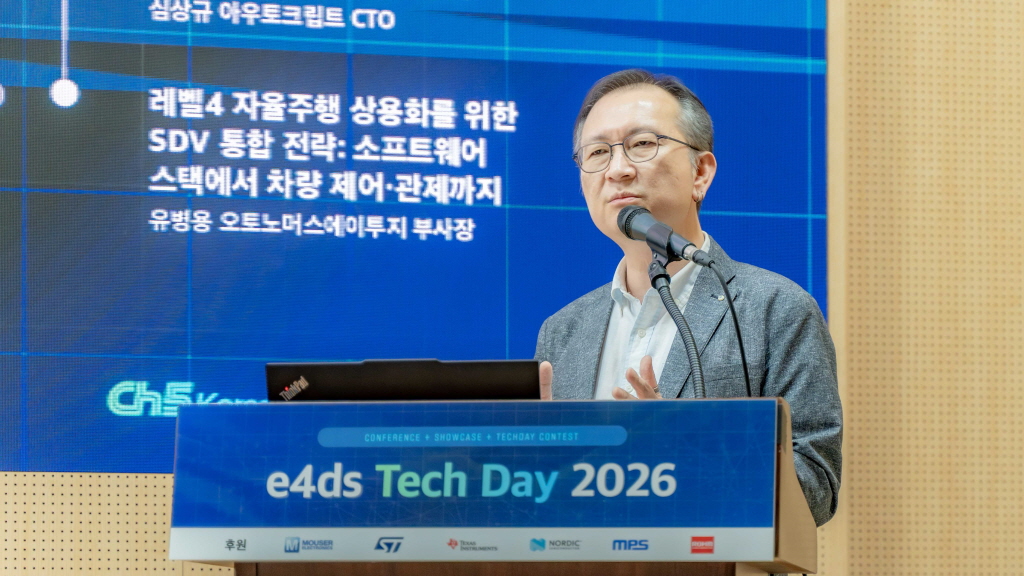
[e4ds Tech Day 2026 ⑨] Sim Sang-gyu, Autocrypt CTO: "In the Physical AI Era, Automotive Security Must Extend Beyond the Vehicle"
At e4ds Tech Day 2026, Sim Sang-gyu, CTO of Autocrypt, explained automotive cybersecurity strategies in the era of Physical AI and SDV (Software-Defined Vehicle). Automobiles are evolving as part of an ecosystem connected to AI, cloud, chargers, IoT, and robots, and he emphasized that the scope of security must expand beyond the vehicle interior to the entire connected environment. In particular, AI model tampering, adversarial attacks, OTA updates, and EV charger hacking were identified as major threats. He explained that response measures require zero trust, AI model integrity protection, intrusion detection, Security by Design and Default, and full lifecycle security management, and that proactive security system establishment beyond regulatory compliance is critical for securing future mobility competitiveness.
2026.10.12by 배종인 기자

Practical HIL Construction Strategy for Automotive and Off-Highway Controller Validation
As vehicle E/E architecture transitions to zonal structures and shifts to software-defined vehicles (SDV), the number of controllers (ECUs) requiring validation and software complexity are surging dramatically. Meanwhile, real vehicle testing cannot provide repeated verification under identical conditions and entails lead time and safety concerns. This white paper explains the principles of HIL (Hardware-in-the-Loop) validation and the structure of the NI platform composed of PXI, SLSC, and VeriStand, and through two actual implementation cases—Camera Record & Replay HIL for In-Cabin Monitoring Controller (ICMU) and Forklift Controller (VCU) HILS—describes how controller-level regression testing becomes possible. Additionally, it explicitly states application boundaries and limitations, such as lack of A2B support.
2026.10.12by 편집부











