



ADI Launches Multi-Channel Mixed-Signal RF Converter Platform
 Published2019.06.11 11:50
| 3x more call processing capacity than 4G LTE base stations
| Meeting mmWave wireless density and data rate requirements
Analog Devices (ADI) today launched a mixed signal front end (MxFE) RF data converter platform that integrates high-performance analog and digital signal processing functions for various wireless equipment such as 4G LTE and 5G mmWave.

ADI's AD9081/2 MxFE platform enables wireless equipment manufacturers to integrate multiband RF into the same footprint as single-band RF, achieving up to three times the call processing capacity of existing 4G LTE base stations.
The new MxFE platform, which supports 1.2 GHz channel bandwidth, enables wireless operators who are adding more antennas to their towers to meet the high radio density and data rate requirements of 5G mmWave.
By moving many frequency conversion and filtering tasks from the analog domain to the digital domain, the AD9081/2 provide software configurability that allows design engineers to optimize their radio technology.
New multi-channelThe Null MxFE platform meets the requirements of broadband applications such as 5G test and measurement equipment, broadband wired video streaming, multi-antenna phased array radar systems, and Low Earth Orbit (LEO) satellite networks.
“Cell towers are nearing saturation in the number of antennas they must support, and our customers want lighter weight, multiband RF that fits into today’s radio form factors,” said Kimo Tam, general manager of ADI’s High-Speed Mixed-Signal Group. “They also demand software-defined RF platforms that provide the configurability and scalability to enable a single platform to be used across multiple geographies and use cases.”
The AD9081/2 MxFE devices integrate eight and six RF data converters, respectively, manufactured using 28nm CMOS process technology. Both MxFE devices achieve an instantaneous bandwidth of up to 2.4 GHz, simplifying hardware design by reducing the number of frequency conversion stages and easing filter requirements.
Its high level of integration reduces the number of chips required compared to alternative devices and saves 60% of PCB area, relieving wireless device design engineers of PCB space constraints.
The new MxFE platform handles more RF spectrum bands and embeds DSP capabilities on-chip, enabling users to configure programmable filters and digital up/down conversion blocks to meet specific RF signal bandwidth requirements.
On an FPGA, this not only reduces power consumption by a factor of 10 compared to architectures that perform RF conversion and filtering tasks, but also allows design engineers to free up valuable processor resources for other valuable tasks or use less expensive FPGAs.
Samples of the AD9081 will begin in September, with mass production starting in March of next year. Samples of the AD9082 will be available at the same time as the AD9081, with mass production starting in December.
Comments
Related news
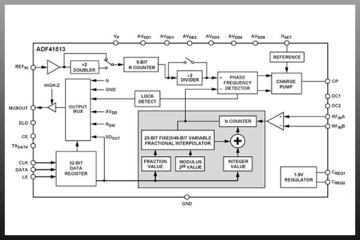
ADI Unveils Two New Products in May… Ultra-Low Noise Frequency Synthesizer ADF41513 and PMU ADP1031
ADI has unveiled two new products in May. The ADF41513 is an ultra-low noise frequency synthesizer that can be used to implement local oscillators at high frequencies up to 26.5GHz in the up-conversion and down-conversion regions of wireless receivers and transmitters. This product is suitable for applications such as test and measurement equipment, wireless infrastructure, microwave P2P, and multipoint RF. The ADP1031 is a high-performance isolated micro PMU that combines an isolated flyback DC/DC regulator, an inverting DC/DC regulator, and a buck DC/DC regulator to deliver three isolated power rails. Additionally, the ADP1031 includes four high-speed SPI isolated channels and three general-purpose isolators for channel-to-channel applications requiring low heat dissipation and compact solution size. Key applications include industrial automation, process control, instrumentation, data acquisition systems, and data and power isolation.
2019.05.27by 이수민 기자

ADI Launches mmWave 5G Network Infrastructure Support Solution
Analog Devices has launched a solution for mmWave 5G wireless network infrastructure. Achieving a high level of integration to alleviate the design requirements and complexity of next-generation cellular network infrastructure, this solution includes ADI's advanced beamformer IC and up/down frequency conversion, along with additional mixed-signal circuits. The new mmWave 5G chipset consists of the 16-channel ADMV4821 dual/single polarization beamformer IC, the 16-channel ADMV4801 single polarization beamformer IC, and the ADMV1017 mmWave UDC.
2019.06.04by 이수민 기자

High-speed Internet access will be available nationwide starting in 2020.
Since the introduction of high-speed Internet in 1998, the government has implemented loan support projects to encourage the market-driven construction of high-speed Internet networks, and through the Rural Broadband Subscriber Network Construction Project, has provided high-speed Internet to small-scale rural areas with fewer than 50 households in 13,473 regions. However, users in high-cost areas such as rural regions still cannot use high-speed Internet due to service providers' reluctance to provide service. Accordingly, the Ministry of Science and Technology has designated high-speed Internet as a universal service, a basic telecommunications service for users, imposed a service provision obligation on designated operators, and committed to ensuring that users who desire service can receive high-speed Internet anywhere.
2019.06.10by 이수민 기자

Intel Unveils Next-Generation 'Core Ultra Series 3' and vPro Platform for Enterprise PCs
Intel has officially unveiled the "Intel Core Ultra Series 3" for next-generation enterprise PCs and the latest vPro platform, addressing a wide range of demands from enterprise notebooks to high-performance workstations.
2026.03.26by 배종인 기자
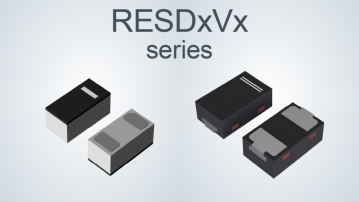
ROHM Launches ESD Protection Diode Compatible with High-Speed Interfaces of 10Gbps or Higher
Semiconductor specialist ROHM has developed the 'RESDxVx series' of ESD (electrostatic discharge) protection diodes capable of responding to next-generation high-speed data communication environments exceeding 10Gbps, simultaneously enhancing both signal quality maintenance required in high-speed interfaces and IC protection performance.
2026.03.26by 배종인 기자











