



SKT Unveils Sangam DMC 5G Autonomous Driving Testbed
 Published2019.06.24 09:10
5G Transportation Technology Unveiled at Autonomous Driving Festival
Unveiled technology that predicts paths using advance vehicle footage
SK Telecom is unveiling a 5G autonomous driving testbed in Sangam Digital Media City (DMC) with the Seoul Metropolitan Government.
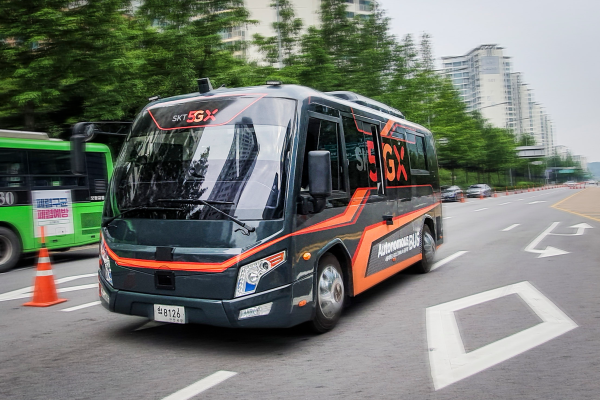
SKT and Seoul City Unveil 5G Autonomous Bus
SK Telecom announced on the 20th that it will unveil the Sangam 5G autonomous driving testbed on the 22nd and demonstrate 5G and V2X convergence autonomous driving technology at the 'Sangam Autonomous Driving Festival'.
The Sangam 5G autonomous driving testbed is a core infrastructure for the Seoul Metropolitan Government's C-ITS (Next-Generation Intelligent Transportation System) demonstration project, for which SK Telecom was selected as the lead contractor in January.
The Sangam Testbed is equipped with 5G-based autonomous driving infrastructure, including 5G networks, smart roads (C-ITS), and control platforms, enabling test drives of autonomous and connected cars on public roads within DMC.
The autonomous driving industry assesses that the Sangam DMC area is the optimal location for urban autonomous driving tests, featuring various road types such as tunnels and roundabouts.
With the unveiling of the Sangam Testbed, a foundation has been laid to further advance autonomous driving technology by integrating 5G, C-ITS, and control platforms.
Driving that is difficult relying solely on vehicle sensors due to sensor errors, bad weather, etc. Even in such situations, safe autonomous driving is expected to become possible through 5G-based V2X (Vehicle to Everything) technologies, such as vehicle-to-vehicle (V2V) communication and vehicle-to-infrastructure (V2I) communication.
Seoul City will accelerate the creation of an autonomous driving ecosystem by opening the Sangam Testbed to industry, academia, and research institutions 24 hours a day for free.
SK Telecom will also begin full-scale demonstration of 5G autonomous driving technology by operating autonomous buses circulating the Sangam DMC area starting in the second half of the year.
To commemorate the unveiling of the Sangam 5G autonomous driving testbed, a public experience event was also held. On the 22nd, the Ministry of Land, Infrastructure and Transport and the Seoul Metropolitan Government held the 'Sangam Autonomous Driving Festival' in the Sangam-dong area from 10 a.m. to 5 p.m. under the theme of 'Future Transportation Connected by 5G'.
SK Telecom demonstrated 5G-based convergence autonomous driving technologies, such as front vehicle video transmission (See-through technology), pedestrian/signal response, and obstacle recognition/avoidance, using a 5G autonomous driving bus.
See-through technology is a technology that receives video information collected by a vehicle ahead in real time via a 5G network. Because it allows you to see through the situation ahead—such as road construction or traffic accidents—even if there is another car in front, it enables not only safe driving but also driving that looks several steps ahead.
Pedestrian/signal response is a technology that enables autonomous vehicles to simultaneously recognize traffic lights and pedestrians to decelerate or stop. SK Telecom has implemented autonomous driving that responds proactively using signal information received in advance via a 5G network, rather than autonomous driving that relies solely on sensors.
Obstacle recognition and avoidance are fundamental to autonomous driving, and it is a technology that detects obstacles on the road, such as stationary vehicles, and avoids them.
Yoo Young-sang, Head of MNO Business at SK Telecom, said, “The core infrastructure for the future transportation era, such as autonomous driving and connected cars, is not roads but 5G networks,” adding, “With the unveiling of this testbed, SK Telecom will achieve a ‘quantum jump’ in domestic autonomous driving research by integrating 5G and C-ITS.”
Meanwhile, SK Telecom agreed with the Seoul Metropolitan Government in May to demonstrate 5G ADAS using 1,700 city buses and taxis.
Comments
Related news
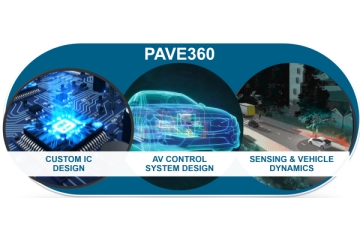
Siemens Announces PAVE360, New Validation Program to Lead the Popularization of IC Design and Development for Autonomous Vehicles
Siemens introduced PAVE360, a pre-silicon autonomous validation program designed to accelerate the development of autonomous vehicle platforms. PAVE360 provides a comprehensive collaborative environment that enables multiple suppliers to work together across the automotive industry ecosystem to develop next-generation automotive chips. PAVE360 extends beyond processors to enable digital twin simulation that spans automotive hardware and software subsystems, complete vehicle models, sensor data fusion, traffic flow, and ultimately smart city simulation in which autonomous vehicles will operate.
2019.05.29by 이수민 기자

The KRnet Conference 2019, which explores the future of internet technology in the era of the Fourth Industrial Revolution, will be held.
The KRnet Conference 2019, hosted by the Ministry of Science and ICT and jointly organized by nine related organizations including the Korea Internet & Security Agency, will be held for two days from the 24th to the 25th at the InterContinental Seoul COEX Hotel in Samseong-dong, Seoul. KRnet 2019, organized to introduce the latest technology trends related to the Internet both domestically and internationally and to explore the future technological development direction of the Internet, has been held annually since July 1993, beginning with the first Korean Academic Computer Network Workshop. Marking its 27th edition this year, KRnet 2019, under the theme "Creating Better for the Future," is expected to feature approximately 70 technical sessions, lectures, and discussions related to future technology trends and collaborative development directions, covering 5G, AI and big data, security, autonomous vehicles, humanities convergence, IoT, cloud and edge computing, immersive content, blockchain, open source, and more.
2019.06.05by 이수민 기자
NVIDIA to Hold AI Conference on July 1st to Explore AI Trends
Nvidia will hold Nvidia AI Conference 2019 over two days, July 1st and 2nd, at the Seoul COEX Convention Center. The Nvidia AI Conference is an annual event where leading domestic and international experts from various fields including AI, deep learning, autonomous vehicles, high-performance computing (HPC), and robotics gather to share the latest AI-related technologies and trends. On the first day of the event, DLI (Deep Learning Institute) will conduct hands-on training using the latest GPU-based deep learning frameworks. On the second day, a conference will be held introducing the current state of the latest AI and deep learning technologies and various industry case studies.
2019.06.11by 이수민 기자
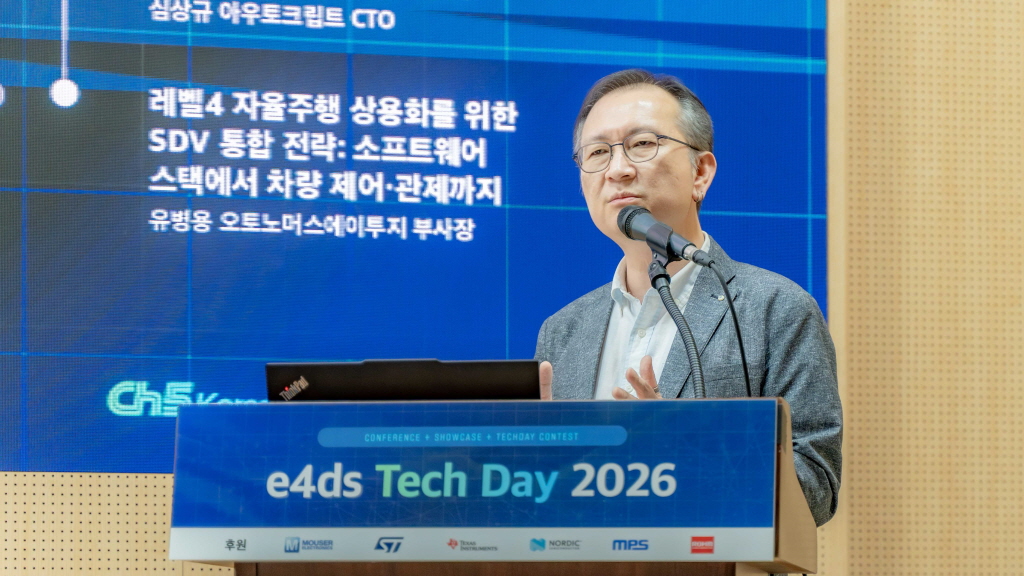
[e4ds Tech Day 2026 ⑨] Sim Sang-gyu, Autocrypt CTO: "In the Physical AI Era, Automotive Security Must Extend Beyond the Vehicle"
At e4ds Tech Day 2026, Sim Sang-gyu, CTO of Autocrypt, explained automotive cybersecurity strategies in the era of Physical AI and SDV (Software-Defined Vehicle). Automobiles are evolving as part of an ecosystem connected to AI, cloud, chargers, IoT, and robots, and he emphasized that the scope of security must expand beyond the vehicle interior to the entire connected environment. In particular, AI model tampering, adversarial attacks, OTA updates, and EV charger hacking were identified as major threats. He explained that response measures require zero trust, AI model integrity protection, intrusion detection, Security by Design and Default, and full lifecycle security management, and that proactive security system establishment beyond regulatory compliance is critical for securing future mobility competitiveness.
2026.10.12by 배종인 기자

Practical HIL Construction Strategy for Automotive and Off-Highway Controller Validation
As vehicle E/E architecture transitions to zonal structures and shifts to software-defined vehicles (SDV), the number of controllers (ECUs) requiring validation and software complexity are surging dramatically. Meanwhile, real vehicle testing cannot provide repeated verification under identical conditions and entails lead time and safety concerns. This white paper explains the principles of HIL (Hardware-in-the-Loop) validation and the structure of the NI platform composed of PXI, SLSC, and VeriStand, and through two actual implementation cases—Camera Record & Replay HIL for In-Cabin Monitoring Controller (ICMU) and Forklift Controller (VCU) HILS—describes how controller-level regression testing becomes possible. Additionally, it explicitly states application boundaries and limitations, such as lack of A2B support.
2026.10.12by 편집부











