



Maxim Launches Bidirectional Current-Sense Amplifier with PWM Noise Reduction, Ideal for DC Motor Control
 Published2019.06.26 10:01
| Removed when PWM slew rate exceeds 500V/µs
| Maintain measurement accuracy and reduce minimum duty cycle↓
Maxim Integrated announced on the 26th that it has launched the 'MAX40056', a bidirectional current-sense amplifier with built-in PWM (Pulse Width Modulation) noise rejection function.
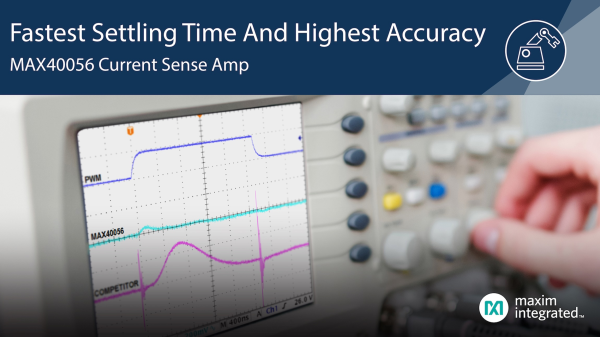
It can increase motor efficiency and reduce vibration.
Implementing a motor control system requires precise motor current sensing and winding current measurement. One method used for this purpose is to use a bridge circuit to measure ground or power as a reference point and then infer the winding current.
Direct measurement of winding current is simpler and more accurate, but is difficult to implement due to the high common-mode swing of the PWM signal. In addition, the PWM rejection performance of existing solutions is weak and the correction speed is slow, which limits the adoption of direct measurement methods.
The MAX40056 rejects PWM slew rates exceeding 500V/µs and completes correction within 500ns, providing complete winding current measurements with a 0.3% tolerance.
Patented PWM cancellation technology enables settling speeds four times faster than competitive products, enabling motor control designers to increase drive frequency or lower minimum duty cycles without compromising measurement accuracy.
Higher PWM frequencies improve current flow and reduce torque ripple, improving motor efficiency. Furthermore, precise winding current measurement at low duty cycles helps reduce or eliminate vibrations that occur when the motor is running at low speeds.
The MAX40056 has a wide common-mode voltage range of -0.1V to +65V and a protection range of -5V to 70V, preventing IC damage in the event of inductive kickback. Its bidirectional sensing capability makes it ideal for DC motor control, base stations, data centers, battery stacks, and many other applications that require accurate current measurement in noisy environments.
“Complex and sensitive systems like autonomous vehicles require accurate sensing feedback for advanced functionality and superior safety,” said Rahul Kumar, analyst at Allied Market Research. “The autonomous vehicle market is expected to grow to $556.67 billion by 2026, increasing the need for more precise motor control solutions.”
“The MAX40056 is ideal for applications that require high levels of accuracy and control by enabling PWM rejection and fast settling of current through the motor winding,” said Dimitry Goder, director of applications and product definition for the Core Products Group at Maxim Integrated. “Its unique design architecture opens up opportunities for performance enhancements and innovation in motor control applications.”
Comments
Related news
Mouser Supplies Maxim 'MAX5995B' PMIC Compliant with IEEE Standards
Mouser Electronics supplies Maxim's PMIC MAX5995B. The MAX5995B features the interface required for PD and delivers performance compliant with IEEE 802.3af/at/bt standards in PoE devices. The MAX5995B provides PD with integrated isolated power switch performance equipped with detection signature, classification signature, and inrush current control functionality. It supports multiple event classification methods in accordance with IEEE 802.3bt standard and provides signaling that identifies PSE from Type 1 through Type 4.
2019.04.15by 이수민 기자
Mouser now stocks Maxim's MAX77860 switch-mode step-down charger for portable applications.
Mouser Electronics supplies Maxim's MAX77860 switch mode buck charger. Combining high performance, wide input voltage range, and USB Type-C CC detection capability, the MAX77860 is suitable for USB Type-C charging for single-cell lithium-ion or lithium polymer applications, portable medical equipment, portable industrial equipment, and portable POS terminals. It is also ideal for smartphones and IoT applications. The MAX77860 buck charger supports an input voltage range of 4.0~13.5V and USB Type-C CC detection capability, and also features a reverse boost function that supplies power to USB On-The-Go accessories. It includes two integrated switches and a single input that can be used with both USB and high-voltage adapters.
2019.06.07by 이수민 기자
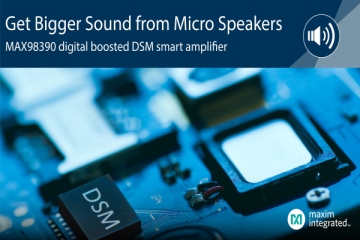
Maxim, Launches MAX98390 DSM Smart Amplifier Maximizing Micro Speaker Efficiency
As devices become increasingly compact, many products are utilizing micro speakers. When speakers shrink, volume and sound pressure level decrease while resonant frequency increases, weakening the bass range. Maxim Integrated has launched the MAX98390 smart amplifier, which integrates a DSM algorithm to deliver micro speaker sound more powerfully and richly with greater efficiency. The MAX98390 safely drives ultra-low-power-rated small speakers of 1~3W up to a maximum of 5.1W. It maximizes audio performance by delivering up to 2.5 times greater volume and 2 octaves lower bass compared to conventional 5V amplifiers.
2019.06.14by 이수민 기자

Intel Unveils Next-Generation 'Core Ultra Series 3' and vPro Platform for Enterprise PCs
Intel has officially unveiled the "Intel Core Ultra Series 3" for next-generation enterprise PCs and the latest vPro platform, addressing a wide range of demands from enterprise notebooks to high-performance workstations.
2026.03.26by 배종인 기자

ROHM Launches ESD Protection Diode Compatible with High-Speed Interfaces of 10Gbps or Higher
Semiconductor specialist ROHM has developed the 'RESDxVx series' of ESD (electrostatic discharge) protection diodes capable of responding to next-generation high-speed data communication environments exceeding 10Gbps, simultaneously enhancing both signal quality maintenance required in high-speed interfaces and IC protection performance.
2026.03.26by 배종인 기자











