


Honeywell Launches 2-Pin Anisotropic Magnetoresistance Sensor IC
 Published2019.06.26 10:05
| Meets AEC-Q100H and ISO26262 ASIL-B(D) standards
Speed and direction measurement for ECU, ABS, and ESC
Honeywell Sensing & IoT business unit announced on the 25th that it has released a 2-pin AMR (Anisotropic MagnetoResistance) sensor IC capable of detecting the speed and direction of a ring magnet encoder target.
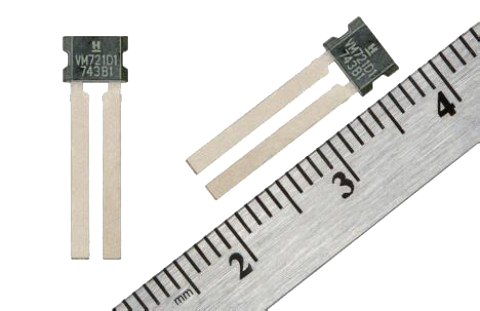
Following the 4-pin AMR sensor IC released earlier this year, Honeywell has newly launched 2-pin type products, the VM721D1 and VM721V1.
The Honeywell 2-pin AMR sensor IC has a higher sensitivity than a Hall sensor due to its AMR bridge structure. It provides more accurate performance and faster response speeds, while offering design flexibility with a larger air gap and enabling improved assembly tolerances.
Since it is not affected by the stimulus size, one sensor can be paired with another ring magnet for use.
It does not require complex correction algorithms and provides stable output even when system vibration, runout, or sudden changes in air gap occur.
AMR signals are more sensitive than Hall sensors and do not require Automatic Gain Control (AGC) or chopper stabilization devices, which can cause jitter during operation.
The sensor IC is equipped with a built-in capacitor for EMC protection, eliminating the need for an external capacitor in most applications. Wide lead wires can be welded for easier mounting tailored to the user's needs.
VM721D1 and VM721V1 can be used for speed and position measurement applications of transmissions, engine cranks, and wheel speeds.
The two products measure speed and direction for the Electronic Control Unit (ECU) for efficiency, comfort, and gear shifting in automobiles and off-road transport, as well as for the Anti-lock Brake System (ABS) and Electronic Stability Control (ESC).
To support these key applications, it meets the functional safety standards of AEC-Q100H, the automotive semiconductor quality standard of the Automotive Electronic Council (AEC), and ISO 26262 ASIL-B(D), the international standard for automotive functional safety.
In addition, it is easy to install and use as it does not require any additional calibration by the user.
Comments
Related news

TI Launches Automotive System-Based Chip with Integrated CAN FD Controller and Transceiver
Texas Instruments announced the launch of an automotive system-based chip product that integrates a CAN FD controller and transceiver. The TCAN4550-Q1 is designed to meet requirements for high bandwidth and flexible data transmission rates in in-vehicle networks, enabling engineers to implement CAN FD interfaces or expand the number of bus ports with minimal hardware modifications across any microcontroller's SPI bus interface. With the newly released TCAN4550-Q1 SBC, engineers can easily upgrade or expand body control and lighting, ADAS, and automotive gateway designs to CAN FD while maintaining their existing microcontroller-based architecture.
2019.06.14by 이수민 기자
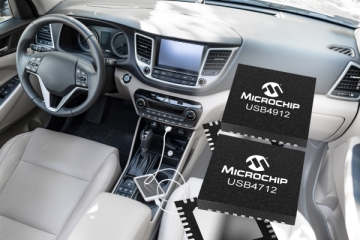
Microchip Launches Two Single-Port USB Smart Hub ICs to Lower System Costs for Automotive OEMs
With growing demand for automotive infotainment and smartphone applications, many automotive OEMs have faced the burden of providing highly reliable and convenient connectivity while optimizing system costs. In response, Microchip Technology has launched new single-port products in its USB 2.0 smart hub IC product line, offering options tailored to diverse development requirements of automotive OEMs. The USB4912 and USB4712, which provide the necessary functionality for single-port implementation, are well-suited for adding a single port according to wireless communication, vehicle central console, or wireless charging implementation.
2019.06.17by 이수민 기자
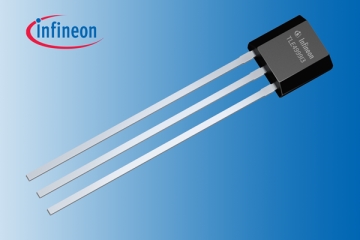
Infineon Launches 'ASIL D Satisfied' Monolithic Linear Hall Sensor
Infineon Technologies is launching a single integrated linear Hall sensor that meets the automotive safety standard ISO26262. Through the XENSIV TLE4999I3, developers can develop fault-tolerant systems that satisfy ASIL D. The ISO26262 standard defines that the system must continue to operate even if a defect occurs in a single component. The TLE4999I3 enables uninterrupted operation at the system level. The new device features a monolithic design that integrates two separate Hall elements. Each signal path is isolated from the other.
2019.06.21by 이수민 기자

Intel Unveils Next-Generation 'Core Ultra Series 3' and vPro Platform for Enterprise PCs
Intel has officially unveiled the "Intel Core Ultra Series 3" for next-generation enterprise PCs and the latest vPro platform, addressing a wide range of demands from enterprise notebooks to high-performance workstations.
2026.03.26by 배종인 기자

ROHM Launches ESD Protection Diode Compatible with High-Speed Interfaces of 10Gbps or Higher
Semiconductor specialist ROHM has developed the 'RESDxVx series' of ESD (electrostatic discharge) protection diodes capable of responding to next-generation high-speed data communication environments exceeding 10Gbps, simultaneously enhancing both signal quality maintenance required in high-speed interfaces and IC protection performance.
2026.03.26by 배종인 기자











