



Discussion on establishing a strategy to secure hydrogen energy source technology
 Published2019.07.05 07:02
Diversifying demand sources for hydrogen as an energy source is necessary.
Hydrogen Technology Development Roadmap Planned for Completion by September
Domestic hydrogen energy technology development is expected to begin in earnest.
On the 4th, the Ministry of Science and ICT held a public-private joint general meeting at the Seoul Textile Center to establish a 'Hydrogen Technology Development Roadmap'.
While sharing the technology development strategy derived through the operation of the five expert committee subcommittees (production, storage/transportation, utilization (transportation), utilization (power generation), safety/environment/infrastructure), we also explored ways to strengthen the execution of the technology roadmap and secure core source technologies in the hydrogen energy field.
This meeting, the second of its kind following the kick-off meeting held in March, was attended by approximately 100 people, including government officials and experts from industry, academia, and research who are involved in developing the technology roadmap.
In the first meeting, Director Jong-hee Han of the Clean Technology Research Institute at the Korea Institute of Science and Technology (KIST), who is in charge of the operation of the expert committee, summarized the progress of establishing the technology roadmap.
Director Han Jong-hee said, “Although the development competition in the hydrogen and fuel cell fields is intensifying worldwide, it is still in its early stages.”He said, “In a situation where there are risks related to future technologies, it is important for the government to create initial conditions for private sector market entry in order to leap forward as a technology-leading country.”
He continued, “In this roadmap, we will closely analyze the current level of domestic technology maturity and competitiveness to derive a technology acquisition strategy suited to the characteristics of each technology,” and “We will focus on organically linking technology development strategies for each field.”
In the panel discussion that followed, Professor Hong Seong-an of Gwangju Institute of Science and Technology, Professor Bu Kyung-jin of Seoul National University, Professor Seol Yong-geon of Yonsei University, Senior Researcher Kim Jong-won of Korea Institute of Energy Research, and Senior Researcher Lim Tae-hoon of KIST participated as panelists and discussed ways to strengthen the execution power of the technology roadmap.
Participants particularly cited the past experience of raising the domestic technological level by establishing a hydrogen economy master plan and operating a large-scale national project team, and urged bold investment in technologies appropriate for the Korean environment, building on past experiences in the current increasingly complex and diversified situation.
In the second meeting, the subcommittee chairs of the five divisions presented the detailed technology-specific development goals derived through discussions within each division and the mid- to long-term technology development strategies to achieve them, and exchanged opinions with other divisions.
To revitalize the hydrogen economy, it is necessary to diversify and expand the demand for hydrogen as an energy source based on a stable and economical hydrogen supply. Furthermore, it is necessary to maintain technological superiority to lead international standards and ensure safety throughout the entire hydrogen cycle.
Going forward, we plan to continue to coordinate the technology development strategies developed by each division through ongoing discussions between divisions to ensure consistency and enhance effectiveness within the broader framework.
Professor Han Moon-hee of Chungnam National University, who serves as the chair of the civilian committee, said, “In addition to harmoniously organizing strategies for each field, we will develop a technology roadmap that will allow us to ‘select and focus’ on promising areas based on our strengths.”
Go Seo-gon, Director General of Basic Research Policy at the Ministry of Science and ICT, said, “Related ministries will work together to ensure that the technology roadmap is not just a slogan but has the power to be implemented.”
Meanwhile, the hydrogen technology development roadmap is scheduled to be completed by September.
Comments
Related news
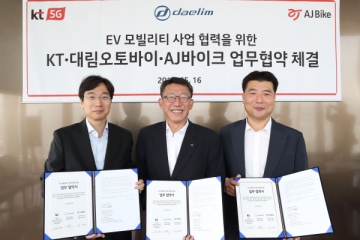
KT, Daerim, and AJ to Promote Electric Motorcycle Smart Mobility Project
Electric two-wheelers have garnered attention as eco-friendly transportation by replacing internal combustion engines that use fossil fuels with electric batteries, thereby reducing carbon emissions and fine particulate matter. However, their adoption remains limited due to constraints such as short driving range and lengthy charging times. KT has signed a memorandum of understanding with Daelim Motorcycle and AJ Bike for "activation of EV mobility business" and will jointly pursue EV-based smart mobility initiatives including electric two-wheeler battery sharing services. Based on this agreement, the three companies—KT, Daelim Motorcycle, and AJ Bike—plan to jointly develop battery sharing services to address the shortcomings of electric two-wheelers and facilitate their market activation.
2019.05.20by 이수민 기자
The Ministry of Science and ICT will train international standards experts in the ICT field.
ICT standards are a crucial key to enhancing the global competitiveness of corporate proprietary technologies and enabling first-mover advantage in global markets. In Korea, standardization activities are primarily conducted by research institutes, universities, and large enterprises, resulting in insufficient participation of SMEs in standardization efforts. In 2018, SME experts accounted for only 34 out of 261 seats at major standardization organizations, representing just 13%. The Ministry of Science and ICT has newly established an emerging global ICT standards expert training program this year to build standard competency among SME personnel and other talent who will drive innovative growth in the era of the Fourth Industrial Revolution, with full-scale education commencing in July.
2019.06.26by 이수민 기자

2019 K-Global Startup Contest Selected Team Launch Ceremony
The Ministry of Science and ICT held a launch ceremony for the selected teams of the 2019 K-Global Startup Competition. The K-Global Startup Competition is a startup support program that discovers startups with innovative ideas in ICT and specialized technology fields and provides support for business establishment and commercialization. The event was held for 33 teams selected through the final screening of startup competition participants recruited until the application deadline in June, aiming to discover collaboration agendas through exchanges with senior entrepreneurs and partner companies as well as guidance on detailed support contents. Starting with the launch ceremony, the 33 selected teams will receive support over the next five months including infrastructure such as collaborative workspace and cloud services necessary for startup and service development, one-on-one mentoring from startup experts, legal consultation through an MOU between the Ministry of Science and ICT and the Korean Bar Association, seminars and networking by field, opportunities for advanced technology benchmarking, and promotional support.
2019.06.29by 이수민 기자
Nvidia invests $5 billion in Intel
NVIDIA and Intel, leaders in global AI computing technology, are now forging ahead in providing cutting-edge solutions through NVLink-based architecture integration. NVIDIA and Intel have officially announced a strategic partnership and stated that they will jointly develop customized data center and personal computing products to accelerate diverse applications and workloads ranging from hyperscale to enterprise and consumer markets, thereby laying the foundation for the next generation computing era.
2025.09.22by 배종인 기자
.jpg)
Applied Materials Launches Environmental Protection Campaign to Mark World Cleanup Day
Applied Materials Korea (CEO Park Kwang-seon) is carrying out environmental cleanup activities with employees and their families around the Dongtan Sinricheon area on the occasion of World Cleanup Day, evolving into a company that engages with the local community beyond technological innovation.
2025.09.22by 명세환 기자











