



Global corporate data breach losses have risen 12% over the past five years, with even greater losses in highly regulated industries.
 Published2019.07.25 11:01
| Damage amount of 26 domestic companies included in the investigation,
| Approximately 3.5 billion won, a 13% increase over the previous year
A report has been published that investigated and analyzed the data breach situation of approximately 500 companies in 16 countries around the world.
IBM and the Ponemon Institute jointly released the '2019 Global State of Corporate Data Breach' report, which examines the state of data breaches among global companies.
This report, for the first time, analyzes not only general data breach cases but also the long-term financial impact of data breaches. Additionally, following last year, 26 domestic companies were included in the survey, providing information on the current status of domestic data leak damage.
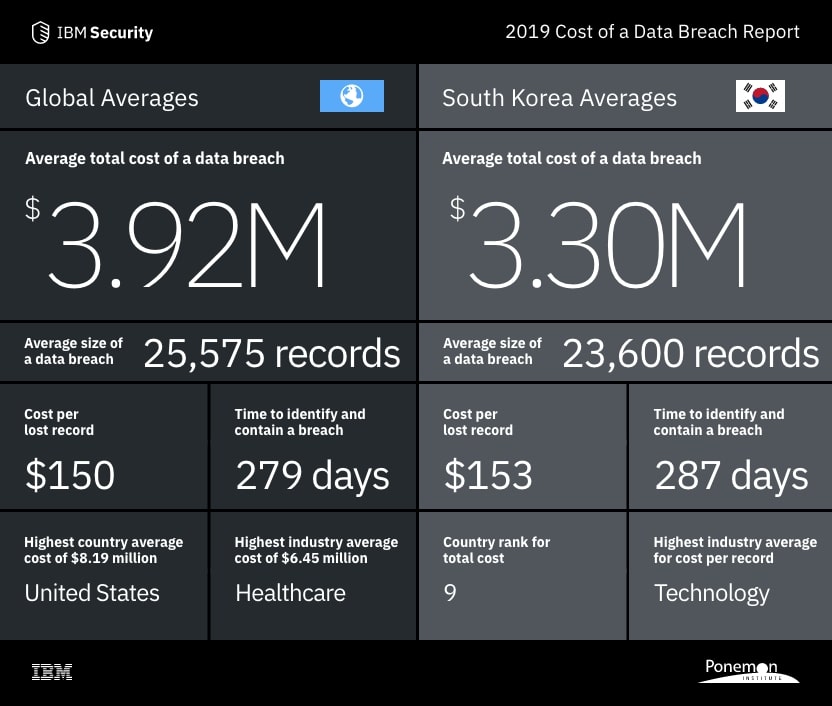
$3.9 million, up 12% over the past five years
According to the report, the scale of damage to companies due to data breaches is steadily increasing worldwide, and the average damage to companies due to data breaches was $3.92 million, an increase of approximately 12% over the past five years.
IBM cited years of financial damage from data breaches, increased regulation, and complex procedures for resolving security incidents as the main reasons for the increase in damages.
The financial impact of data breaches is particularly pronounced for small and medium-sized businesses.
The report found that businesses with fewer than 500 employees suffered an average loss of more than $2.5 million. This figure could have devastating consequences for small businesses with average annual revenues of less than $50 million.
It also appears that more than half of data breaches result from malicious cyberattacks. The average damage caused by cyberattacks was $4.45 million, which was about $1 million more than the damage caused by internal system errors ($3.5 million) or employee errors ($3.24 million).
The threat is growing, with data breaches due to malicious cyberattacks increasing from 42% to 51% over the past six years.
According to a survey of 26 domestic companies, data breaches resulted in financial losses of 3.5 billion won per company, a 13% increase from the previous year (3.1 billion won). On average, the damage per person for each lost or stolen piece of data was 165,100 won, a 9.92% increase from the previous year (149,500 won).
The industry with the highest per-data-item damage was the technology industry, at 245,577 won per person. Other industries with the highest damage per data-item damage included finance (217,334 won), services (216,955 won), and transportation (185,226 won). The public sector recorded the lowest per capita income at 94,776 won.
Starting this year, we also analyzed the long-term financial damage to companies caused by data breaches.
The financial impact of a data breach on a company can last for years, with an average of 67% of the costs occurring in the first year, 22% in the following year, and the remaining 11% incurred two years after the incident.
Long-term costs incurred in years 2 and 3 were higher for companies in highly regulated industries such as healthcare, financial services, energy, and pharmaceuticals.
Additionally, IBM emphasized a company's incident response capabilities as the most effective factor in reducing the scale of damage.
According to the report, the average lifespan of a data breach is 279 days, meaning it takes companies 206 days to detect a breach and 73 days to contain it. However, companies that detect and contain a breach within 200 days can reduce their total damages by an average of $1.2 million.
Companies that implemented incident response teams and proactively reviewed and tested their incident response plans saved an average of $1.23 million in data breach costs.
“Cybercrime generates significant revenue for cybercriminals, but it also costs businesses enormous amounts of money,” said Wendi Whitmore, global head of IBM Global X-Force Breach Response and Intelligence Services. “Given that companies have experienced the loss or theft of more than 11.7 billion records in the past three years, organizations need to fully understand the financial impact of a data breach on their bottom line and focus on mitigating those costs.”
Comments
Related news
Ixia Combats Complex Security Threats with Network Device Security Testing Solution
Recently, IT departments at various enterprises have been struggling with increased workloads due to enhanced cybersecurity measures while facing intensifying network security threats. Keysight Ixia's Solutions Business Division has launched BreakingPoint QuickTest, which supports enterprises in verifying their cyber security response posture by rapidly validating the performance and security of network equipment and security devices. BreakingPoint QuickTest provides concise and practical test scores for quick result analysis and supports automation for continuous evaluation. It enables system performance measurement while handling various types of application traffic, including encrypted traffic, and validates the effectiveness of security equipment or systems that mitigate attack and breach attempts while maintaining traffic continuity.
2019.07.11by 이수민 기자

Everything about AI at a glance: The International AI Expo opens on the 17th.
What will AI mean for us in the future, and what innovations will it bring to our society and industry? The Second International AI Expo, where you can check everything about AI including related AI technologies and platforms, solutions, AI-based business models, and business strategies of domestic and international AI companies, will be held for four days from the 17th to the 19th at COEX in Samseong-dong, Seoul. At this event, approximately 120 domestic and international AI-specialized companies and organizations will participate and showcase their capabilities in machine learning, deep learning, neural networks, reinforcement learning, natural language processing, speech recognition, image recognition, AI chips and components, computing, AI platforms and solutions, chatbots and assistants, 5G and networks, IoT, autonomous vehicles, healthcare, gaming, finance, security, manufacturing, distribution and retail, AI robots, wearables, smart factories, smart cities and smart homes, drones and UAVs, predictive maintenance, and AI consulting over the four-day period.
2019.07.16by 이수민 기자
Nuvoton Launches Arm Cortex-M23-Based IoT Security MCU
Nuvoton introduces FreeRTOS kernel functionality through its M2351 series. The M2351 is the first Arm Cortex-M23 based MCU currently available on the market. Nuvoton provides relevant examples necessary to run FreeRTOS on the Armv8-M architecture, which officially supports embedded developers. In early 2019, the M2351 series obtained Arm Platform Security Architecture Level 1 certification and Platform Security Architecture capability certification. Nuvoton verifies the latest level standards in real-time and provides IoT security MCUs that meet the required specifications necessary to obtain Arm Platform Security Architecture certification.
2019.07.23by 이수민 기자
.png)
Databricks Unveils Open AI Security Monitoring 'Lakewatch'
Databricks entered the security market on March 24 by unveiling LakeWatch, an open-source agentic SIEM. The core functionality of this product is to integrate and analyze security, IT, and business data in a single environment to support AI-based threat detection and investigation. The company explained that it reduces the limitations of existing security operations centers, which have had to forgo some data due to high cost structures, and enables large-scale data analysis and automation based on open formats and ecosystems. LakeWatch is currently offered as a private preview, with Adobe and Dropbox mentioned as early customers. Databricks also announced an expanded partnership with Anthropic as well as the acquisition of Antimatter and SiftD.ai.
2026.03.26by 배종인 기자

Kaspersky Unveils Revamped 'NEXT' Combining SOC Integrated Management and AI Analytics
As enterprises increase demand for integrated management and automation in the construction and operation of Security Operations Centers (SOC), Kaspersky has disclosed updates to its B2B security product suite 'Kaspersky Next'. This update expands EPP, EDR, XDR, and SIEM integration through a single console based on OSMP, incorporates AI capabilities such as DLL hijacking detection and suspicious account takeover behavior identification, and includes integration with generative AI assistant tool KIRA. The company stated that in large-scale deployment environments, EDR Expert can reduce resource requirements by up to 30%, and XDR Expert by up to 60%.
2026.03.25by 배종인 기자











