



Maxim Launches Two Low-Power Medical Sensors for Next-Generation Wearables
 Published2019.07.26 10:31
| In-ear heart rate monitor MAXM86161
| Low-Power Digital Temperature Sensor MAX30208
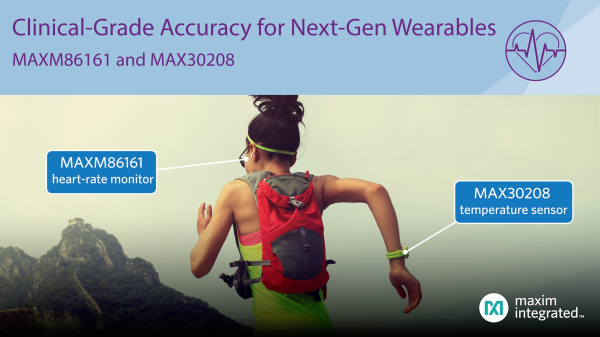
Maxim has launched an in-ear heart rate monitor and a medical digital temperature sensor.
According to IDTechEx Research, wearable devices continue to exert increasing influence on the market. Global sales of wearable devices are projected to grow at a compound annual growth rate (CAGR) of 13% from $56.4 billion in 2019 to $78.3 billion in 2022.
Key growth drivers in the wearables market include the growing value of smartwatches and earbuds, as well as the adoption of dedicated wearables in key healthcare sectors.
Maxim Integrated announced on the 26th that it has launched the in-ear heart rate monitor 'MAXM86161' and the medical digital temperature sensor 'MAX30208'.
Wearable medical and fitness monitors must accurately measure human biometric information such as body temperature and heart rate. Until now, small, battery-powered wearable devices have had many limitations due to sensor accuracy.
Maxim's two new continuous monitoring body sensors improve the accuracy of vital signs measurements such as body temperature, heart rate, and blood oxygen saturation (SpO2).
Designers of wearable medical and fitness applications can reduce the power required for temperature measurement by 50% using the MAX30208.
The MAXM86161 can reduce the size of optical solutions by up to 40% and improve both sensitivity and accuracy with the highest signal-to-noise ratio (SNR).
The MAXM86161 in-ear heart rate monitor and pulse oximeter is a fully integrated solution designed for hearable and wearable applications to measure heart rate and oxygen saturation with high accuracy.
This solution is housed in an ultra-small OLGA package (2.9 mm x 4.3 mm x 1.4 mm), making it 40% smaller than competing products. Equipped with three LEDs, the red and IR LEDs measure oxygen saturation, while the green LED measures heart rate.
Power consumption is less than 10μA in operating mode (typically 25sps) and 1.6μA in standby mode, which is approximately 35% less than competing products, extending wearable battery life.
By adopting an integrated analog front-end (AFE), there is no need to purchase a separate chip and the additional AFE that needs to be connected to the optical module is eliminated.
Development of a wider range of devices is also possible with the MAXM86161, which has the best SNR in its class. To improve measurement accuracy, an algorithm for motion compensation is also provided.
The MAX30208 digital temperature sensor operates at 67μA and is available in a thin 10-pin LGA package (2mm x 2mm x 0.75mm).
The MAX30208 provides medical-grade temperature measurement accuracy (±0.1℃) and responds quickly to temperature changes.
This solution is also suitable for small battery-operated applications such as smartwatches and medical patches due to its low power and small size.
It also simplifies the design of battery-powered medical temperature sensing wearable applications.
The MAX30208 is compatible with up to four I2C addresses, allowing multiple sensors to be connected to the same IC bus and can be mounted on a PCB or FPC (Flexible Printed Circuit).
Comments
Related news
.png)
Nordic's cellular IoT module, the nRF9160 SiP, has achieved key certifications and is now entering volume production.
Nordic Semiconductor announced on the 4th that its nRF9160 SiP, an LTE-M/NB-IoT and GPS cellular IoT module, has successfully completed quality validation and obtained major certifications, and has entered the final mass production silicon manufacturing phase. Major certifications include GCF and PTCRB, FCC (United States and Latin America), CE (Europe), ISED (Canada), ACMA (Australia and New Zealand), TELEC/RA (Japan), NCC (Taiwan), and IMDA (Singapore). The nRF9160 SiP, measuring 10 x 16 x 1mm, is suitable for compact wearable consumer and medical devices as well as small asset tracking devices, and is a solution that can integrate IoT applications and cellular connectivity with only an external battery, SIM, and antenna.
2019.07.04by 이수민 기자
Maxim Launches Ultra-Compact LED Driver for HBLEDs
As automotive lighting rapidly transitions to LED, designers face new challenges including improving efficiency, simplifying design, and reducing system costs while complying with stringent EMI requirements. In response, Maxim Integrated has introduced the MAX25610A and MAX25610B LED drivers. High-performance automotive lighting application designers can now drive HBLEDs more easily and efficiently with the MAX25610A/B. Maxim has also unveiled the MAX25600, a 60V synchronous high-voltage 4-switch buck-boost LED controller that seamlessly transitions between buck, buck-boost, and boost modes. This IC is well-suited for LED load changes in automotive, commercial, and industrial high-power lighting applications.
2019.07.17by 이수민 기자
Maxim Launches RTC for Wearables Guaranteeing Accurate Time Measurement
Systems using MCUs for accurate timekeeping can face battery life waste issues in the wearable sector. Particularly in small battery systems, energy efficiency is poorest. To address this, Maxim Integrated has launched the MAX31341B nanopower RTC, offering the industry's smallest package and longest battery life. The MAX31341B provides timekeeping even during dormancy, allowing the MCU to remain powered down to conserve power and extend battery life.
2019.07.25by 이수민 기자

Intel Unveils Next-Generation 'Core Ultra Series 3' and vPro Platform for Enterprise PCs
Intel has officially unveiled the "Intel Core Ultra Series 3" for next-generation enterprise PCs and the latest vPro platform, addressing a wide range of demands from enterprise notebooks to high-performance workstations.
2026.03.26by 배종인 기자

ROHM Launches ESD Protection Diode Compatible with High-Speed Interfaces of 10Gbps or Higher
Semiconductor specialist ROHM has developed the 'RESDxVx series' of ESD (electrostatic discharge) protection diodes capable of responding to next-generation high-speed data communication environments exceeding 10Gbps, simultaneously enhancing both signal quality maintenance required in high-speed interfaces and IC protection performance.
2026.03.26by 배종인 기자











