


KETI Localizes Autonomous Driving LiDAR Sensors for Unmanned Transport Robots
 Published2019.08.26 15:51
Precise measurement of a range of over 180° at 30m is possible
| Simplified with a dual-axis structure separating laser transmitter and receiver
Domestic researchers have succeeded in localizing the production of lidar sensors for AGVs.
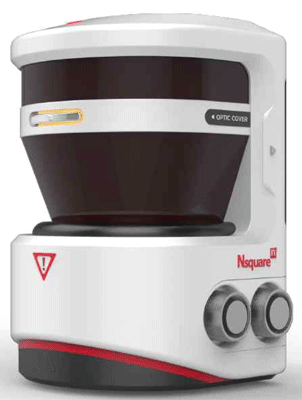
The Korea Electronics Technology Institute (KETI) announced on the 26th that it has localized scanning LiDAR sensors for Simultaneous Localization and Mapping (SLAM) for autonomous driving of Automatic Guided Vehicles (AGVs) in smart factories.
An AGV is an automated transport robot that automatically performs object transfer tasks while moving along a path by driving electric motors and wheels.
In the past, AGVs moved using the traditional SLAM method, which involved recognizing artificial markers such as metal wires or magnetic wires attached to the floor for optical recognition and driving along a set path.
Recently, autonomous driving AGVs that use LiDAR to recognize location without separate markings and further create and utilize surrounding maps are becoming commonplace.
For this, scanning capable of precisely measuring a range of more than 180° over 30m is required LiDAR sensor products are essential.
Until now, scanning LiDAR sensors for SLAM had to rely on Japanese and German products costing around 2 to 3 million won.
.png)
The 'scanning lidar sensor for autonomous driving of unmanned transport robots' developed by KETI this time is capable of 180° detection and detecting objects as small as 10cm at a distance of up to 30m.
It can replace overseas products as it is Class 1, which is safe even with prolonged exposure to the naked eye when using laser optical products.
The research team reduced the volume and manufacturing cost to less than half compared to German SICK products, particularly through structural simplification.
Unlike existing products with an integrated transmitting and receiving structure, the dual-axis structure with separated laser transmitting and receiving reduces interference between transmitted and received signals, thereby increasing measurement precision. Additionally, by shortening the length of the transmitting module and simplifying the structure, manufacturing costs could be lowered.
Dr. Hyun-Chang Cho of the KETI IT Convergence Components Research Center said, “Lidar sensors are one of the essential sensors that accelerate the development of autonomous driving technology for unmanned transport robots, along with ultrasound, cameras, and radar,” adding, “We expect this technology to be utilized in various fields, including smart factories, as well as logistics, safety, security, and robot vacuum cleaners.”
Comments
Related news
CEVA Announces SLAM SDK for Low-Power Embedded Systems
CEVA has announced the CEVA-SLAM software development kit to provide convenient development of SLAM (Simultaneous Localization and Mapping) applied to mobile devices, AR/VR headsets, robots, autonomous vehicles, and camera-based devices. Available for the CEVA-XM intelligent vision DSP and NeuPro AI processor product families, CEVA-SLAM integrates hardware, software, and interfaces to significantly lower the entry barrier for companies seeking to implement SLAM in low-power embedded systems.
2019.06.05by 이수민 기자
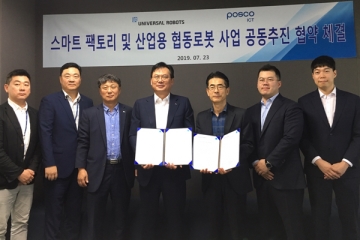
Universal Robots and POSCO ICT Form Joint Front for Industrial Collaborative Robots to "Preempt the Smart Factory Market"
Universal Robots and POSCO ICT have concluded a joint cooperation agreement to advance smart factory and industrial collaborative robot business. POSCO ICT provides IRaaS, a robot-integrated O&M operation solution, while Universal Robots supplies collaborative robots for IRaaS. The two companies agreed to jointly cooperate on marketing and distribution utilizing Universal Robots' domestic distributor network. Universal Robots will work with distributors to support IRaaS solution marketing and sales, as well as supply and deployment of collaborative robots and applications. POSCO ICT will provide consulting and engineering services for collaborative robot business, and development, supply, and deployment of robot-integrated O&M solutions and IT solutions. Universal Robots' collaborative robots are planned to be gradually expanded and applied across POSCO Group companies in the future.
2019.08.08by 이수민 기자
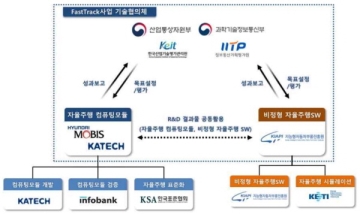
Ministry of Trade, Industry and Energy and Ministry of Science and ICT Join Hands to Develop Innovative Autonomous Driving Technology
The Ministry of Industry and the Ministry of Science and Technology will establish a "Fast Track Technology Consultation Body" to accelerate the autonomous driving industry. For R&D projects requiring rapid advancement, pilot projects will be implemented across four ministries prior to preliminary feasibility studies, and the Ministry of Trade, Industry and Energy and the Ministry of Science and ICT, among the four ministries, will collaborate to develop foundational technologies and core technologies for autonomous driving industrialization.
2019.08.26by 명세환 기자
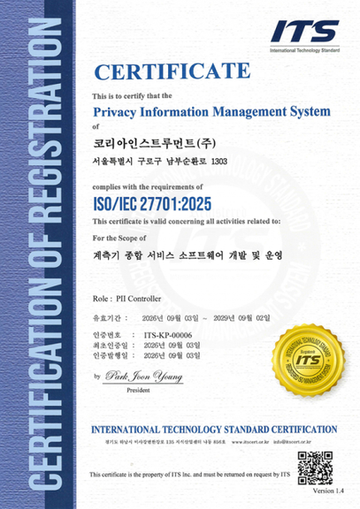
Korea Instrument, KOLAS Accredited Calibration Agency First to Simultaneously Acquire ISO/IEC 27,001·27,701
Korea Instrument has become the first among KOLAS accredited calibration agencies to simultaneously acquire ISO/IEC 27,001 and ISO/IEC 27,701 certifications. Through its proprietary platforms CWIZ Enterprise and CWIZ Partners, the company has embedded information security and personal data protection requirements across all business processes including customer information, equipment data, and calibration reports, with plans to continuously advance its management system through regular audits and security inspections.
2026.10.12by 배종인 기자
TeamViewer One, IT Incident Automation Workflow and Resolution Center Enhanced
TeamViewer has added IT incident automation capabilities and an advanced Resolution Center to its integrated digital workplace management platform 'TeamViewer ONE'. Recurrent service disruptions, configuration errors, and capacity shortages are automatically handled according to preset policies, and device status verification through script deployment can be managed in a unified interface, significantly reducing repetitive tasks for IT teams.
2026.10.12by 배종인 기자











