


KIST and KAIST Prove Potential of "Step-on Charging" Lithium-ion Batteries
 Published2019.09.04 11:21
| Observation of changes in electrode lithium within the electrolyte and elucidation of its behavior
Expected application of pressure-to-electricity conversion energy harvesting
As the demand for large-capacity energy storage media increases, interest in the development of high-capacity lithium alloy batteries is growing.
However, high-capacity lithium alloy batteries have a problem in that their capacity drops drastically and their volume changes significantly due to the pressure generated during the charging and discharging processes. In particular, since the phenomena occurring when pressure is applied to lithium battery electrodes take place at the nanoscale, direct measurement and observation were difficult due to the challenges in establishing the experimental environment.
Dr. Sangtae Kim's team at the Electronic Materials Research Group of the Korea Institute of Science and Technology (KIST), in collaboration with Professor Jongmin Yuk's team at KAIST, revealed the effect of pressure on the battery charging and discharging process and, based on this, presented the possibility of a lithium-ion battery that can be charged by applying pressure on August 30.
The joint research team utilized tin to directly observe and interpret the effects of pressure on batteries at the nanoscale.
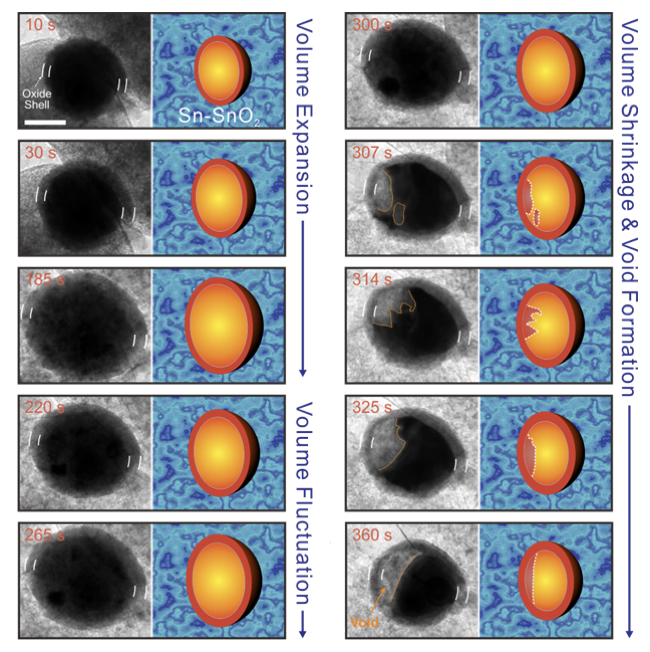
Lithium reaction of tin-tin oxide nanoparticles (Image=KIST)
Using real-time graphene liquid-phase transmission electron microscopy, the joint research team confirmed the effect of surface pressure on tin nanoparticles and succeeded in directly observing the pressure-induced discharge phenomenon during electrode charging for the first time. Furthermore, through thermodynamic calculations and modeling, they predicted the pressure difference within the battery electrode and interpreted that the resulting electrochemical energy difference serves as the driving force for lithium ion movement and discharge.
Through this study, the research team revealed that pressure and the amount of lithium ions in the electrode have an inverse relationship. Based on this, the possibility was presented to construct a battery that charges by moving lithium through pressure applied by human footsteps or similar movements.
The joint research team developed and tested a battery element that charges when external force is applied, such as by bending or stepping on it, and found that about 0.5 mA of power is generated when one adult male steps on it. This is the power capable of driving a sensor (about 2 mA) with a low-power Bluetooth module attached, assuming that 4 adults step on it.
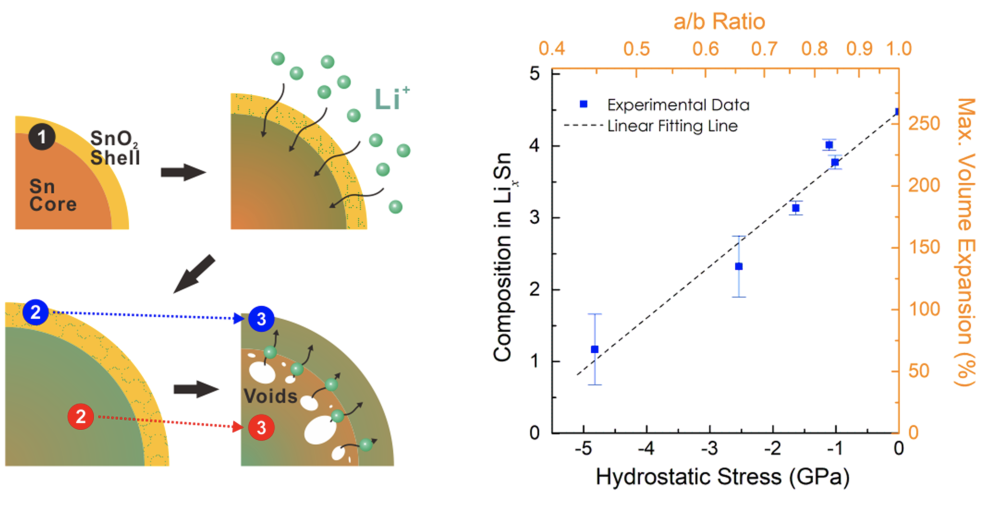
The emerging stress-composition correlation model (Image=KIST)
This device, which generates and stores electricity on its own without an external power supply, is expected to be used in the future for energy harvesting, such as by installing it in paving blocks to convert wasted energy into electricity.
Dr. Kim Sang-tae of KIST stated, “This research result is an achievement in storing mechanical energy as electrochemical energy,” adding, “It is expected to contribute to the design of high-efficiency energy harvesters, such as IoT sensors.”
"Recently, there has been high interest in high-capacity lithium battery materials that can be used stably and for a long time, such as in electric vehicles and energy storage devices," said Professor Yuk Jong-min of KAIST. "This research achievement will be helpful in designing new high-capacity alloy-based electrodes."
Comments
Related news
Korean researchers successfully develop technology for continuous charging of implantable medical device batteries.
Professor Kim Sang-woo's research team at Sungkyunkwan University has developed a new energy harvesting technology that continuously charges biocompatible implantable medical devices using triboelectricity generated within the body without periodic surgical interventions for battery replacement. For power supply to implantable medical devices such as pacemakers and insulin pumps, biocompatibility considerations had to be taken into account when wirelessly transmitting significant external power into the body. Accordingly, energy harvesting research has been ongoing to convert mechanical energy within the body—such as heartbeats, blood flow, and muscle movement—into electrical energy, but the small magnitude of mechanical energy generated in vivo made it difficult to achieve sufficient power generation. The research team demonstrated that external ultrasound induces deformation of specific materials inserted into the body, and triboelectricity induced by vibrations from such deformation can generate high-level electrical energy.
2019.08.02by 이수민 기자
LG Electronics Launches All-in-One ESS for Small-Scale Solar Power Generation
LG Electronics has launched an all-in-one ESS for 100kW-class solar power generation. The battery capacity is maintained at up to 75.4% even after 15 years, and comes with a 3-year warranty.
2019.08.13by 명세환 기자

Microchip's Membrane Neuromorphic Memory Solution Helps Build Embedded AI Processing Architectures
As AI processing shifts from the cloud to the network edge, battery-powered high-performance embedded devices are facing the need to perform AI functions such as computer vision and speech recognition. Microchip Technology stated that through its subsidiary Silicon Storage Technology, it can address this situation by applying its analog memory technology, Membrains neuromorphic memory solution, which significantly reduces power consumption. Based on SuperFlash technology, Microchip's analog flash memory solution optimized for neural network VMM execution improves the implementation of VMM system architecture through an analog in-memory computing approach, thereby enhancing AI inference capabilities on edge devices.
2019.08.19by 최인영 기자
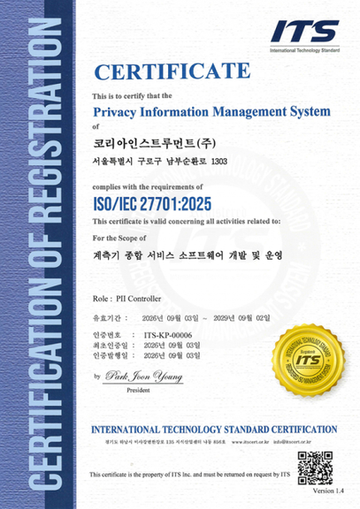
Korea Instrument, KOLAS Accredited Calibration Agency First to Simultaneously Acquire ISO/IEC 27,001·27,701
Korea Instrument has become the first among KOLAS accredited calibration agencies to simultaneously acquire ISO/IEC 27,001 and ISO/IEC 27,701 certifications. Through its proprietary platforms CWIZ Enterprise and CWIZ Partners, the company has embedded information security and personal data protection requirements across all business processes including customer information, equipment data, and calibration reports, with plans to continuously advance its management system through regular audits and security inspections.
2026.10.12by 배종인 기자

TeamViewer One, IT Incident Automation Workflow and Resolution Center Enhanced
TeamViewer has added IT incident automation capabilities and an advanced Resolution Center to its integrated digital workplace management platform 'TeamViewer ONE'. Recurrent service disruptions, configuration errors, and capacity shortages are automatically handled according to preset policies, and device status verification through script deployment can be managed in a unified interface, significantly reducing repetitive tasks for IT teams.
2026.10.12by 배종인 기자











