



Wearable sensor made from sea cucumber shell detects harmful gases
 Published2019.09.24 17:52
| Development of fiber with sensing function for detecting harmful gases
| Expected to be used in next-generation wearable sensors
Wearable sensors are sensors that can detect conditions and environments in real time by being worn, and their shapes and functions can be changed by combining them with various materials. The fiber form is flexible and can be woven into general fibers, so it is attracting attention as an ideal platform.
The research team of Dr. Hyunsoo Jeong and Dr. Seungki Lee from the Functional Composite Materials Research Center of the Korea Institute of Science and Technology (KIST) and the research team of Professor Heetae Jeong from the Korea Advanced Institute of Science and Technology (KAIST) announced on the 3rd that they had developed a fiber-type nitrogen dioxide ( NO2 ) sensor that does not require a post-processing process and can be continuously mass-produced.
Most existing fiber-based sensor materials were manufactured by coating general fibers with conductive materials and sensor materials. However, the resistance was high, requiring high voltage, and above all, the bonding strength between the fibers and the materials being coated was low, resulting in poor durability.
To solve this problem, graphene oxide fibers, which are conductive fibers themselves, have emerged. However, graphene fibers have been criticized for having the disadvantages of being uneconomical due to the necessity of a post-processing process, significant reduction in flexibility, and high process and material costs.
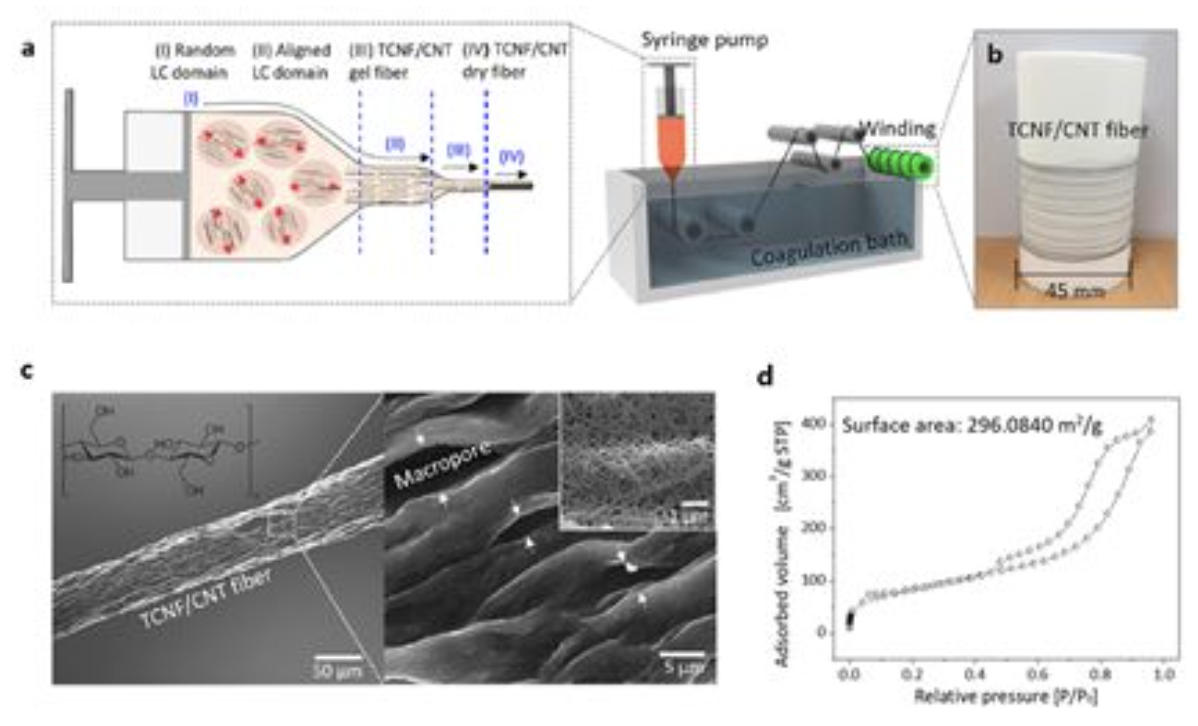
The KIST research team developed a nitrogen dioxide sensor material that does not require post-treatment or catalyst by extracting nanocellulose from sea squirt shells and manufacturing a composite fiber by combining it with carbon nanotubes.
Nanocellulose is a component of the cell walls of green plants and various forms of algae and oomycetes, and is a substance that is made by breaking down cellulose, the most abundant organic compound on Earth, to the nano level.
The developed composite fiber possesses both mechanical strength and flexibility, so it can be woven with regular fibers. The research team actually succeeded in creating a fabric with composite fibers inserted and detecting nitrogen dioxide, a harmful gas. Since composite fibers can be continuously produced using the existing industrialized wet spinning method, it is expected to be advantageous for commercializing inexpensive wearable gas sensors in the future.
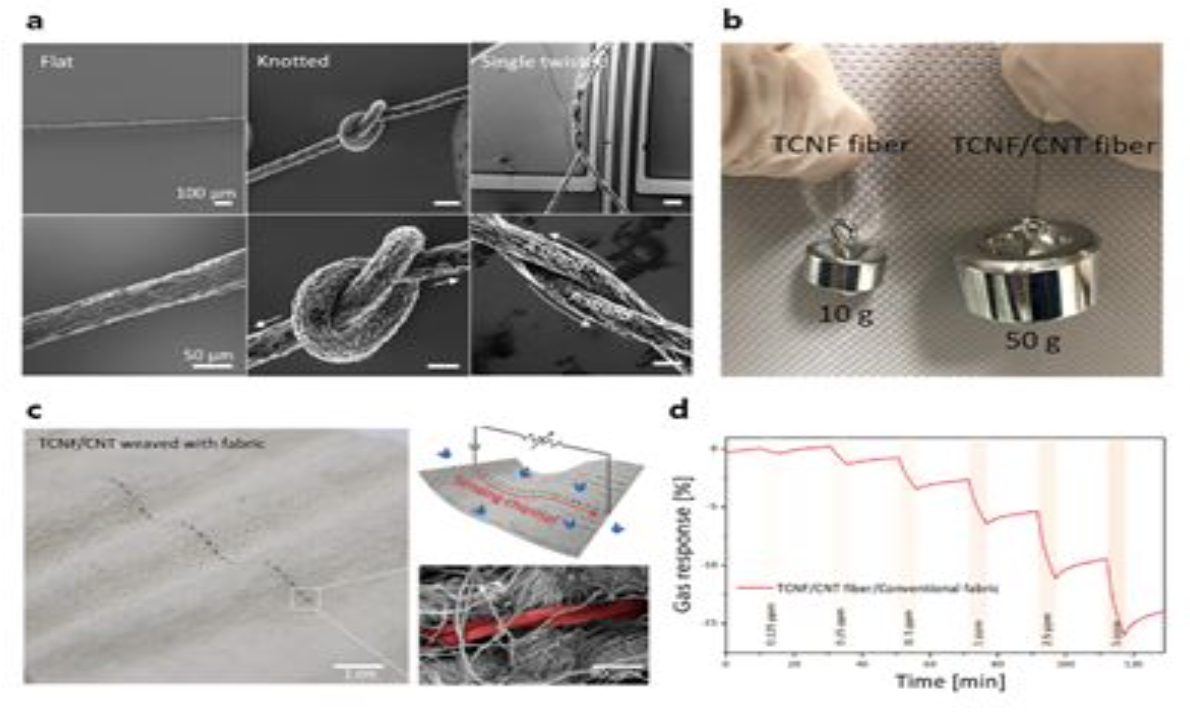
The research team calculated the manufacturing cost based only on the price of the materials used in the study, and confirmed that the cost is less than 10 won per meter of fiber. The composite fibers manufactured by this method have conductivity, porosity, and high selectivity and sensitivity (ppb level) for nitrogen dioxide gas in one step from the manufacturing stage.
Dr. Jeong Hyeon-su of KIST said, “Through this research, we were able to find out that the basic properties required for a wearable sensing material can be manufactured at once through material composites,” and added, “In the future, we will strive to develop economically viable wearable materials for detecting other harmful gases in addition to nitrogen dioxide.”
Meanwhile, this study was conducted through the KIST Open Research Program and the National Research Foundation of Korea Nanomaterial Technology Development Project with support from the Ministry of Science and ICT. The research results were published in the latest issue of 'ACS Nano', an international journal in the materials field, and KIST has completed application for a domestic patent for the manufacturing technology.
Comments
Related news
ETRI Successfully Develops Thermoelectric Device That Generates Electricity from Body Heat
The Electronics and Telecommunications Research Institute has successfully developed a battery-free wearable patch that can be affixed to the wrist like a band, harvesting energy from body heat alone to display information. The technology converts thermal energy from body temperature into electricity, amplifies it, and uses it as a power source for wearable devices. The research team believes that this technology will eventually be incorporated into devices combined with body temperature and pulse sensors, enabling wireless data collection. The application of this technology is expected to extend to monitoring of infants and patients, as well as location monitoring of pets.
2019.01.28by 이수민 기자
Maxim Launches Two Low-Power Medical Sensors for Next-Generation Wearables
The influence of wearable devices on the market continues to grow. Global wearable device sales are projected to grow at an average annual rate of 13% from $56.4 billion in 2019 to $78.3 billion in 2022. The primary growth drivers of the wearable market include smartwatch and earwear device growth and development leading to enhanced value, as well as the adoption of dedicated wearable devices in major medical fields. Wearable medical and fitness monitors must accurately measure human biometric information such as body temperature and heart rate. Until now, battery-powered compact wearable devices have faced significant constraints due to sensor accuracy. In response, Maxim announced the launch of the MAXM86161, an in-ear heart rate monitor, and the MAX30208, a medical-grade digital temperature sensor.
2019.07.26by 이수민 기자
TI Unveils LDO Linear Regulators That Extend Battery Life
As demand for smaller and smarter connected devices increases, attention to battery life is also growing. To maintain extended battery life, ultra-low quiescent current is required. The TI TPS7A02 linear regulator enables ultra-low quiescent current control under light load conditions, improving battery life by at least twice in applications using standard battery compounds such as lithium-ion. Additionally, with a low shutdown quiescent current of 3nA, it can extend battery life by up to 5 times compared to competing devices in portable medical and wearable applications.
2019.09.19by 최인영 기자
Korea Instrument, KOLAS Accredited Calibration Agency First to Simultaneously Acquire ISO/IEC 27,001·27,701
Korea Instrument has become the first among KOLAS accredited calibration agencies to simultaneously acquire ISO/IEC 27,001 and ISO/IEC 27,701 certifications. Through its proprietary platforms CWIZ Enterprise and CWIZ Partners, the company has embedded information security and personal data protection requirements across all business processes including customer information, equipment data, and calibration reports, with plans to continuously advance its management system through regular audits and security inspections.
2026.10.12by 배종인 기자

TeamViewer One, IT Incident Automation Workflow and Resolution Center Enhanced
TeamViewer has added IT incident automation capabilities and an advanced Resolution Center to its integrated digital workplace management platform 'TeamViewer ONE'. Recurrent service disruptions, configuration errors, and capacity shortages are automatically handled according to preset policies, and device status verification through script deployment can be managed in a unified interface, significantly reducing repetitive tasks for IT teams.
2026.10.12by 배종인 기자











