


South Korea aims to have Level 4 autonomous driving infrastructure in place by 2027.
 Published2019.10.30 16:47
Development of Level 4 autonomous vehicles by 2024
Transforming the Future Car Ecosystem with 60 Trillion Won in Private Investment
The global automobile market is projected to experience low growth of around 1% going forward. Furthermore, changes are occurring, such as eco-friendliness, intelligence, and service-oriented trends, triggered by the Fourth Industrial Revolution and strengthening environmental regulations. The electric vehicle market is expanding, the development and commercialization of autonomous vehicles are accelerating, and car-sharing services are proliferating.

On the 15th, the government held a ceremony to declare the national vision for future automobiles and jointly announced the '2030 Future Automobile Industry Development Strategy' with relevant ministries.
Global auto OEMs are pursuing large-scale investments related to future vehicles along with restructuring, and governments around the world are also pursuing large-scale demonstration complexes to build infrastructure for future vehicle development and road operation.
As of 2018, South Korea produced 4.03 million vehicles, ranking 7th in the world in automobile production. As such, the automobile industry plays a significant role in the national economy. This is the backdrop to concerns that if we fail to adequately prepare for the transition to future vehicles, the national economic growth momentum may be weakened.
However, unlike the traditional automobile market, the future car market still lacks a clear leader, presenting an opportunity for the Korean auto industry to make a significant leap forward. The government established the 2030 Future Auto Industry Development Strategy after holding 21 meetings with auto OEMs and parts manufacturers, telecommunications, software, and semiconductor companies, auto-related unions, and academic societies.
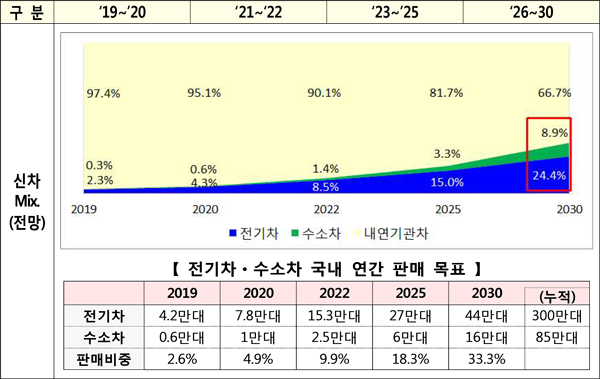
The government has set two main goals. First, it will increase the share of electric and hydrogen vehicles in domestic new car sales to 33% by 2030 and increase their global market share to 10%. Second, it will launch Level 4 autonomous vehicles by 2024 and, by 2027, establish major road infrastructure nationwide to support Level 4 autonomous driving, thereby achieving the world's first commercialization.
He also presented three key strategies for the Korean future vehicle industry over the next decade: 1) aggressively targeting the global market by developing eco-friendly vehicle technologies and accelerating domestic distribution; 2) establishing a fully autonomous vehicle system and infrastructure by 2024; and 3) transitioning to an open future vehicle ecosystem based on approximately 60 trillion won in private investment.
To successfully achieve its two major goals and three major strategies, the government plans to invest 385.6 billion won in eco-friendly vehicle technology development projects from 2020 to 2026, and the project has already passed the preliminary feasibility study. We also invest in autonomous vehicle systems, components, and communications.
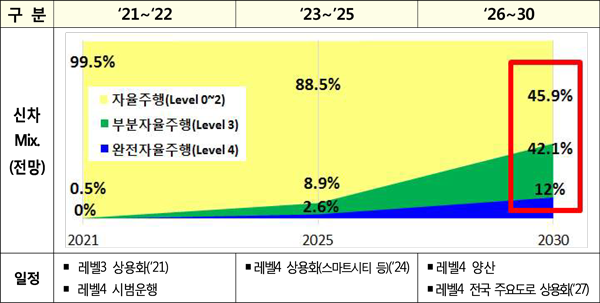
The government plans to invest 1.7 trillion won in implementing Level 4 autonomous driving from 2021 to 2027, and a preliminary feasibility study is currently underway. Additionally, the government plans to operate an industry-academia-research human resource development program to train 2,000 R&D and field personnel by 2025, and will provide over 2 trillion won for domestic production and future development of components.
The Future Vehicle Strategy Council, the control tower for future vehicle policy, will operate until 2024. It will host regular working-level meetings, with participation from officials from the Ministry of Trade, Industry and Energy, the Ministry of Economy and Finance, the Ministry of Science and ICT, the Ministry of Environment, the Ministry of Land, Infrastructure and Transport, the Ministry of SMEs and Startups, the National Police Agency, and industry experts. Furthermore, to foster convergence across industries such as automobiles, parts, and IT, the Council plans to establish a "Future Vehicle Industry Alliance" and operate a "Labor-Management-Government Forum."
Through the aforementioned policies, the government expects to reduce traffic fatalities to less than 1,000 by 2030, reduce traffic congestion by 30%, reduce greenhouse gases by 30%, and reduce fine dust by 11%.
Comments
Related news
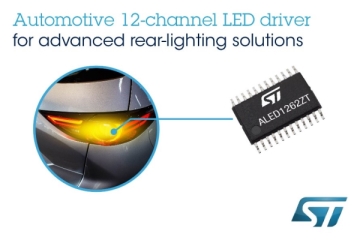
ST Launches 12-Channel LED Driver for Automotive Lighting
ST Microelectronics has launched the ALED1262ZT, a 12-channel LED driver for automotive rear combination lamps and interior lighting. The ALED1262ZT provides independent 7-bit PWM dimming functionality on all channels, enabling various lighting effects for tail lights, brake lights, and turn signals. Each channel supplies a constant output current at 19V to control multiple LED series strings. With adjustable output ranging from 6 to 60mA, it ensures maximum brightness along with a wide dimming range.
2019.10.11by 최인영 기자
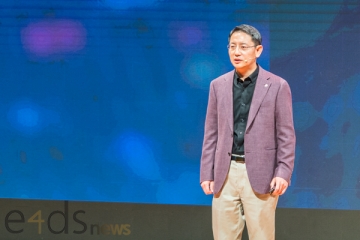
Why the Electronics Industry Is Focusing on the Mobility Market!
Automobiles are now undergoing transformation into connected, autonomous, shared, and electric vehicles. This transformation is not a future prospect but a present reality. The 50th Korea Electronics Show 2019, held over four days from October 8th to 11th, provided an opportunity to observe and examine the current state and prospects of Korea's advanced electronics industry. LG Electronics Center Director Lee Sang-yong, who delivered the keynote address at this year's Korea Electronics Show, discussed the current state of the changing automotive industry and the direction Korea should pursue, with the theme "Industry Trends and Evolution Direction According to Changes in Mobility."
2019.10.14by 이수민 기자
AVCC, a consortium developing an autonomous driving computing platform, has been launched.
Arm has announced the launch of AVCC, a global cooperative body for implementing fully autonomous vehicles. AVCC is an autonomous computing technology consortium composed of leading companies across various industries including automotive, automotive components, semiconductors, and computing. Initial members include Arm, Bosch, Continental AG, Denso, GM, Nvidia, NXP, and Toyota, with many additional companies joining the consortium. AVCC members plan to address key challenges encountered in implementing large-scale autonomous vehicles through collaborative efforts.
2019.10.15by 최인영 기자
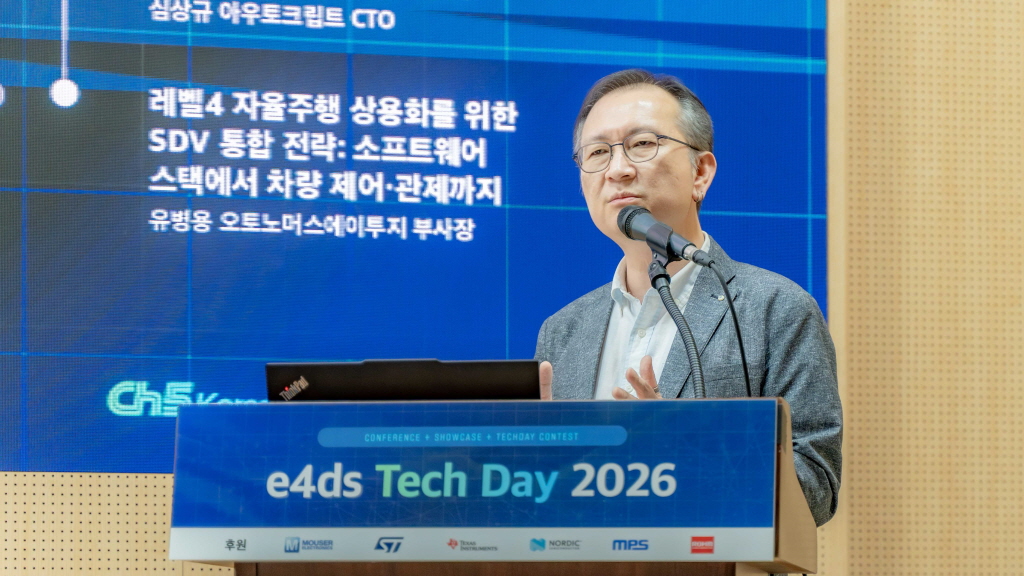
[e4ds Tech Day 2026 ⑨] Sim Sang-gyu, Autocrypt CTO: "In the Physical AI Era, Automotive Security Must Extend Beyond the Vehicle"
At e4ds Tech Day 2026, Sim Sang-gyu, CTO of Autocrypt, explained automotive cybersecurity strategies in the era of Physical AI and SDV (Software-Defined Vehicle). Automobiles are evolving as part of an ecosystem connected to AI, cloud, chargers, IoT, and robots, and he emphasized that the scope of security must expand beyond the vehicle interior to the entire connected environment. In particular, AI model tampering, adversarial attacks, OTA updates, and EV charger hacking were identified as major threats. He explained that response measures require zero trust, AI model integrity protection, intrusion detection, Security by Design and Default, and full lifecycle security management, and that proactive security system establishment beyond regulatory compliance is critical for securing future mobility competitiveness.
2026.10.12by 배종인 기자

Practical HIL Construction Strategy for Automotive and Off-Highway Controller Validation
As vehicle E/E architecture transitions to zonal structures and shifts to software-defined vehicles (SDV), the number of controllers (ECUs) requiring validation and software complexity are surging dramatically. Meanwhile, real vehicle testing cannot provide repeated verification under identical conditions and entails lead time and safety concerns. This white paper explains the principles of HIL (Hardware-in-the-Loop) validation and the structure of the NI platform composed of PXI, SLSC, and VeriStand, and through two actual implementation cases—Camera Record & Replay HIL for In-Cabin Monitoring Controller (ICMU) and Forklift Controller (VCU) HILS—describes how controller-level regression testing becomes possible. Additionally, it explicitly states application boundaries and limitations, such as lack of A2B support.
2026.10.12by 편집부











