



NI Announces Wi-Fi 6 Frontend Test Reference Architecture
 Published2019.10.17 07:01
Wi-Fi 6 PA/FEM Test Reference Architecture Announced
Extending VST bandwidth, accuracy, and measurement speed
On the 16th, National Instruments (NI) announced a Wi-Fi 6 front-end test reference architecture for testing Wi-Fi 6 Power Amplifiers (PAs) and Front-End Modules (FEMs) operating in frequency bands above 6 GHz.
.jpg)
(Image = National Instruments)
The NI Wi-Fi 6 Frontend Test Reference Architecture integrates RF signal generators up to 12 GHz and RF signal analyzers with an instantaneous bandwidth of 1 GHz to extend Wi-Fi test coverage to a new band between 6 and 7.125 GHz. This extends the high bandwidth, accuracy, and fast measurement speeds of the Vector Signal Transceiver (VST).
The new solution provides excellent linearity, low noise, and high dynamic range during PA/FEM characterization and verification to verify the performance of Wi-Fi 6 1024-QAM. In addition, dynamic EVM measurement was simplified while the speed of FPGA-based power level measurement was increased.
"VST's wide frequency range and large instantaneous bandwidth are important for delivering stable data across the entire Wi-Fi frequency band in a short time while embracing new bandwidths," said Stefanie Breyer, Vice President of Product Planning at NI. "By selecting NI's software-defined platform-based testers, you can respond to the latest wireless communication standards."
Comments
Related news
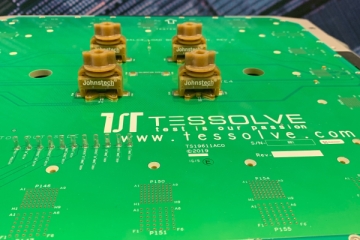
National Instruments, Tesolve, and JonesTech have jointly developed a quad-site mmWave 5G package test solution.
National Instruments (NI), Tessolve, and JonsTech jointly unveiled a quad-site mmWave 5G package test solution. One of the key components of the mmWave 5G package test solution is NI's semiconductor test system. NI recently added multisite mmWave test capabilities for 5G power amplifiers, beamformers, and transceivers. The solution is characterized by modularity featuring reusable software with a modular mmWave radio head and baseband/IF instrumentation, which is also a strength, enabling it to handle additional mmWave frequency bands in the future.
2019.06.13by 이수민 기자
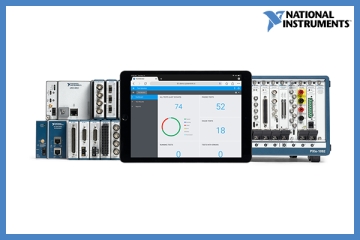
NI Unveils New Version of SystemLink for Distributed System Management
National Instruments (NI) has released the latest version of SystemLink software, a solution for distributed system management. SystemLink is a platform developed for engineers who need to manage differences between systems as distributed systems expand and data grows exponentially. Engineers can improve operational efficiency by using SystemLink's single interface to rapidly configure and manage multiple facilities, test bench software, tests, and equipment. The latest version released this time includes a new Asset module. Through this new module, users can centrally manage test data such as equipment usage history and calibration data, and can quickly check relevant data through a new type of dashboard.
2019.06.28by 이수민 기자

Three 5G NR Challenges That Can Be Solved Right Now
Korea's 5G is preparing for a step-by-step upgrade to meet market demands. This represents a leap from the 3.5GHz frequency band, known as 4.5G since its initial launch in 2018, to true 5G via 28GHz. By simultaneously utilizing the 3.5GHz band and existing LTE networks to bring the entire nation within 5G coverage, the NSA (Non Stand Alone) designation is expected to be removed after 2020. However, the introduction of 28GHz is adding further challenges to the already complex 5G development landscape, placing additional tasks before development engineers. This technical article addresses the challenges of 5G New Radio as presented by Keysight and discusses methods for resolving the current issues at hand.
2019.10.07by 명세환 기자
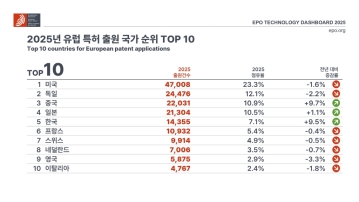
European Patent Applications Surpass 200,000 for the First Time… South Korea Maintains 5th Place, Led by Batteries and Telecommunications
According to the European Patent Office (EPO)'s 'Technology Dashboard 2025', European patent applications last year reached 201,974, surpassing 200,000 for the first time. Korean companies and inventors filed 14,355 applications, representing a 9.5% increase from the previous year and maintaining 5th place by country. Battery, digital communication, and semiconductor technologies led the growth, with Samsung ranking as the top EPO applicant for the second consecutive year and LG reaching 3rd place. The presence of major domestic cities such as Seoul, Suwon, and Yongin was also confirmed. It was also revealed that Korea's European patent strategy is expanding beyond individual technologies to span the entire industry.
2026.03.24by 명세환 기자

SK Telecom First Applies AI-Based Network Operations at Gwanghwamun K-Pop Concert
SK Telecom announced that it applied an AI-based network operation system for the first time at a large-scale K-pop concert held in the Gwanghwamun area of Seoul on March 21st, managing communication quality throughout the event. Mobile data usage during the three hours before and after the concert reached 12.15TB, approximately doubling compared to the same time slot the previous weekend. SK Telecom monitored traffic using the AI system 'A-One' in five-minute and 50-meter units to respond to potential overload situations, while also operating temporary communication facilities and on-site personnel in parallel. This case is interpreted as confirmation of the practical applicability of AI-based autonomous network operation in an environment where demand from dense events and foreign users increases simultaneously.
2026.03.23by 명세환 기자











