



U+ to Build 5G MEC-Based Telepresence Service
 Published2019.11.04 10:39
U+ builds MEC and integrates AI algorithms.
DoubleMe creates holograms with a single 3D camera.
Now you can conduct remote meetings while seeing each other's faces.
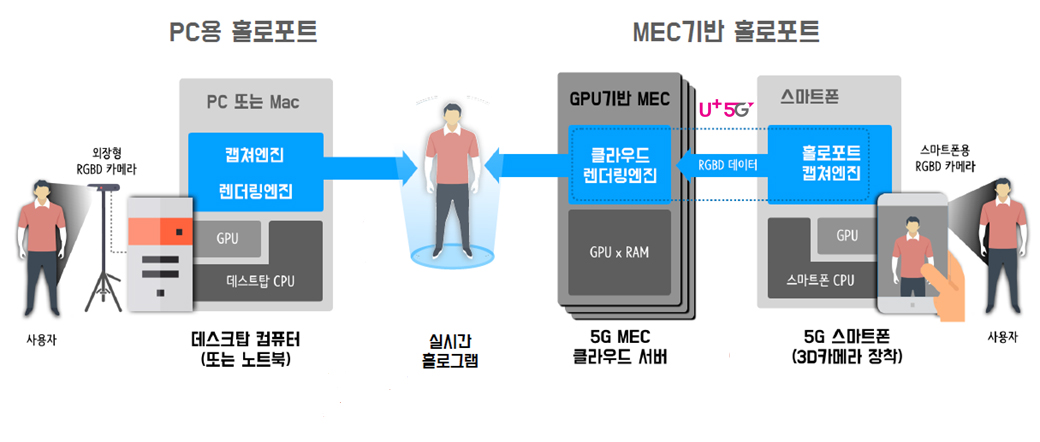
(Image = LG U+)
LG Uplus announced on the 4th that it will jointly develop 5G-based real-time telepresence technology with hologram content production company DoubleMe.
Telepresence is a technology that allows people in remote locations to appear as if they were present in the same space, using hologram-like VR. For example, it allows employees in rural areas to be brought in as holograms and hold remote meetings with colleagues in Seoul.
To implement telepresence, LG U+ plans to build a Mobile Edge Computing (MEC) network that processes data on servers installed close to users. This will enable real-time delivery of high-capacity 3D holographic content, requiring data transmission and processing of approximately 20 MB per second. AI algorithms that enhance the quality of holographic content will also be implemented on MEC and utilized as computing resources.
DoubleMe offers Holoport, a technology that can create real-time holograms with a single 3D camera. Holoport uses AI to infer the subject's movements through machine learning, automatically supplementing the image with areas not captured by the camera.
LG Uplus’s Managing Director of Future Technology Development Group, Lee Hae-seong, said, “As 3D cameras for smartphones become more widespread, telepresence technology will receive even more attention,” and added, “We will collaborate with DoubleMe to discover various business models based on telepresence, such as remote conferencing, remote treatment, and remote education.”
DoubleMe CEO Kim Hee-kwan said, “We expect that our collaboration with LG U+ will accelerate the popularization of holograms,” adding, “In addition to B2B, the potential for expanding the use of holograms in areas such as entertainment and sports is limitless.”
Meanwhile, according to Global Industry Analysts (GIA), the domestic hologram market is expected to grow from approximately KRW 900 billion in 2020 to KRW 1.5 trillion in 2025.
Comments
Related news
Ansys and Autodesk Partner to Enhance Automotive Lighting Simulation
Automotive OEMs worldwide must respond to customer demands for increasingly personalized solutions while innovating technology and adapting to rapidly changing regulatory environments. Ansys announced a collaboration with Autodesk, a design and manufacturing software supplier, to address this need. The collaboration was established to enable automotive OEMs to combine visual design review and regulatory compliance verification in a connected workflow. The Ansys Automotive workflow uses Ansys lighting simulation together with Autodesk VRED to provide physically accurate interior and exterior lighting simulation to the design studio.
2019.09.25by 이수민 기자
LG Uplus Demonstrates Voice-Controlled 5G Drone… Real-time FHD Video Transmission Also Capable
LG U+ unveiled the 5G U+ Smart Drone equipped with AI voice recognition and real-time FHD video transmission technology during a public demonstration in Baegot New City. Officials from the Siheung Police Station controlled the drone, which moves at a maximum altitude of 50m and speed of 36km/h, using voice commands through a smartphone app. The high-definition real-time video transmission technology via the drone's camera was also demonstrated. Using a 5G-based joystick, the camera was operated in real-time with left, right, up, and down movements, and through zoom in/out functions, text on a business card-sized object on the ground was displayed. The demonstration was conducted jointly with Usys, Celvas AI, and Ubivellox Mobile.
2019.10.22by 이수민 기자

Busan Port to Evolve into a 5G Smart Port Starting End of This Year
LG Uplus, Busan Port Authority, Dongbu Busan Container Terminal, Seoho Electric, and Advanced Institute of Technology have concluded a Memorandum of Understanding for '5G-based Smart Port Crane Automation Business Cooperation.' Through this MOU, each participating organization plans to collaborate on the development of remote control and automation systems for port cranes utilizing 5G communication, ultra-low latency video transmission solutions based on 5G communication for remote control of port cranes, and additional business cooperation leveraging mobile communication networks in the smart port sector.
2019.11.03by 이수민 기자
European Patent Applications Surpass 200,000 for the First Time… South Korea Maintains 5th Place, Led by Batteries and Telecommunications
According to the European Patent Office (EPO)'s 'Technology Dashboard 2025', European patent applications last year reached 201,974, surpassing 200,000 for the first time. Korean companies and inventors filed 14,355 applications, representing a 9.5% increase from the previous year and maintaining 5th place by country. Battery, digital communication, and semiconductor technologies led the growth, with Samsung ranking as the top EPO applicant for the second consecutive year and LG reaching 3rd place. The presence of major domestic cities such as Seoul, Suwon, and Yongin was also confirmed. It was also revealed that Korea's European patent strategy is expanding beyond individual technologies to span the entire industry.
2026.03.24by 명세환 기자

SK Telecom First Applies AI-Based Network Operations at Gwanghwamun K-Pop Concert
SK Telecom announced that it applied an AI-based network operation system for the first time at a large-scale K-pop concert held in the Gwanghwamun area of Seoul on March 21st, managing communication quality throughout the event. Mobile data usage during the three hours before and after the concert reached 12.15TB, approximately doubling compared to the same time slot the previous weekend. SK Telecom monitored traffic using the AI system 'A-One' in five-minute and 50-meter units to respond to potential overload situations, while also operating temporary communication facilities and on-site personnel in parallel. This case is interpreted as confirmation of the practical applicability of AI-based autonomous network operation in an environment where demand from dense events and foreign users increases simultaneously.
2026.03.23by 명세환 기자











