


U+ succeeds in demonstrating interoperability of heterogeneous equipment based on 5G SA
 Published2019.11.05 13:31
Network slicing with modular core equipment
MEC implementation that maintains minimal latency based on location
Is the day not far off when 5G will escape the criticism that it is merely 4.5G?
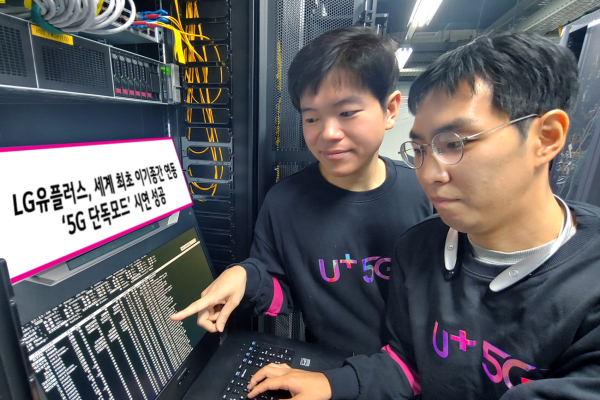
LG Uplus announced on the 3rd that it successfully demonstrated a 5G service by linking core equipment, base station equipment, and auxiliary equipment made by different equipment companies based on the 5G Standalone (SA) standard.
While there have been successful interoperability tests between SA-based base stations and core equipment from the same manufacturer, this is the first time that equipment from different manufacturers, such as Samsung Electronics and Ericsson, has been interconnected.
Along with this, they also succeeded in demonstrating network slicing and Mobile Edge Computing (MEC), which are core technologies of 5G.
LG Uplus has succeeded in implementing network slicing technology through container-based modularized core equipment.
Container technology is a technology that virtualizes an operating system (OS) for software application development. Many manufacturers are adopting this technology because it allows for rapid combination and application by modularizing software into functional units.
MEC is a core technology that achieves ultra-low latency by separating only the data processing unit from the signaling and data processing units of core equipment and distributing them to locations adjacent to customers.
While there have been cases of building edge clouds based on 5G Non-Standalone (NSA) standards, a drawback has been pointed out that latency increases because core equipment handling traffic cannot be changed when the customer's location changes.
The MEC demonstrated this time separates the signaling and data processing units, allowing only the data processing units to be distributed to areas adjacent to customers, thereby minimizing latency.
It was also confirmed that by applying network connection latency reduction technology introduced in SA base station equipment, latency can be significantly reduced compared to edge cloud based on the 5G NSA standard.
An LG Uplus official stated that another feature is the ability to process traffic generated from base stations equipped with upload speed enhancement technology at adjacent core equipment, enabling the provision of the quality required for services such as smart factories that demand ultra-high-speed networks.
The newly applied base station network connection time reduction technology has improved the initial network connection time by 2 to 4 times compared to the existing one.
In 5G SA, the network connection of a terminal is handled exclusively by the 5G base station, thereby reducing the time required for information exchange between LTE and 5G base stations that was previously required in NSA, where initial network connection was made through the LTE network.
In addition, while NSA used only one antenna for data transmission to utilize 5G and LTE networks simultaneously, 5G SA is implemented to use two antennas, boosting upload speeds by up to two times.It suited him.
LG Uplus plans to improve the quality of the 5G SA technology verified through this demonstration and proceed with commercialization next year.
Park Song-cheol, Head of the Network Development Group at LG Uplus, stated, “We have secured additional technologies necessary for the 5G SA network to lay the foundation for providing a wider range of services,” adding, “We will thoroughly prepare for commercialization to ensure that no quality issues arise.”
Comments
Related news
Ericsson and SKT Sign MOU to Improve Cloud-Native 5G SA Core Network Technology
With the rapid adoption of 5G networks and services and the increase in data traffic, telecommunications operators need to build more agile and programmable 5G core networks for efficient and automated network operations. Accordingly, Ericsson and SK Telecom have signed a memorandum of understanding to jointly promote technical improvements across a wide range of areas including technology, architecture, implementation, and operations of next-generation 5G SA core networks. This agreement focused on performance improvement and optimization through cloud-native microservices.
2019.03.25by 이수민 기자
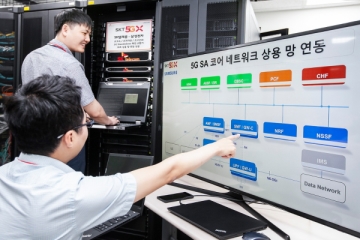
SKT and Samsung Electronics Take First Step Toward Commercialization of 5G SA Service
SK Telecom announced that it has successfully achieved data communication using a pure 5G system by interconnecting a 5G SA packet switch, which is Korea's first 5G standalone standard equipment, and core equipment together with Samsung Electronics. A packet switch is an essential gateway through which all voice and data traffic generated from mobile devices such as smartphones must pass in order to access the internet network. The current 5G network operates in NSA mode, which partially shares equipment with LTE. 5G SA, which configures the network with 5G equipment only, requires significant time, cost, and resources for standardization and development. The 5G SA presented this time demonstrates data processing efficiency three times higher compared to the existing 5G NSA. It can efficiently control large-scale traffic and provide optimal communication performance for next-generation services expected in the 5G era, such as AR/VR, autonomous driving, smart factories, and smart farms.
2019.07.06by 이수민 기자

U+ to Build 5G MEC-Based Telepresence Service
Telepresence is a technology that implements people located at a distance as holograms or VR as if they were in the same space. LG U+ announced that it will jointly develop 5G-based real-time telepresence technology with Doublemi, a hologram content production company. To implement telepresence, LG U+ plans to build an MEC network that processes data from users and servers installed in close proximity. Doublemi provides Holoport, a technology that can generate real-time holograms with a single 3D camera.
2019.11.04by 최인영 기자
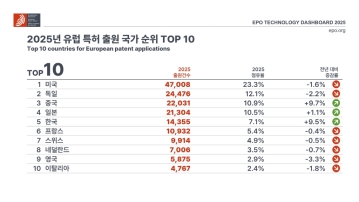
European Patent Applications Surpass 200,000 for the First Time… South Korea Maintains 5th Place, Led by Batteries and Telecommunications
According to the European Patent Office (EPO)'s 'Technology Dashboard 2025', European patent applications last year reached 201,974, surpassing 200,000 for the first time. Korean companies and inventors filed 14,355 applications, representing a 9.5% increase from the previous year and maintaining 5th place by country. Battery, digital communication, and semiconductor technologies led the growth, with Samsung ranking as the top EPO applicant for the second consecutive year and LG reaching 3rd place. The presence of major domestic cities such as Seoul, Suwon, and Yongin was also confirmed. It was also revealed that Korea's European patent strategy is expanding beyond individual technologies to span the entire industry.
2026.03.24by 명세환 기자

SK Telecom First Applies AI-Based Network Operations at Gwanghwamun K-Pop Concert
SK Telecom announced that it applied an AI-based network operation system for the first time at a large-scale K-pop concert held in the Gwanghwamun area of Seoul on March 21st, managing communication quality throughout the event. Mobile data usage during the three hours before and after the concert reached 12.15TB, approximately doubling compared to the same time slot the previous weekend. SK Telecom monitored traffic using the AI system 'A-One' in five-minute and 50-meter units to respond to potential overload situations, while also operating temporary communication facilities and on-site personnel in parallel. This case is interpreted as confirmation of the practical applicability of AI-based autonomous network operation in an environment where demand from dense events and foreign users increases simultaneously.
2026.03.23by 명세환 기자











