


Kionix Develops Accelerometer with Built-in Noise Filtering
 Published2019.11.05 14:23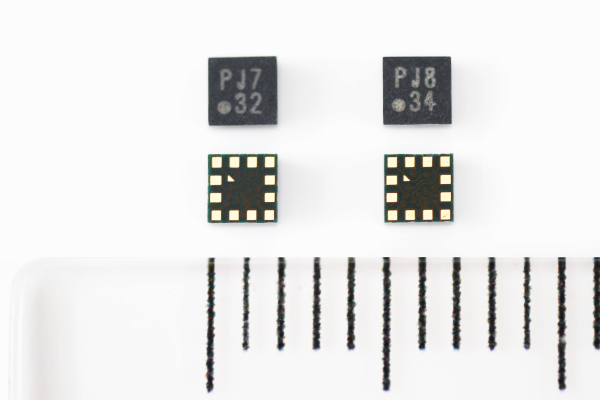
(Photo by ROHM Semiconductor)
On the 5th, KIONICS of ROHM Group announced that it has developed the 3-axis accelerometer sensors 'KX132-1211' and 'KX134-1211' suitable for applications requiring low-power, high-precision motion sensing.
Equipped with KIONIX's proprietary ADP (Advanced Data Path) function, the KX132-1211 and KX134-1211 can independently perform sensor signal processing and noise filtering that were previously handled by the MCU.
.jpg)
This lowers the load on the MCU and leads to reduced power consumption and improved performance in applications.
The KX132-1211 has a maximum frequency band of 4,200Hz and accelerationIt can detect degrees (g) in the range of ±2g to ±16g. The higher-end product, KX134-1211, can detect a maximum frequency band of 8,500Hz and acceleration (g) in the range of ±8g to ±64g.
While the operating temperature of existing products is up to 85℃, the new product provides normal operation even at 105℃. Therefore, it is suitable for machine health monitoring, such as motor vibration analysis, in industrial equipment.
The current consumption is as low as 0.67µA in low consumption mode, and it is equipped with a Wake Up function and a Back to Sleep function, so it supports sensing of battery-powered devices such as wearable devices.
Meanwhile, mass production of the two products began this September with a production capacity of 100,000 units per month.
Comments 1
1 Comments:
Related news
ROHM Launches SiC MOSFET in TO-247-4L Package
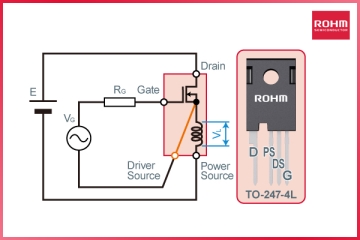
Rohm has launched six types of 650/1200V SiC MOSFETs with trench gate structure (SCT3xxx xR series) suitable for high-efficiency server power supplies, solar inverters, and electric vehicle charging stations. The SCT3xxx xR series adopts a TO-247-4L package. The conventional TO-247N package experienced gate voltage drop due to inductance components in the source terminal, which delayed switching speed. In contrast, the TO-247-4L allows separation of the power source terminal and driver source terminal, which suppresses the effects of inductance components. In particular, turn-on losses have been improved. Considering both turn-on and turn-off losses combined, approximately 35% loss reduction compared to existing products is achievable.
2019.09.19by 이수민 기자
ROHM Announces Automotive Comparator with High EMI Withstand
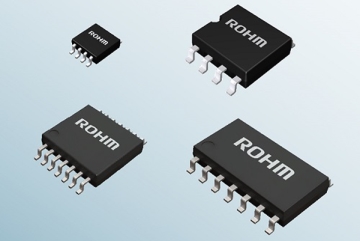
As electronization and high-density implementation advance in automotive systems, the noise environment is deteriorating. In response, Rohm announced the development of the BA8290xYxxx-C series ground sense comparator for automotive systems. The BA8290xYxxx-C series, consisting of BA82903YF-C, BA82903YFVM-C, BA82901YF-C, and BA82901YFV-C, is a comparator used for threshold determination of sensor output signals and similar applications. The BA8290xYxxx-C series has achieved EMI noise immunity of ±1% or less output voltage fluctuation across all noise frequency bands in the noise evaluation test of the international standard ISO11452-2.
2019.10.11by 이수민 기자

What smart factory sensor technologies should we pay attention to now?
Germany's Industry 4.0, defined by the German government for the revival of German manufacturing, pursues mass production of diverse product types, unlike the heavy and rigid Industry 3.0, through modular processes, variable and flexible equipment, autonomous and distributed control, wireless communication, and real-time location tracking. To realize Industry 4.0, sensors mounted on each piece of equipment in smart factories are trending toward transformation into MEMS that integrate sensing elements and sensor SoCs equipped with intelligent algorithms, moving away from board-form implementations.
2019.10.21by 이수민 기자

Intel Unveils Next-Generation 'Core Ultra Series 3' and vPro Platform for Enterprise PCs
Intel has officially unveiled the "Intel Core Ultra Series 3" for next-generation enterprise PCs and the latest vPro platform, addressing a wide range of demands from enterprise notebooks to high-performance workstations.
2026.03.26by 배종인 기자

ROHM Launches ESD Protection Diode Compatible with High-Speed Interfaces of 10Gbps or Higher
Semiconductor specialist ROHM has developed the 'RESDxVx series' of ESD (electrostatic discharge) protection diodes capable of responding to next-generation high-speed data communication environments exceeding 10Gbps, simultaneously enhancing both signal quality maintenance required in high-speed interfaces and IC protection performance.
2026.03.26by 배종인 기자












좋은 정보 감사합니다