



[Joint Reporting] Semiconductor Industry Turnaround: Focus on OT Infrastructure and Edge Computing in 2020
 Published2019.11.26 17:08
5G 통신 사업 확대와 AI, IoT 기술 활용증가에 따라 2020년 반도체 산업은 호황을 맞을 전망이다. 여의도 증권가에서는 2020년 주도주로 이구동성 ‘반도체주’를 꼽았다.
▲ 2019년 3분기 DRAM 매출액 증가세 전환과 삼성전자의 시장증가율 확대는 2020년 반도체 시장에 낙관적 요인으로 작용할 전망이다.
지난 2018년 페이스북, 아마존, 구글, 애플 등이 Cloud사업에 뛰어들며 메모리 수요가 폭발적으로 증가했지만 이후 메모리 구입에 대해 관조적인 자세를 보이며 반도체 재고량 적재를 불러왔다. 하지만 반도체 기업들이 수급조절을 암시하고 한일군사정보보호협정(GSOMIA) 연장 등에 대한 논의가 이뤄질 것으로 전망되며 반도체 업계가 주목받고 있다.
글로벌 시장조사업체 디램익스체인지가 발표한 2019년 3분기 세계 DRAM 반도체 매출 자료에 따르면 지난 3분기 국내 반도체 매출액은 154억 4,700만 달러(한화 약 18조원)로 2분기 148억 4,400만 달러 대비 4.1% 증가했다. DRAM 가격이 소폭 반등하고 삼성전자의 시장점유율이 높아지면서 지난 2018년 4분기부터 위축돼 오던 반도체 시장에 청신호를 알렸다.
디램익스체인지에 따르면 삼성전자의 3분기 DRAM 반도체 매출액은 71억 1,900만 달러(한화 약 8조 2,900억원), 시장점유율 46.1%로 지난 2017년 2분기 46.2% 이후 2년 만에 최고치를 기록했다. 이어 SK하이닉스가 28.6%, Micron이 19.9%를 차지하며 국내 반도체 기업의 위상을 입증했다.
5G, AI, IoT 등 스마트시티 구현을 위한 인프라스트럭처(infrastructure) 확장은 2020년에도 반도체 시장 호조세를 이끄는 요인으로 작용할 전망이다.
산업연구원이 지난 25일 발표한 ‘2020 경제·산업 전망 보고서’에 따르면 수출핵심품목에 해당하는 반도체가 공급과잉현상을 완화하며 수출증가세를 견인해 2019년 대비 수출금액은 2.5% 증가할 것으로 나타났다.
반도체 수출은 DRAM, Nand flash 등 메모리반도체 수요공급 밸런스 회복과 단가하락 진정, 5G 수요확대 등의 영향으로 2019년 대비 8.3% 증가할 것을 전망했다. 반도체 생산증가율은 통신·데이터처리용 전자기기 보급 확대에 따른 수요증가와 미세공정 전환의 영향으로 2019년 대비 약 10.3% 증가할 것으로 예측했다.
국내시장에서는 5G 통신 관련 반도체 수요 증가 및 특수목적용 반도체 수입 증가에 따라 2019년 대비 11.0% 증가할 것으로 예상했다.
ICT에서 OT로 변화하는 반도체 시장
IoT 구현을 위해 필요한 IT 기반은 이미 포화상태로 향후 IT업계는 OT가 이끌 것으로 전문가들은 예상하고 있다.
OT(Operational Technology)는 물리적 장치나 프로세스를 직접 모니터링·제어하는 방식을 통해 물리적 프로세스의 변경을 감지하거나 변경을 유발하는 하드웨어 및 소프트웨어를 이르는 말로 시스템의 물리적 상태를 하드웨어나 소프트웨어로 바꿔놓는 것을 의미한다.
IT 시장분석·컨설팅 기관인 IDC가 발표한 ‘반도체 애플리케이션 전망(Semiconductor Application Forecaster)’에 따르면 2018년부터 2023년까지 향후 5년간 CAGR(연평균 성장률)은 ▲ICT 69% ▲OT 31%로 ICT 분야는 10% 줄어든 반면 OT 분야는 10% 증가했다. OT 반도체 시장은 2023년까지 1,550억 달러의 매출이 예상되는 분야로 포화상태에 이른 PC와 모바일 분야를 대신해 성장성을 주목받고 있다.
AI, IoT 시장 증가세 견인
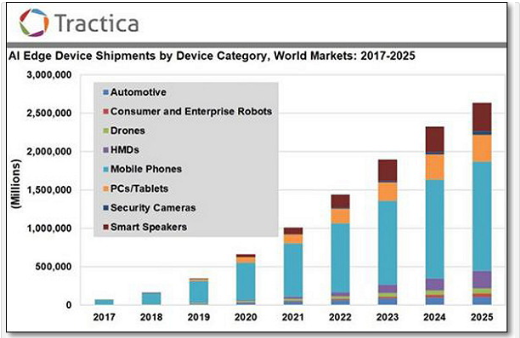
End Point 및 Edge Computing, Automotive 영역에서 AI기술 활용이 증가함에 따라 Cloud를 필요로 하는 반도체 시장 성장도 가속화될 전망이다.
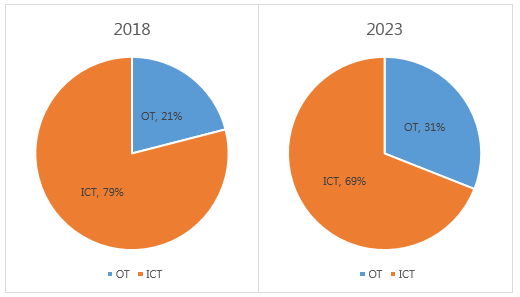
▲ 자료/IDC Semiconductor Application Forecaster, July 2019
모바일, 스마트 스피커, PC·태블릿, 헤드 마운트 디스플레이, 자동센서, 드론, 로봇, 보안카메라, 웨어러블 센서, 빌딩센서, 도심설비 전반 등에서 AI 구현을 위한 TPU2와 같은 칩 적용이 확대됨에 따라 반도체 시장은 2021년 상반기까지 성장세를 유지할 것으로 예상된다. 여기에 자율주행, 커넥티드카(connected car), 차량공유 등을 핵심으로 하는 Automotive 분야의 전장화도 반도체 수요 증가를 견인한다.
파운드리(Foundry) 시장점유율을 보면 대만의 TSMC(60%)와 삼성전자가 전체 MS의 70%를 차지하고 있다. 향후 메모리 시장은 Automotive, Industrial, Wireless 부문의 성장이 예상되는데 이는 메모리 시장의 변화에 따른 것으로 전문가들은 분석하고 있다.
1nm에 이르는 메모리 양산 기대
2020년부터 2023년까지 향후 4년간 메모리 기술은 2020년까지는 입지가 줄어들다가 2022년부터 7nm 반도체 시장을 중심으로 성장할 것으로 예측된다.
2020년 상반기 TSMC와 삼성전자가 5nm의 반도체 양산에 돌입한 후 2021년 TSMC와 삼성전자의 3nm 반도체 시장점유를 위한 각축전이 예상된다. 2023년에 이르러서는 1~3nm 크기의 반도체를 양산할 것으로 예상된다.
DRAM 하락폭↓· NAND 가격↑
2019년 상반기 DRAM 시장은 구글, 페이스북, 애플, 마이크로소프트 등 글로벌 기업의 메모리 구입 관망세의 영향으로 수요는 하락하고 재고량은 증가했다. 하반기에는 DRAM 수요가 서버(Server), 모바일(Mobile), PC순으로 변화하면서 수요 증가를 견인해 연말 기준 DRAM 재고는 정상수준(4~5주)을 회복하며 감소할 전망이다.
이후 2020년부터는 본격적인 수요공급 안정권에 접어들며 공급량은 감소하지만 자연적인 수요 증가에 따라 업계 전망은 밝을 것으로 기대된다.
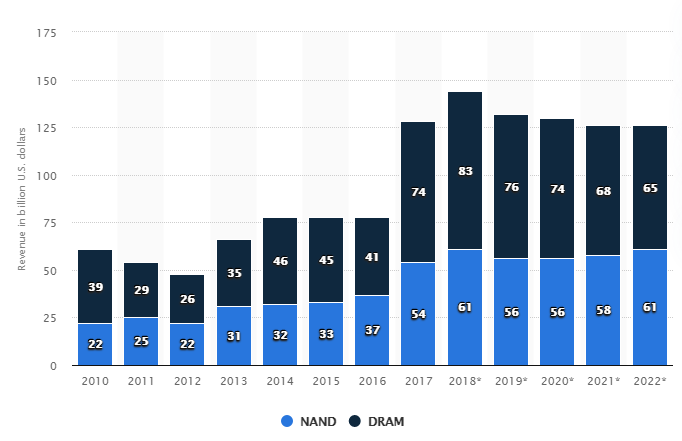
▲ 자료/Arne Holst, Jul 22, 2019
2020년 1분기에는 삼성전자와 하이닉스가 기존 DRAM 라인을 CIS 라인으로 전환하고 3분기에는 Micron이 신규공장 건설에 집중할 예정이다.
또한 5G 산업 성장이 안정권에 접어들며 4분기에는 모바일과 서버의 DRAM 탑재량이 크게 늘어나면서 수요·공급밸런스를 유지할 전망이다. 이에 따라 DRAM 공급량은 줄어드는 반면 기존 사이클로의 복귀가 가능해질 전망이다.
NAND 시장의 경우 2019년 TOSHIBA 메모리 공장의 정전사건에 따른 공급감소로 Cost Cover를 위한 일시적 가격 상승이 일어났다. 하지만 2020년에는 3분기까지 가격상승에 따른 수익성 개선이 큰 폭으로 나타나며 4분기에는 수익성 안정권에 진입할 예정이다.
삼성전자와 SK하이닉스는 상반기에 각각 시안2공장과 M15 공장을 초기 가동할 계획으로 공급부족에 따른 가격상승이 예상된다. 하반기에는 업체별 신규 공장 장비 투자 가속화에 따라 NAND 공급과잉이 다시 일어날 전망이지만 수요의 계절적 성수기와 업계 내 유통 재고 증가가 일정부분 진행될 때까지 가격 안정세가 나타날 것으로 예측된다.
경쟁에서 인수합병으로…반도체 2023년까지 호조세 지속
최근 반도체 업계에서는 인수합병(M&A)이 활발하게 일어나고 있다. 실제로 Broadcom이 Symantec과 CA테크놀로지를 각각 1조 3,000억 달러, 189억 달러에 인수했으며 Renesas가 IDT를 63억 달러에, NVIDIA가 Mellanox를 69억 달러에 인수했다.
과거 상호 경쟁하던 방식에서 사들이는 방향으로 전략을 바꾼 것이다. 여기에 5G와 AI 산업의 급성장, Automotive 시장의 확대가 반도체 시장 호황을 이끌어 갈 전망이다.
특히 14억 인구를 가진 중국이 2022년 베이징 동계올림픽을 계기로 미중 무역분쟁 장기화로 주춤했던 5G 보급사업에 속도를 낼 경우 반도체 수요는 폭발적으로 증가할 것으로 기대된다.
Comments
Related news
Fabless, Now Available with EDA Tools at 1% of Purchase Cost
EDA tools are essential for fabless companies, but with a price tag of 100 to 200 million won per tool, they represent a significant burden for small and medium-sized fabless companies and startups. Fabless companies typically use approximately 10 different EDA tools, and roughly 80% of semiconductor development costs are allocated to EDA tools and prototype manufacturing. The Ministry of Science and ICT has allocated 4.6 billion won from a supplementary budget to support joint utilization of EDA tools for fabless companies. Usage fees have been set at approximately 1% of the cost of individual purchases, and for startups within three years of establishment, fees have been set at approximately 0.1% of individual purchase costs, with preferential access planned to be granted to these companies.
2019.10.22by 이수민 기자
The reality and breakthrough of the Korean semiconductor industry, the answer is the memory gap and next-generation semiconductor development
Korea maintains a strong position in the memory semiconductor market. However, the memory semiconductor market accounts for only 30.7% of the overall semiconductor market. As the need to expand into the non-memory semiconductor market becomes urgent, China's pursuit is intensifying. Korea must now research and develop next-generation memory to secure market leadership.
2019.11.18by 이수민 기자
What is the future of the semiconductor industry amidst the 5G and AI competition?
Semiconductor demand is rapidly surging in areas such as 5G, AI, IoT, robots, and autonomous vehicles. China, led by Huawei, is experiencing swift growth. Although the United States is applying comprehensive pressure on China, the Chinese semiconductor industry continues to expand. Samsung Electronics is working to expand its foundry and system LSI market share in order to leap to the position of the leading non-memory semiconductor company by 2030.
2019.11.19by 최인영 기자

Intel Unveils Next-Generation 'Core Ultra Series 3' and vPro Platform for Enterprise PCs
Intel has officially unveiled the "Intel Core Ultra Series 3" for next-generation enterprise PCs and the latest vPro platform, addressing a wide range of demands from enterprise notebooks to high-performance workstations.
2026.03.26by 배종인 기자

ROHM Launches ESD Protection Diode Compatible with High-Speed Interfaces of 10Gbps or Higher
Semiconductor specialist ROHM has developed the 'RESDxVx series' of ESD (electrostatic discharge) protection diodes capable of responding to next-generation high-speed data communication environments exceeding 10Gbps, simultaneously enhancing both signal quality maintenance required in high-speed interfaces and IC protection performance.
2026.03.26by 배종인 기자











