



400Mbps communication speed achieved with next-generation satellite communication 'beam hopping'
 Published2019.12.04 10:46
Consists of a transceiver the size of a video set-top box
Communication data capacity and transmission speed increased by 15% and 20% respectively compared to existing levels
Domestic researchers have succeeded in developing a technology that actively sends satellite signals to where they are needed, making it possible to improve communication efficiency.
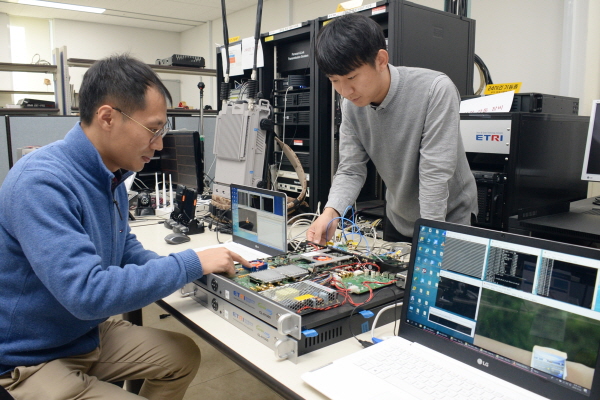
▲ ETRI researchers are testing a satellite communication transmission and reception model. <Photo = ETRI>
The Electronics and Telecommunications Research Institute (ETRI) announced on the 3rd that it has developed a satellite communication modem utilizing Beam Hopping Satellite System technology, which can variably allocate satellite resources according to recent demand.
The newly developed satellite communication transceiver model is scheduled to be applied to the beam-hopping satellite communication currently being developed for the first time in the world by France's Eutelsat.
In the case of existing fixed-satellite communication technology, communication efficiency was low because satellite resources were allocated fixedly to specific regions, requiring the same signals to be sent even to vast oceans or airspace where there is almost no communication demand, and additional resources could not be allocated even to areas with high traffic.
With the development of technology that allows the utilization of satellite resources to meet user demand, it has become possible to send signals only to locations where essential ships and aircraft are situated, even across vast areas. It has become possible to increase communication speeds and reduce the problem of high satellite communication band costs.
To apply this technology, the research team conducted a technology verification test last October at the Rambouillet Teleport in France using a satellite emulator from the Fraunhofer Institute in Germany, which was configured with the same communication environment as a beam-hopping satellite.
As a result of the test, from a service perspective, communication data capacity and distribution efficiency increased by up to 15% and 20%, respectively, compared to existing technology, and communication speed recorded a maximum of 400Mbps per beam. Currently, the maximum speed in the same frequency band is around 150 Mbps, but with the application of this technology, more than 100 users will be able to receive HD video streaming simultaneously on an airplane.
A modem consisting of a transceiver the size of a video set-top box is expected to be used as a communication device and for verifying the functions of a satellite scheduled for launch in the first half of 2020.
The core of a modem is network synchronization technology, which synchronizes signals between satellite and ground gateway stations as satellite signals change, and variable data transmission technology, which dynamically changes and transmits data according to user requirements.
ETRI plans to improve network synchronization technology and develop high-speed modems to increase the current speed from 400 Mbps to 1 Gbps, and transfer the technology to overseas and domestic satellite communication equipment manufacturers.
To this end, ETRI is conducting research on network synchronization technology and technological advancement with the goal of commercialization by the launch of the beam-hopping satellite in 2020.
Yoo Jun-kyu, Head of the Satellite Wide Area Infrastructure Research Lab at ETRI, stated, “By developing next-generation beam-hopping satellite modem equipment, we will contribute to laying the foundation for Korea’s space industry,” adding, “We will focus on securing domestic beam-hopping satellites to prepare for the upcoming global telecommunications era.”
Meanwhile, this technology was developed as part of the Korea-France bilateral network project 'Joint Development of Ground Equipment for Korea-France Quantum Satellite Response,' which was jointly funded for three years starting in 2017 by the Ministry of Trade, Industry and Energy's Korea Institute for Industrial Technology Advancement (KIAT), France's Bpi Banque publique d'invesissement, and the French National Industrial Bank.
The project is led by Korea's ASAT and France's Eutelsat, and ETRI is supporting ASAT as a participating organization by developing network synchronization technology and forward link modem technology, which are core components of beam hopping technology.
Comments
Related news

Korea-Turkmenistan to Strengthen Cooperation in 5G Infrastructure and Satellite Sectors
The Ministry of Science and ICT held a ministerial meeting with Turkmenistan's Ministry of Industry and Communications. During the meeting, Korea shared its experience as the world's first to commercialize 5G and successful cases in satellite development, and both sides agreed to cooperate on ways Korea can contribute to Turkmenistan's advancement in mobile communications and space sectors. The meeting was conducted as a follow-up measure to the ICT MOU signed by the two ministers in the presence of both countries' leaders at Turkmenistan's Presidential Palace on the morning of the 17th.
2019.04.20by 이수민 기자
ETRI and the Three Major Mobile Carriers Push for International Standardization of Quantum Cryptography Transmission Systems
Quantum key distribution transmission systems are network security technologies that protect customer data transmission from hackers by combining quantum key distribution technology and optical transmission network technology based on SDN technology. Domestic telecommunications operators have been enhancing their technical capabilities for commercialization of quantum key distribution technology. However, to combine quantum key distribution systems and optical transmission systems composed of multiple units and commercialize them as universally applicable technology, international standardization work was necessary. Accordingly, ETRI held SDN/NFV forum and international standardization meetings on the 21st. Currently, ETRI and the three telecommunications operators are pursuing domestic proprietary standardization of quantum key distribution transmission systems to provide commercial quantum key distribution services, with plans to link with international standardization in the future.
2019.10.31by 이수민 기자
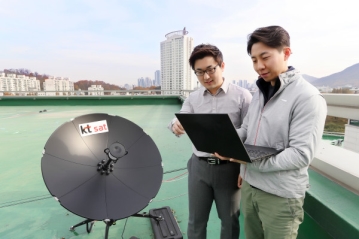
Satellite 5G Technology Enabling Data Communication Without Data Coverage Advances Further
KT SAT has successfully conducted the world's first satellite 5G-SAT technology test, enabling data transmission and reception by linking 5G networks with geostationary satellites. KT SAT, which has implemented satellite 5G hybrid transmission and 5G edge cloud media technology utilizing satellite communication backhaul links, has secured technology for normal data transmission and reception even without 5G network coverage.
2019.11.24by 최인영 기자
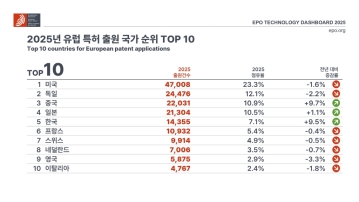
European Patent Applications Surpass 200,000 for the First Time… South Korea Maintains 5th Place, Led by Batteries and Telecommunications
According to the European Patent Office (EPO)'s 'Technology Dashboard 2025', European patent applications last year reached 201,974, surpassing 200,000 for the first time. Korean companies and inventors filed 14,355 applications, representing a 9.5% increase from the previous year and maintaining 5th place by country. Battery, digital communication, and semiconductor technologies led the growth, with Samsung ranking as the top EPO applicant for the second consecutive year and LG reaching 3rd place. The presence of major domestic cities such as Seoul, Suwon, and Yongin was also confirmed. It was also revealed that Korea's European patent strategy is expanding beyond individual technologies to span the entire industry.
2026.03.24by 명세환 기자

SK Telecom First Applies AI-Based Network Operations at Gwanghwamun K-Pop Concert
SK Telecom announced that it applied an AI-based network operation system for the first time at a large-scale K-pop concert held in the Gwanghwamun area of Seoul on March 21st, managing communication quality throughout the event. Mobile data usage during the three hours before and after the concert reached 12.15TB, approximately doubling compared to the same time slot the previous weekend. SK Telecom monitored traffic using the AI system 'A-One' in five-minute and 50-meter units to respond to potential overload situations, while also operating temporary communication facilities and on-site personnel in parallel. This case is interpreted as confirmation of the practical applicability of AI-based autonomous network operation in an environment where demand from dense events and foreign users increases simultaneously.
2026.03.23by 명세환 기자











