


Commercialization of next-generation micro LED roll transfer technology is underway.
 Published2019.12.19 17:55
Development by Kim Jae-hyun, Director of the Korea Institute of Machinery and Materials
Establishment of YTS, a research institute for commercialization
Micro LED roll transfer technology, which will improve the productivity of Micro LED (Micro Light Emitting Diode) displays, which are attracting attention as the next-generation display following OLED, is being commercialized.
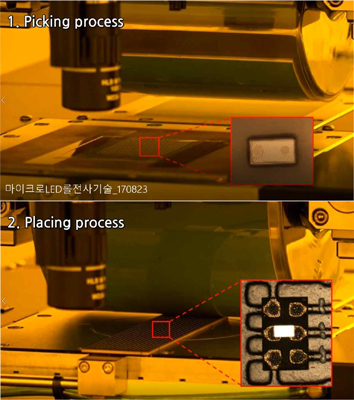
The Ministry of Science and ICT announced on the 19th that it established YTS Microtech, a research institute company for the commercialization of micro LED roll transfer technology developed by the research team of Kim Jae-hyun, Director of the Nano Applied Mechanics Laboratory at the Korea Institute of Machinery and Materials, and held a plaque ceremony.
Micro LEDs place a single-crystal inorganic micro LED in each pixel of the display, improving response speed and luminous efficiency compared to existing OLEDs. It has the advantage of having better luminous efficiency than OLED, lower power consumption, superior durability, and fewer restrictions on the substrate, so it can be manufactured on flexible rubber materials or transparent plastic materials.
Micro LED roll transfer technology is a technology for making micro LED panels by lifting micro LED elements on a temporary substrate using a roll stamp and then placing them on a desired location on a flexible circuit board.
In July 2017, the research team succeeded in developing a technology to produce micro LED displays with a panel size of 4 inches using roll transfer technology, but the transfer area was limited, making it difficult to apply to mass production processes.
However, this time, we successfully developed a metastructure—an artificial material with properties not found in nature—by arranging metaatoms smaller than the wavelength of light. By applying this to the roll transfer process, we were able to improve transfer yield and transfer area. As a result, we can expect a 100-1,000-fold increase in productivity compared to existing technologies.
The research team is currently reviewing technical specifications with various smart pad manufacturers to commercialize the developed technology, and plans to establish a research institute company to develop micro LED roll transfer equipment capable of transferring 10-inch smart pad panels at once and build a prototype mass production line.
Kim Jae-hyun, head of the Nano Applied Mechanics Lab at the Korea Institute of Machinery and Materials, said, “The establishment of the research institute company has provided an opportunity to pursue the production of application products and verification of mass production based on the highly productive micro LED roll transfer technology,” and added, “We will do our best to commercialize smart pads using micro LEDs so that they can be mass-produced and widely used.”
Comments
Related news
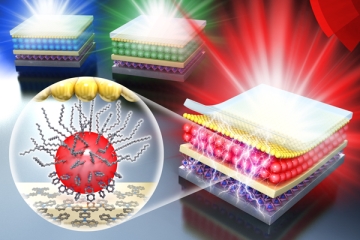
ETRI Improves QLED Efficiency with Quantum Dot Surface Substitution Technology
While OLED utilizes organic materials, QLED leverages semiconductors, specifically quantum dots, instead of organic materials. Through the development of QLED hole injection improvement technology, ETRI has developed core technology that can enhance the brightness, current, and power efficiency of QLEDs by modifying the molecular sieves that constitute the quantum dot surface. In the device that comprises a QLED display, electrons and holes injected from both electrodes meet at the quantum dots to emit light. However, while electrons move freely up and down, holes face difficulty in movement due to slower energy transfer between the electrode and quantum dots. This electron-hole imbalance problem degrades the performance of quantum dot light-emitting diodes and shortens the device lifespan, necessitating research to address this issue.
2019.04.17by 이수민 기자
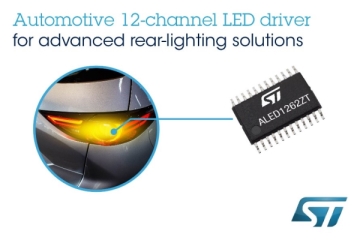
ST Launches 12-Channel LED Driver for Automotive Lighting
ST Microelectronics has launched the ALED1262ZT, a 12-channel LED driver for automotive rear combination lamps and interior lighting. The ALED1262ZT provides independent 7-bit PWM dimming functionality on all channels, enabling various lighting effects for tail lights, brake lights, and turn signals. Each channel supplies a constant output current at 19V to control multiple LED series strings. With adjustable output ranging from 6 to 60mA, it ensures maximum brightness along with a wide dimming range.
2019.10.11by 최인영 기자
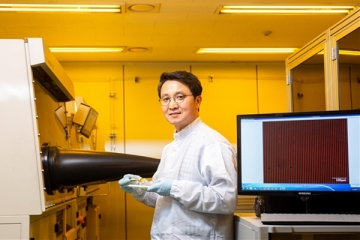
OLED displays for VR and AR are manufactured on glass substrates.
To implement vivid image quality in VR·AR device displays, PPI must be increased, and it must be proportionally improved as the display comes closer to the eyes. The Korea Institute of Science and Technology has successfully developed process technology capable of manufacturing VR·AR OLED pixels in RGB format on a glass substrate, achieving a resolution of 1,867 PPI.
2019.11.25by 이수민 기자
Intel Unveils Next-Generation 'Core Ultra Series 3' and vPro Platform for Enterprise PCs
Intel has officially unveiled the "Intel Core Ultra Series 3" for next-generation enterprise PCs and the latest vPro platform, addressing a wide range of demands from enterprise notebooks to high-performance workstations.
2026.03.26by 배종인 기자
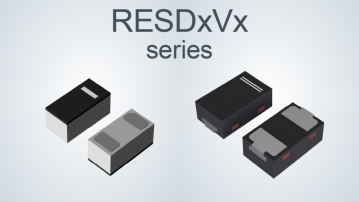
ROHM Launches ESD Protection Diode Compatible with High-Speed Interfaces of 10Gbps or Higher
Semiconductor specialist ROHM has developed the 'RESDxVx series' of ESD (electrostatic discharge) protection diodes capable of responding to next-generation high-speed data communication environments exceeding 10Gbps, simultaneously enhancing both signal quality maintenance required in high-speed interfaces and IC protection performance.
2026.03.26by 배종인 기자











