



'Quantum-resistant cryptography' technology that even quantum computers cannot crack is being developed
 Published2019.12.20 14:01
U+ Signs MOU with Seoul National University and Crypto Lab for Quantum-Resistant Cryptography
5G security to be enhanced using quantum-resistant cryptography
Post-Quantum Cryptography (PQC) is a cryptographic technology capable of countering security threats from quantum computers, utilizing encryption methods that employ difficult mathematical problems that cannot be solved even by the computational power of quantum computers.
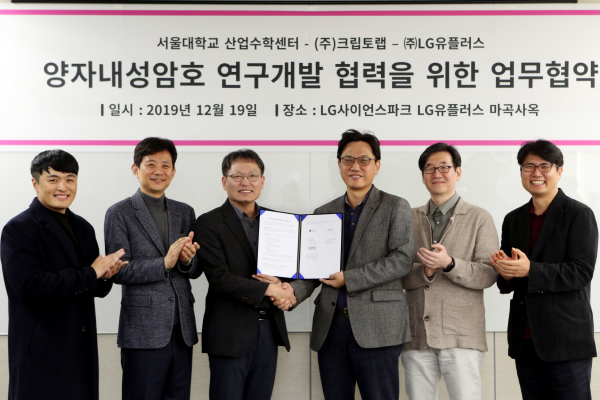
▲ LG Uplus signed an MOU with Seoul National University’s Center for Industrial Mathematics and Crypto Lab in the field of wired and wireless quantum-resistant cryptography (Photo = LG Uplus)
LG Uplus signed a 'business agreement in the field of wired and wireless quantum-resistant cryptography' with the Seoul National University Center for Industrial Mathematics and Crypto Lab on the 19th.
Quantum-resistant cryptography technology does not require the construction of a separate network infrastructure for cryptographic key distribution. Accordingly, it is characterized by its ability to be flexibly applied to various segments of wired and wireless networks that require encryption.
Under this agreement, LG Uplus, Seoul National University, and Crypto Lab will cooperate on: ▲analysis of network security vulnerabilities and research on quantum-resistant cryptographic algorithms in the era of quantum computing; ▲algorithm implementation and software development; and ▲development of optimal security network structures and equipment through the provision of test environments.
We plan to further develop quantum-resistant cryptography technology so that it can be applied to next-generation wired and wireless networks and 5G services where a vast amount of data, such as IoT and big data, is exchanged.
Park Song-cheol, Executive Vice President and Head of the Network Technology Operations Group at LG Uplus, said, “Through this collaboration, we will be able to secure the reliability of 5G networks against security threats in the upcoming era of quantum computing,” adding, “We will continue security cooperation with leading domestic researchers, such as those at Seoul National University, to provide telecommunication services that customers can use with peace of mind.”
Professor Cheon Jeong-hee, Director of the Center for Industrial Mathematics at Seoul National University and CEO of Crypto Lab, stated, “Once quantum computers are commercialized, existing encryption algorithms that were difficult to crack even after decades will be solved within minutes, making the introduction of quantum-resistant cryptography technology urgent.” She added, “Through technological cooperation with LG Uplus, I will contribute to the advancement of domestic quantum-resistant cryptography technology.”
Meanwhile, the Center for Industrial Mathematics at Seoul National University was the only Korean institution to advance to the second round of the National Institute of Standards and Technology (NIST)'s quantum-resistant cryptography standard competition by jointly proposing an algorithm with an overseas research team. Additionally, the algorithm proposed in Korea was adopted as a domestic quantum-resistant cryptography standard by the Korea Information and Communications Technology Association (TTA).
Comments
Related news
SK Telecom Protects 5G Network with Quantum Cryptography
SK Telecom announced that it will establish a secure 5G infrastructure by introducing quantum key distribution (QKD) technology to its 5G communication network. Quantum key distribution is a communication technology that prevents eavesdropping by utilizing quantum properties to generate encryption keys that only the sender and receiver can decrypt. Starting this month, SK Telecom has applied IDQ's quantum random number generator to its 5G subscriber authentication server. The quantum random number generator is a device that uses quantum properties to generate random numbers that are inherently immune to pattern analysis, thereby completely blocking the risk of hacking through communication networks. Additionally, in April, SK Telecom will integrate IDQ's quantum key distribution technology on the Seoul-Daejeon section, a critical transmission segment for national data traffic, to strengthen security for 5G and LTE data transmission and reception.
2019.03.20by 이수민 기자
ETRI and the Three Major Mobile Carriers Push for International Standardization of Quantum Cryptography Transmission Systems
Quantum key distribution transmission systems are network security technologies that protect customer data transmission from hackers by combining quantum key distribution technology and optical transmission network technology based on SDN technology. Domestic telecommunications operators have been enhancing their technical capabilities for commercialization of quantum key distribution technology. However, to combine quantum key distribution systems and optical transmission systems composed of multiple units and commercialize them as universally applicable technology, international standardization work was necessary. Accordingly, ETRI held SDN/NFV forum and international standardization meetings on the 21st. Currently, ETRI and the three telecommunications operators are pursuing domestic proprietary standardization of quantum key distribution transmission systems to provide commercial quantum key distribution services, with plans to link with international standardization in the future.
2019.10.31by 이수민 기자
Will Quantum Computer Commercialization Be Accelerated? Intel Announces Quantum Computing System Control SoC 'Horse Ridge'
Intel Labs has announced Horse Ridge, a cryogenic control chip designed to accelerate full-stack quantum computing systems. Through early-stage quantum hardware development efforts including silicon spin qubit and superconducting qubit systems, Intel identified that interconnects and control electrodes are the key bottlenecks preventing the commercialization of quantum computers. Horse Ridge, developed in collaboration with QuTech at Delft University of Technology in the Netherlands, was fabricated using FinFET technology in Intel's 22-nanometer process.
2019.12.10by 이수민 기자
.jpg)
SalePoint Signs Multi-Year Partnership Agreement with AWS… Promoting Identity Security that Integrates Even AI Agents
Sailpoint has entered into a multi-year strategic partnership agreement with AWS and is moving forward with establishing an integrated governance system that manages both human and non-human identities together. The plan is to consistently manage access permissions in an environment where AI agents are increasing as work execution entities, while applying the principle of least privilege and automated policy enforcement. The two companies plan to jointly expand capabilities to manage the identities of various entities, including AI agents, within a single layer in the AWS environment. This collaboration is interpreted as a move to design security and governance together in corporate environments where AI adoption is expanding.
2026.03.26by 배종인 기자
.png)
Databricks Unveils Open AI Security Monitoring 'Lakewatch'
Databricks entered the security market on March 24 by unveiling LakeWatch, an open-source agentic SIEM. The core functionality of this product is to integrate and analyze security, IT, and business data in a single environment to support AI-based threat detection and investigation. The company explained that it reduces the limitations of existing security operations centers, which have had to forgo some data due to high cost structures, and enables large-scale data analysis and automation based on open formats and ecosystems. LakeWatch is currently offered as a private preview, with Adobe and Dropbox mentioned as early customers. Databricks also announced an expanded partnership with Anthropic as well as the acquisition of Antimatter and SiftD.ai.
2026.03.26by 배종인 기자











