



Accelerating 5G-V2X business toward fully autonomous driving
 Published2019.12.19 15:34
Promoting early commercialization of 5G V2X for fully autonomous driving
Building a public-private joint precision road mapping and win-win cooperation ecosystem
The government is actively pursuing the introduction of autonomous driving-based future mobility services and is accelerating the realization of the national vision for future vehicles announced on October 15th.
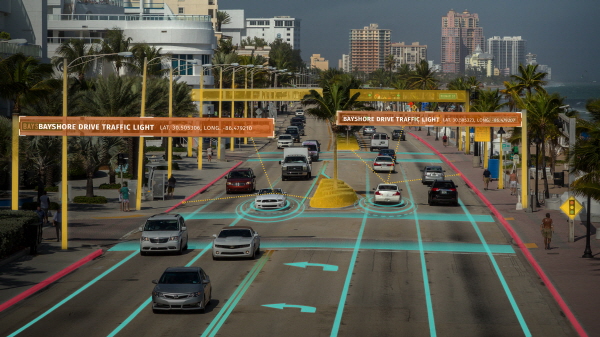
▲ The Ministry of Land, Infrastructure and Transport is actively promoting the early commercialization of 5G-based V2X for fully autonomous driving.
On the 18th, the Ministry of Land, Infrastructure and Transport held a meeting at the The K Hotel in Seoul to discuss the direction of development of the future automobile industry with representatives from around 10 companies, including Hyundai Motor Company, SK Telecom, Samsung Electronics, startups, and small and medium-sized enterprises.
This event also provided a platform to share the year's achievements of the Industry Development Council, which includes 260 companies from autonomous driving-related industries, including automobiles, communications, maps, security, and services.
Participating companies suggested ▲ expanding government investment for verification of new mobility services (autonomous shuttles, delivery robots, etc.) ▲ determining the method of V2X (vehicle-to-everything communication) communication technology ▲ expanding opportunities for participation of small and medium-sized and venture companies when promoting government-led projects ▲ strengthening public-private collaboration, etc.
The Ministry of Land, Infrastructure and Transport will begin providing administrative and financial support for vehicle manufacturing and infrastructure (C-ITS, precision road maps, etc.) for autonomous driving mobility service verification starting in 2020, after gathering opinions from industry officials.
In addition, within the pilot operation area under the Autonomous Vehicle Act that will be implemented in May 2020, autonomous vehiclesRealize passenger and logistics services based on rate.
To this end, the Ministry of Land, Infrastructure and Transport has been operating an inter-ministerial research team to determine the direction of introduction of V2X communication technology since last October, and is continuously expanding opportunities for business meetings and technology exchanges between large and small businesses through the Industrial Development Council.
In addition, the Ministry of Land, Infrastructure and Transport is promoting a pilot project for joint construction of a high-precision road map between the government and the private sector (235 km in Seoul) and continuously expanding the cooperation model.
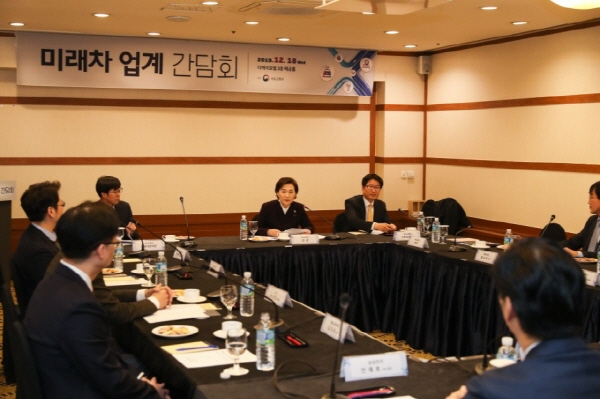
▲ On December 18, the Ministry of Land, Infrastructure and Transport held a forum to explore the future direction of the automobile industry. <Photo = Ministry of Land, Infrastructure and Transport>
At the council's performance presentation, the council's key activities for 2019 were introduced, including strengthening inter-company networks, supporting technology development, and fostering industry.
The number of council members increased significantly (36%) from 190 organizations last year to 260 as of the end of 2019, contributing to establishing the council as a focal point for mutual cooperation and standardization among companies in the autonomous cooperative driving field.
The council's member companies (approximately 30 organizations) jointly collected and shared driving data, and standardization of image (sensor) data based on this was also promoted.
An agreement was also signed between the Korea (ITS Association) and the US (OmniAir) to use a joint certification mark (certifiable in Korea) that will allow domestic companies to reduce certification costs by up to 65 million won and shorten the development period (by two years) when developing smart infrastructure (C-ITS) products.
As a result of the agreement, approximately 100 startups participating in the council attracted new investments worth 13 billion won, and some companies were able to expand into China, Europe, and other countries.>
Minister of Land, Infrastructure and Transport Kim Hyun-mee said, “We are proceeding smoothly with the future automobile industry development strategy announced jointly by the public and private sectors last October,” and added, “We will do our best to ensure that the domestic future automobile industry does not fall behind on the international stage due to regulations, inadequate infrastructure, or insufficient safety.”
Meanwhile, on October 15, the government announced a national vision for future vehicles, which includes the following goals: ▲ commercialization of level 3 autonomous driving by 2020, ▲ completion of core infrastructure by 2024, and ▲ commercialization of fully autonomous driving by 2027, with the goal of making the country the number one in future vehicle competitiveness by 2030.
Comments
Related news

Technology Standards Forum to Promote Commercialization of Autonomous Vehicles Held
The National Institute of Standards and Technology under the Ministry of Trade, Industry and Energy held a plenary session of the autonomous vehicle standardization forum. At the plenary session, domestic R&D achievements were shared to implement standards-related initiatives of the future vehicle industry development strategy established by the ministry. Additionally, international standards candidate projects that could become global standards were identified and discussed.
2019.11.27by 이수민 기자

Will autonomous driving, which has become a reality after 60 years, be completed with 5G-based C-ITS?
Recently, not only mobile carriers but also vendors are actively stepping up efforts to build C-ITS based on 5G. C-ITS, which is grounded in V2X technology, requires massive amounts of data for real-time data transmission and reception, necessitating 5G, which is 50 times faster than LTE. Can autonomous vehicles, which encompass technologies such as big data, IoT, AI, and robotics, achieve clear situational awareness and decision-making through 5G communication alone?
2019.12.10by 최인영 기자

Top 5 Key Keywords of 'Autonomous Driving' Dominating 2019
The top 5 key terms that garnered industry attention in autonomous vehicles in 2019 were Level 4 autonomous driving, C-ITS, AI, automotive semiconductors, and ISO 26262 SOTIF. While 5G gained prominence in the ICT sector, we reviewed the major issues of autonomous vehicles in 2019, which transformed the concept of vehicles from mere transportation to living spaces.
2019.12.18by 최인영 기자

[e4ds Tech Day 2026 ⑨] Sim Sang-gyu, Autocrypt CTO: "In the Physical AI Era, Automotive Security Must Extend Beyond the Vehicle"
At e4ds Tech Day 2026, Sim Sang-gyu, CTO of Autocrypt, explained automotive cybersecurity strategies in the era of Physical AI and SDV (Software-Defined Vehicle). Automobiles are evolving as part of an ecosystem connected to AI, cloud, chargers, IoT, and robots, and he emphasized that the scope of security must expand beyond the vehicle interior to the entire connected environment. In particular, AI model tampering, adversarial attacks, OTA updates, and EV charger hacking were identified as major threats. He explained that response measures require zero trust, AI model integrity protection, intrusion detection, Security by Design and Default, and full lifecycle security management, and that proactive security system establishment beyond regulatory compliance is critical for securing future mobility competitiveness.
2026.10.12by 배종인 기자

Practical HIL Construction Strategy for Automotive and Off-Highway Controller Validation
As vehicle E/E architecture transitions to zonal structures and shifts to software-defined vehicles (SDV), the number of controllers (ECUs) requiring validation and software complexity are surging dramatically. Meanwhile, real vehicle testing cannot provide repeated verification under identical conditions and entails lead time and safety concerns. This white paper explains the principles of HIL (Hardware-in-the-Loop) validation and the structure of the NI platform composed of PXI, SLSC, and VeriStand, and through two actual implementation cases—Camera Record & Replay HIL for In-Cabin Monitoring Controller (ICMU) and Forklift Controller (VCU) HILS—describes how controller-level regression testing becomes possible. Additionally, it explicitly states application boundaries and limitations, such as lack of A2B support.
2026.10.12by 편집부











