



Improving urban internet speeds with low-cost, ultra-high-speed 'wireless backhaul'
 Published2019.12.23 17:21
Expansion of the mobile backhaul market as an alternative to small cell 5G base stations
An institutional foundation is being established for the use of low-cost, ultra-high-speed 60GHz band wireless backhaul to enable the wireless transmission of internet data using unlicensed frequency bands.

The Ministry of Science and ICT revised the technical standards for the 60GHz unspecified band.
Internet data used on devices such as smartphones and computers is transmitted and received through multiple communication networks, so a transmission network called a "backhaul," which connects edge networks (such as base stations) with the backbone network (the highest-level network), is effective.
Until now, backhaul has mainly utilized wired networks such as optical cables and copper wires, or microwave (M/W) equipment in the 1–40 GHz band for long-distance communication of tens of kilometers.
However, in the recent 5G mobile communication service environment, data traffic is surging due to the transmission of large-capacity content, and as backhaul investment costs are expected to increase in high-density areas such as cities, the demand for 60GHz band-based wireless backhaul is growing to operate inefficient communication networks with improved performance. The performance of the backhaul, an intermediate step, has become important for the efficient transmission of high-efficiency data.
Accordingly, the Ministry of Science and ICT revised the technical standards for the 60GHz unspecified band (57~66GHz) to promote wireless backhaul.
A clear basis was established for applying beam-forming technology, which creates transmit and receive beams in a specific desired direction to reduce the cost of building a wireless backhaul network, and the output standard was raised from a maximum of 57dBm to 85dBm to expand the radio wave reach, bringing it up to the level of major countries such as the United States.

The expansion of the mobile backhaul market utilizing the 60GHz band is expected as an alternative to the small cell transformation of 5G base stations.
The 60GHz band is an unlicensed frequency that anyone can freely use without additional cost. Although its communication range is shorter than that of expensive, large microwave equipment used for long-distance communication, it utilizes a wide bandwidth, resulting in faster data transmission speeds.
In addition, unlike wired networks, wireless does not require network burial, so the cost and time required for network construction can be drastically reduced. Wireless backhaul utilizing the 60GHz band has value as a complement to wired backhaul, and can be widely used in rural areas, densely populated urban areas, and smart cities where it is difficult to install wired networks due to reasons such as economic feasibility.
An official from the Ministry of Science and ICT stated, “As 5G base stations become small cells due to the surge in data traffic and the increased use of high-frequency bands with short radio wave reach, the industry expects the mobile backhaul market utilizing the 60GHz band to expand as well,” adding, “We expect that through this regulatory improvement, we will be able to improve internet speeds in densely populated areas such as urban centers at a low cost while simultaneously eliminating blind spots in internet access.”
Comments
Related news

[5G Now] 28 billion wavelengths per second, how far has the development of 5G 28GHz come?
Since the 2018 PyeongChang Olympics, fierce 5G competition has been taking place among South Korea's three major telecommunications companies. However, due to the expansion of networks based on LTE infrastructure, they still have not shed the label of NSA (Non Stand Alone). Additionally, due to the low frequency band of 3.5GHz, 5G technology with the banner of high-speed, large-capacity communications has not been greatly recognized in the market. Japan and the United States recognized these issues and prepared to build market infrastructure from the 6GHz band and above, whereas in South Korea, perhaps due to the title of "world's first," the rollout began from what is commonly referred to as 4.5G, and currently multiple consumer complaints regarding telecommunications services continue to be raised. South Korea's three telecommunications companies announced a goal to implement 28GHz 5G communications by 2020 to address these issues. Whether 28GHz will actually become SA (Stand Alone) or whether it will become another NSA utilizing both 3.5GHz and 28GHz networks is a matter that remains to be seen.
2019.10.08by 명세환 기자
KT Demonstrates 28GHz Band Enterprise 5G Network Technology
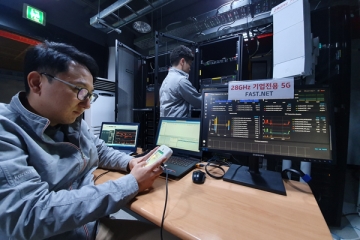
KT demonstrated FAST.NET, an enterprise-dedicated 5G network technology, using the 28GHz frequency band. The FAST.NET technology is KT's ultra-low latency infrastructure technology designed to transmit all data from terminals through networks to services within a round-trip latency of 10ms or less. It is a core technology for future enterprise-exclusive 5G networks aimed at realizing autonomous vehicles and smart factory automation control. In the demonstration, using 5G base station equipment and terminals supporting the domestic 28GHz band, ultra-low latency data transmission of a minimum of 5ms and an average of 8ms was achieved in actual wireless environments.
2019.10.31by 이수민 기자
"5G Bandwidth Will Double": Second Inter-Ministerial, Public-Private Joint 5G+ Strategy Committee Convened
The government held the second pan-governmental private-public joint 5G+ Strategy Committee meeting. At the second strategy committee meeting, agendas regarding private sector implementation results and plans, 5G trade insurance support strategy, 5G+ strategy 2020 implementation plan, and 5G+ spectrum plan were reported. Having laid the foundation for establishing a 5G ecosystem this year, the government will increase 5G-related budget by approximately 87% next year and pursue testbed expansion by 2.4 times, among other measures. Additionally, the government decided to double the 5G frequency bandwidth by 2026.
2019.12.06by 이수민 기자
European Patent Applications Surpass 200,000 for the First Time… South Korea Maintains 5th Place, Led by Batteries and Telecommunications
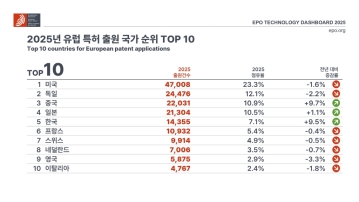
According to the European Patent Office (EPO)'s 'Technology Dashboard 2025', European patent applications last year reached 201,974, surpassing 200,000 for the first time. Korean companies and inventors filed 14,355 applications, representing a 9.5% increase from the previous year and maintaining 5th place by country. Battery, digital communication, and semiconductor technologies led the growth, with Samsung ranking as the top EPO applicant for the second consecutive year and LG reaching 3rd place. The presence of major domestic cities such as Seoul, Suwon, and Yongin was also confirmed. It was also revealed that Korea's European patent strategy is expanding beyond individual technologies to span the entire industry.
2026.03.24by 명세환 기자

SK Telecom First Applies AI-Based Network Operations at Gwanghwamun K-Pop Concert
SK Telecom announced that it applied an AI-based network operation system for the first time at a large-scale K-pop concert held in the Gwanghwamun area of Seoul on March 21st, managing communication quality throughout the event. Mobile data usage during the three hours before and after the concert reached 12.15TB, approximately doubling compared to the same time slot the previous weekend. SK Telecom monitored traffic using the AI system 'A-One' in five-minute and 50-meter units to respond to potential overload situations, while also operating temporary communication facilities and on-site personnel in parallel. This case is interpreted as confirmation of the practical applicability of AI-based autonomous network operation in an environment where demand from dense events and foreign users increases simultaneously.
2026.03.23by 명세환 기자











