


430,000 air taxis will be operating in the global skies by 2040.
 Published2019.12.31 10:46
Following the UAE, New Zealand, and Singapore, Brazil and Mexico are set to take active steps.
With the launch of air taxi operations in the Middle East in 2022, a total of 430,000 air taxis are expected to be in operation globally by 2040.
Driven by government support and technological advancements, aerospace and automotive companies as well as specialized technology developers are expected to enter the Urban Air Mobility (UAM) market in large numbers and lead the air taxi market. It is expected that 430,000 air taxis will be operating in the skies worldwide by 2040.
.jpg)
▲ It is expected that 430,000 air taxis will be operating in the skies worldwide by 2040. <Photo = Hyundai Motor Group>
According to the '2019 Analysis of Urban Air Mobility and the Evolving Air Taxi Landscape' report published by global market research firm Frost & Sullivan, the United Arab Emirates (UAE), New Zealand, and Singapore are emerging as the first countries in the world to introduce air taxis, followed by countries such as Brazil and Mexico, which are expected to actively pursue the introduction of air taxis by leveraging their expertise in helicopter taxis.
Currently, about 50 cities around the world are focusing on the air taxi market with an emphasis on the feasibility of urban air mobility, and air taxis are expected to record a CAGR (compound annual growth rate) of 45.9% by 2040.
Industries utilizing air taxis are predicted to ultimately focus on establishing an urban air mobility vehicle market, extending beyond the cargo drone sector.
As the number of urban air mobility vehicles increases, the service market for pilot training, maintenance, and repair also has high growth potential. Reflecting this, market strategies proposed by Frost & Sullivan include: integrating in-vehicle fail-safe mechanisms targeting potential customers; reducing noise through collaboration with rotor and propeller developers; establishing support infrastructure such as take-off and landing stations, passenger waiting rooms, and landing pads in residential buildings; and developing cybersecurity capabilities or acquiring cybersecurity startups.
Sim Jin-han, Director of Frost & Sullivan Korea, said, “Safety, noise levels, infrastructure for takeoffs and landings, and government regulations that will have a positive impact on the industry will be key factors in the commercialization of air taxis,” adding, “OEMs will invest in the development of alternative energy sources, including hybrid fuel systems, lightweight high-strength composite materials, and large-capacity solar batteries, to enable fuel efficiency and long-distance operation.”
Meanwhile, the newly released report contains an analysis of vehicle models and applications, evaluations of major city and intercity taxi service companies, and strategic recommendations, as well as the potential of air taxi services and ecosystem support measures.
Comments
Related news
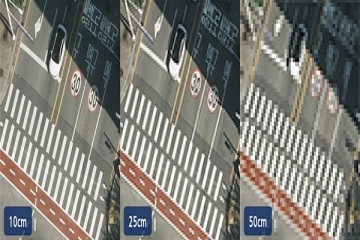
A 10cm resolution aerial image map of the entire country has been produced.
Sama Mapping has successfully produced high-precision aerial image maps at 10cm resolution covering the entire national territory, maximizing the discrimination capability of image maps. 10cm resolution refers to spatial resolution in which 10cm of a subject is recognized as a single pixel. Aerial image maps are maps created by correcting subjects that can be distorted due to various causes to appear as if viewed vertically from the sky. The aerial image maps produced this time have completed accurate positioning and displacement correction for distortion and relief of terrain features, and can be integrated and utilized in various spatial information systems.
2019.07.17by 이수민 기자

2019 Global Autonomous Driving Industry Outlook Report Released
Frost & Sullivan Announces 2019 Global Autonomous Driving Industry Outlook Report One out of every four vehicles sold worldwide by 2030 is projected to be an autonomous vehicle (Level 3 or higher)
2019.08.26by 명세환 기자

"Connected car sales to reach 65 million units by 2025"
With advances in telecommunications technology, global electric vehicle sales are projected to reach approximately 30 million units in 2025. Connected car sales equipped with telematics, including remote services, OTA updates, and advanced diagnostics capabilities, are expected to approach 65 million units.
2019.12.30by 최인영 기자

Enhancing commercial vehicle autonomy through the introduction of AI and telematics
As the adoption of emerging technologies such as AI, IoT, telematics, data analytics, and blockchain increases in commercial vehicles, collaboration between automotive OEMs and technology developers is being accelerated. Global market research firm Frost & Sullivan announced that the transportation industry, which is a critical element of the logistics supply chain, is undergoing significant transformation driven by emerging technologies, and that collaboration and M&A among technology providers are increasing to secure market leadership.
2019.12.30by 최인영 기자

[e4ds Tech Day 2026 ⑨] Sim Sang-gyu, Autocrypt CTO: "In the Physical AI Era, Automotive Security Must Extend Beyond the Vehicle"
At e4ds Tech Day 2026, Sim Sang-gyu, CTO of Autocrypt, explained automotive cybersecurity strategies in the era of Physical AI and SDV (Software-Defined Vehicle). Automobiles are evolving as part of an ecosystem connected to AI, cloud, chargers, IoT, and robots, and he emphasized that the scope of security must expand beyond the vehicle interior to the entire connected environment. In particular, AI model tampering, adversarial attacks, OTA updates, and EV charger hacking were identified as major threats. He explained that response measures require zero trust, AI model integrity protection, intrusion detection, Security by Design and Default, and full lifecycle security management, and that proactive security system establishment beyond regulatory compliance is critical for securing future mobility competitiveness.
2026.10.12by 배종인 기자











