



'World's First' Safety Standards for Level 3 Autonomous Driving Established
 Published2020.01.05 11:10
Vehicles equipped with the Auto Maintenance feature can be launched and sold starting in July.
Starting this coming July, the launch and sale of Level 3 autonomous vehicles equipped with lane-keeping functions will become possible, and safety standards for partially autonomous vehicles will be introduced for the first time in the world.
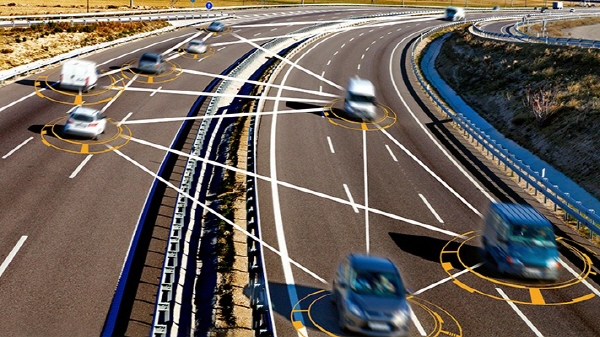
▲ Safety standards for Level 3 autonomous driving have been established for the first time in the world. <Photo = Hyundai Motor Group>
The Ministry of Land, Infrastructure and Transport announced on the 5th that it is introducing safety standards for Level 3 (partially autonomous) autonomous vehicles for the first time in the world to ensure that autonomous vehicles can be safely manufactured and commercialized.
Under existing safety standards, the advanced steering system of Level 2 autonomous vehicles was designed to assist the driver, so even when the lane-keeping function was activated, the driver still had to drive manually. The driver must keep their hands on the steering wheel while driving, and the system is set to sound a warning alert after a short delay if they take their hands off the wheel.
However, the new Level 3 autonomous driving safety standards include technology that allows the autonomous vehicle system to continuously maintain the lane even when the driver takes their hands off the steering wheel within a designated operating area.
The Level 3 safety standards were established by the Ministry of Land, Infrastructure and Transport based on international trends discussed at the UN Forum on the Harmonization of Automotive Safety Standards and internal research results, incorporating feedback from domestic industry and academia.
Key contents include ▲clarification of functional distinctions by stage through the definition of autonomous driving systems ▲establishment of safety standards for partial autonomous driving systems by situation ▲joint integration of lane-keeping and manual lane-changing functions.
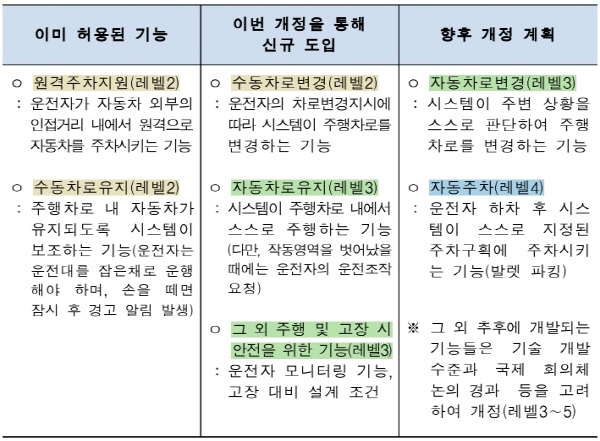
▲ Current Status of Revisions to Safety Standards Related to Autonomous Driving Functions <Source: Ministry of Land, Infrastructure and Transport>
According to the Society of Automotive Engineers classification (Levels 0–5), Level 3 is classified as partial autonomous driving, Level 4 as conditional fully autonomous driving, and Level 5 as fully autonomous driving; Levels 1–2 refer to vehicles equipped with driver assistance features, while Level 3 and above refer to autonomous vehicles.
As Level 3 autonomous vehicles must be able to respond appropriately to various situations encountered during lane keeping, the Ministry of Land, Infrastructure and Transport has established safety standards for partial autonomous driving.
A system must be designed to detect whether the driver is seated in preparation for situations where the driver needs to hold the steering wheel while operating a partially autonomous driving system. This system ensures that the transfer of driving occurs only when driving capability is confirmed.
In addition, to enable autonomous vehicles to safely implement lane-keeping functions, performance must be implemented to accurately detect not only the maximum speed but also the minimum safe distance from the preceding vehicle based on speed.
When a situation is anticipated where the vehicle will exit the operating area, such as a highway exit, during autonomous driving, a warning is given 15 seconds in advance so that the driver can take hold of the steering wheel, and in the event of an unexpected situation such as sudden road construction, a warning to immediately switch to driving is provided.
In particular, in situations where there is insufficient time to request the driver to take control, such as when a collision is imminent, the system is designed to decelerate as much as possible according to emergency driving standards and respond with emergency steering.
If the driver does not respond within 10 seconds even when a driver response is required, the system is designed to slow down for safety while simultaneously activating emergency warning signals to minimize risk. In addition, the design must take into account system redundancy and other measures to ensure safe operation even if the autonomous driving system fails.
This amendment includes provisions allowing the system to be equipped with a Level 2 manual lane change function, in which the system safely changes lanes according to driver instructions, along with a Level 3 automatic lane keeping function.
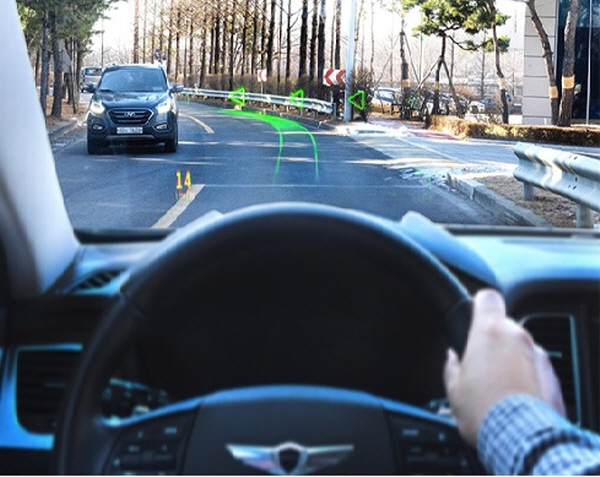
▲ The Ministry of Land, Infrastructure and Transport has established phased, situation-specific standards to ensure a safe autonomous driving environment. <Photo = Hyundai Motor Group>
Based on international discussions, the Ministry of Land, Infrastructure and Transport plans to gradually introduce Level 3 lane-changing capabilities, which allow autonomous vehicles to independently decide and change lanes.
Lee Chang-ki, Head of the Advanced Automotive Technology Division at the Ministry of Land, Infrastructure and Transport, stated, “Starting with the introduction of these safety standards for autonomous vehicles, we plan to actively participate in discussions on international safety standards to support Korea in leading international standards for autonomous vehicles,” adding, “We will do our utmost to ensure that institutional deficiencies in the autonomous vehicle sector do not hinder industrial development.”
Meanwhile, the Level 3 autonomous vehicle safety standards prepared this time are scheduled to take effect six months after their promulgation, and the Ministry of Land, Infrastructure and Transport plans to prepare detailed enforcement rules, such as test methods for verifying the performance of autonomous vehicles, before the safety standards take effect.
Comments
Related news
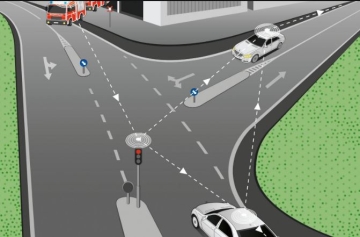
C-ITS Market Entered by Telecommunications Companies, Will 5G-Based C-V2X Establish a Technology System?
With the completion of the C-ITS pilot project led by the Ministry of Land, Infrastructure and Transport in December of this year, full-scale expansion and construction of the next-generation transportation network nationwide is anticipated. The C-ITS communication technology system, which has repeatedly faced confusion over DSRC method versus cellular-based V2X method, appears to be shifting toward C-V2X communication with active participation from telecommunications carriers based on 5G. This shift seems to have been influenced by the European Commission for Transport's re-establishment of legislation from DSRC method to C-V2X method as well. Most notably, with the introduction of 5G-based cellular method, which shows a significant difference in communication packet capacity compared to existing cellular method, the technology appears to be gaining momentum on the foundation of stability.
2019.10.30by 명세환 기자
Accelerating 5G-V2X business toward fully autonomous driving
The government is actively pursuing the introduction of autonomous driving-based future mobility services and accelerating the early commercialization of 5G-based V2X for fully autonomous driving. Starting from 2020, the Ministry of Land, Infrastructure and Transport will provide comprehensive administrative and financial support for vehicle manufacturing and the construction of C-ITS and precision road maps to conduct pilot demonstrations of autonomous driving mobility services.
2019.12.19by 최인영 기자

Ministry of Land, Infrastructure and Transport Announces Autonomous Driving ‘Ethical Guidelines’
The Ministry of Land, Infrastructure and Transport announced autonomous driving ethics guidelines that encompass fundamental values and behavioral standards related to autonomous driving. To facilitate the introduction of safe autonomous vehicles that the public can trust and use, the Ministry of Land, Infrastructure and Transport plans to prepare a final version of ethics and behavioral guidelines for autonomous vehicle future policy direction and manufacturing/operation processes through a review of domestic and international cases and a process of public opinion gathering.
2019.12.12by 최인영 기자

[e4ds Tech Day 2026 ⑨] Sim Sang-gyu, Autocrypt CTO: "In the Physical AI Era, Automotive Security Must Extend Beyond the Vehicle"
At e4ds Tech Day 2026, Sim Sang-gyu, CTO of Autocrypt, explained automotive cybersecurity strategies in the era of Physical AI and SDV (Software-Defined Vehicle). Automobiles are evolving as part of an ecosystem connected to AI, cloud, chargers, IoT, and robots, and he emphasized that the scope of security must expand beyond the vehicle interior to the entire connected environment. In particular, AI model tampering, adversarial attacks, OTA updates, and EV charger hacking were identified as major threats. He explained that response measures require zero trust, AI model integrity protection, intrusion detection, Security by Design and Default, and full lifecycle security management, and that proactive security system establishment beyond regulatory compliance is critical for securing future mobility competitiveness.
2026.10.12by 배종인 기자

Practical HIL Construction Strategy for Automotive and Off-Highway Controller Validation
As vehicle E/E architecture transitions to zonal structures and shifts to software-defined vehicles (SDV), the number of controllers (ECUs) requiring validation and software complexity are surging dramatically. Meanwhile, real vehicle testing cannot provide repeated verification under identical conditions and entails lead time and safety concerns. This white paper explains the principles of HIL (Hardware-in-the-Loop) validation and the structure of the NI platform composed of PXI, SLSC, and VeriStand, and through two actual implementation cases—Camera Record & Replay HIL for In-Cabin Monitoring Controller (ICMU) and Forklift Controller (VCU) HILS—describes how controller-level regression testing becomes possible. Additionally, it explicitly states application boundaries and limitations, such as lack of A2B support.
2026.10.12by 편집부











