



How far can consumers go with their personal information in exchange for personalized products and services?
 Published2020.01.09 12:00
Since Generation X, there has been less resistance to expensive personalized products.
88% of consumers say providing personal information requires thorough management.
Today's young consumers are driving the trend toward personalization that improves products and services, quality of life, and personal safety, and they are willing to pay more and share their personal information for these experiences, according to research.
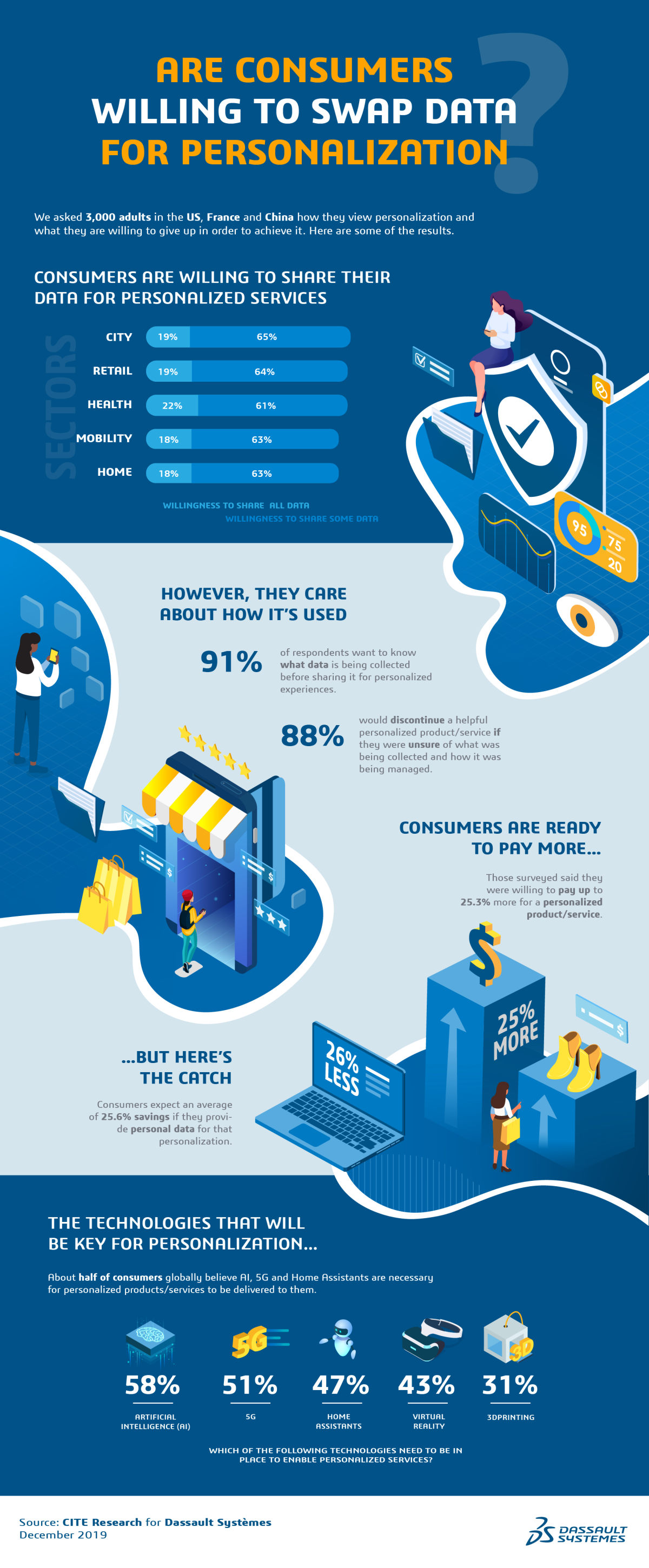
Dassault Systèmes announced the results of a survey with these contents at CES 2020, held in Las Vegas, USA from the 7th to the 10th. This survey was conducted jointly by Dassault Systèmes and market research firm CITE Research, targeting 3,000 adults in the United States, China, and France.
In this survey, consumers revealed differences across generations, regions, and technology levels in their views on personalization in mobility, healthcare, shopping, and residential and urban environments; their definition of personalization; and what they are willing to sacrifice for personalization.
The results show that most consumers value personalization for healthcare and personal safety, but express concerns about how their data is collected and managed to achieve this.
The detailed survey results are as follows.
Consumers want personalization, but they don't want delays. Eighty-three percent of consumers expect personalized products and services to be delivered immediately, without waiting. Only 21% said they would be willing to wait more than four days.
Consumers were willing to pay an average of 25.3% for personalization. However, they also said they would be willing to pay an average of 25.6% in return for providing their personal data. While they were willing to pay more for personalized healthcare services, they were less willing to pay for personalized shopping experiences.
The industry needed to clearly define personalization. Consumers define personalization differently. Over 50% of consumers define it as customizing products and services before purchase or selecting desired products and services from a large number of options. In contrast, 63% of early adopters defined products and services as being developed based on personal data.
Consumers appear to prefer personalized products or services that benefit their health, such as behavioral alerts that can help prevent accidents.
Ninety-six percent of consumers expressed concerns about data privacy. Most consumers are willing to share only the data they agreed to share in exchange for personalization, and six in ten are even more willing to share anonymized data. Eighty-eight percent of consumers said they would abandon personalized services if they were unsure how their data was being managed. Sixty-eight percent said consumer demand would lead to greater data privacy protections.
AI, 5G, and smart homes are expected to become more personalized. Nearly half of respondents said 5G technology is particularly necessary for personalized healthcare, while shopping is less important.
Expectations for personalization varied across generations. Generation X (born in the 60s and 70s), Millennials (born in the 80s and 90s), and Generation Z (born in the late 90s to early 2000s) were more willing to provide data for better personalization than Baby Boomers (born in the 40s and 60s) and the Silent Generation (born in the mid-20s to mid-40s), and were more willing to agree to provide personal information for personal safety, time, and economic benefits. 60% of baby boomers preferred personalization of healthcare, 24% of Gen Z preferred personalization of mobility, and 21% of millennials preferred personalization of the environment.
Young Chinese consumers are more interested in personalization than their American and French counterparts, but Americans have the highest expectations for personalization. Consumers expect personalized products and services to become commonplace by 2030 and are willing to pay more for them.
“Consumers, especially younger consumers, are seeking personalized experiences as a differentiating factor,” said Florence Bergeran, Senior Vice President, Dassault Systèmes. “To capitalize on this trend, companies must strengthen data privacy protections while simultaneously collecting, analyzing, and transforming data.”
Meanwhile, Dassault Systèmes showcased personalized innovations at CES 2020, including customized shoes developed with ECCO, an electric autonomous vehicle developed with Canoo, and 5G technology.
Comments
Related news
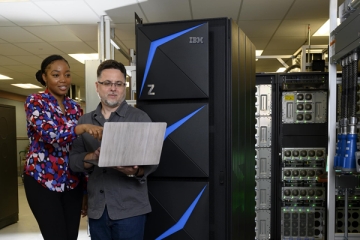
IBM Launches Z15 Platform with Privacy Protection Features
IBM has unveiled the IBM z15 enterprise platform and LinuxOne III, a Linux-exclusive server that support customer data privacy in hybrid multicloud environments. The z15 is equipped with a data privacy passport feature that enables revocation of data access rights across the entire hybrid multicloud scope, allowing enterprises to control and manage data access permissions according to company policies. Additionally, it minimizes downtime through an instant recovery function. Meanwhile, IBM is providing Red Hat OpenShift on IBM Z and LinuxOne, enabling developers to develop z/OS applications on OpenShift.
2019.09.19by 이수민 기자

The autonomous vehicle market will grow explosively starting in 2025
Recent advances in AI technology have been significantly driven by deep learning technology. Accordingly, big data based on high-quality data has emerged as an important factor, and major advanced nations are strengthening policy support by incorporating the big data sector into their AI technology development strategies. On the 29th, IRS Global published a report analyzing domestic and international core technology development trends and business analysis for artificial intelligence (AI) in the automotive and robotics sectors. According to the report, AI technology is growing into a core technology that will transform not only industry but human life itself, and the ability to secure and leverage AI technology will now determine the competitiveness of companies, nations, and individuals.
2019.10.30by 이수민 기자
In an era where user experience takes precedence, what direction should home appliances evolve in?
Today's consumers expect positive life experiences—such as convenience, stability, and enjoyment—that products deliver, rather than product ownership itself. Samsung Electronics President Kim Hyun-suk defined the next decade as an era of experience, stating that home appliance manufacturers must work to provide increasingly personalized experiences and environments by combining hardware and software for individuals.
2020.01.07by 이수민 기자

ESP32 Development Environment Selection and GPS Application Implementation
The ESP32 is a microcontroller that integrates Wi-Fi, Bluetooth, 12-bit ADC, capacitive touch, PWM, DAC, and UART in a single SoC. However, the abundance of features does not by itself solve the designer's problems. The real challenges lie in selecting the appropriate development environment, determining which pins can be used and which must be avoided, and converting raw data from modules into usable information. This document addresses ESP32 peripheral constraints (ADC2 and Wi-Fi coexistence limitation, UART1 occupancy, ADC non-linear regions), the trade-offs between Arduino IDE and ESP-IDF, and the process from connecting NEO-6M/NEO-M8N GPS modules to UART2, parsing NMEA sentences, and visualizing routes in Google Earth, all organized based on documented references.
2026.10.12by 편집부
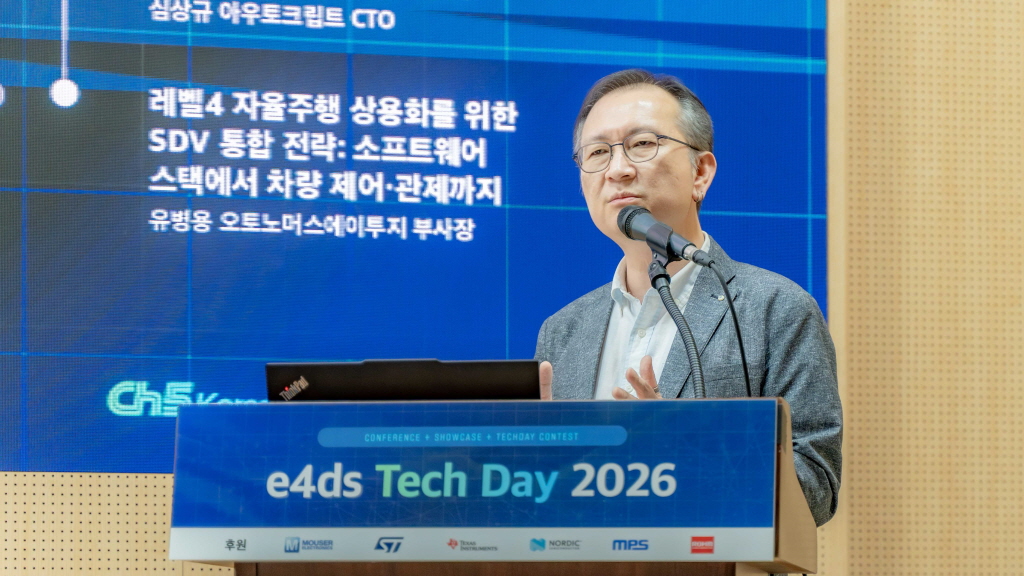
[e4ds Tech Day 2026 ⑨] Sim Sang-gyu, Autocrypt CTO: "In the Physical AI Era, Automotive Security Must Extend Beyond the Vehicle"
At e4ds Tech Day 2026, Sim Sang-gyu, CTO of Autocrypt, explained automotive cybersecurity strategies in the era of Physical AI and SDV (Software-Defined Vehicle). Automobiles are evolving as part of an ecosystem connected to AI, cloud, chargers, IoT, and robots, and he emphasized that the scope of security must expand beyond the vehicle interior to the entire connected environment. In particular, AI model tampering, adversarial attacks, OTA updates, and EV charger hacking were identified as major threats. He explained that response measures require zero trust, AI model integrity protection, intrusion detection, Security by Design and Default, and full lifecycle security management, and that proactive security system establishment beyond regulatory compliance is critical for securing future mobility competitiveness.
2026.10.12by 배종인 기자











