


The Korea Institute of Machinery and Materials (KIMM) has developed a "humanoid robotic hand" capable of performing everyday tasks ranging from carrying eggs to cutting with scissors.
 Published2020.01.22 12:14
Designed to move independently with 4 fingers and 16 joints
The Korea Institute of Machinery and Materials has developed a human-sized robotic hand that can manipulate objects and tools in everyday life, such as picking up eggs or cutting with scissors.
It is manufactured with a universal structure, so it can be mounted on various robot arms, and its gripping force relative to its weight is at the world's highest level, so it is expected to be used in industrial sites as well as in everyday life.
.jpg)
▲ Humanoid robot hand <Image = Korea Institute of Machinery and Materials>
The research team led by Dr. Do Hyeon-min of the Robotics and Mechatronics Laboratory at the Advanced Production Equipment Research Center of the Korea Institute of Machinery and Materials announced that they have developed a humanoid robot hand that manipulates objects in the same way by imitating the movements and structure of human fingers.
The humanoid robotic hand consists of four fingers and 16 joints, and 12 motors are used to move them in all directions. Each finger is designed to move independently.
Additionally, we developed and applied a mechanism that allows the fingers to move with multiple degrees of freedom even in narrow spaces, allowing them to move at a level similar to that of a human hand. The actuator that moves the fingers was modularized by mounting it inside the palm, and the design was made so that the robot hand can be mounted without changing the existing robot arm structure.
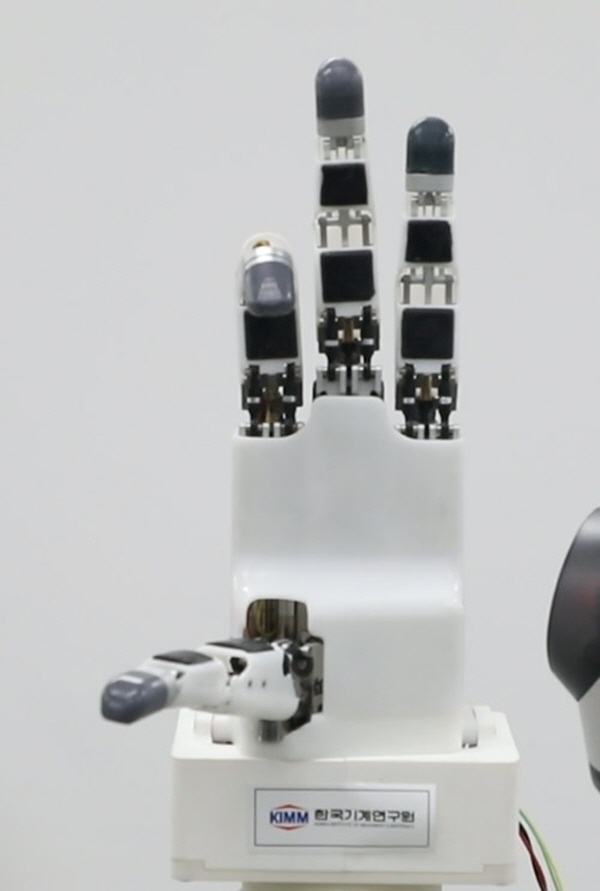
▲ Demonstration of degrees of freedom, including joint bending, of a robot hand <Photo = Korea Institute of Machinery and Materials>
The newly developed robotic hand is lighter and stronger than existing commercially available robotic hands. The humanoid robotic hand weighs less than 1 kg but can lift objects weighing over 3 kg.
To provide tactile sensing capabilities for detecting contact with objects, the research team developed force-measuring sensors and installed them on the fingertips, joints, and fingers. The force sensors mounted on the fingertips are ultra-small, measuring 15 mm in diameter and weighing less than 5 g. They can measure the magnitude and direction of force detected at the fingertips when the robotic hand makes contact with an object. The core of robotic hand technology lies in controlling the gripping force.
The finger joints and palm are equipped with skin-type tactile sensors developed through joint research with Seoul National University. A skin-type tactile sensor can measure the distribution and force of the contact area when a robotic hand comes into contact with an object.
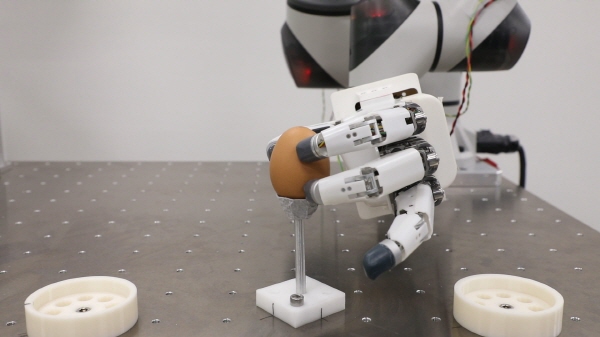
▲ A robot hand lifting and moving an egg <Photo = Korea Institute of Machinery and Materials>
Do Hyun-min, a senior researcher at the Korea Institute of Machinery and Materials, said, “Humanoid robot hands were developed to mimic the delicate movements of the human hand and handle objects such as tools that we use in our daily lives.” He added, “Commercial robot hands developed so far have had limitations in their utility because there were no modular products that had built-in tactile sensors and finger actuators mounted inside the palm. However, we expect that the robot hand developed this time will be able to perform platform development such as research on algorithms and robot manipulation intelligence.”
Meanwhile, this study was conducted as part of a project to develop robot task control technology capable of grasping and manipulating various objects in everyday life environments and performing tool-utilizing tasks based on multimodal recognition, led by the Ministry of Trade, Industry and Energy.
Comments
Related news
Mouser & TE Publish E-book 'Solutions for Robots and Robot Control'
Mouser Electronics and TE Connectivity have jointly published an e-book titled "Solutions for Robotics and Robot Control," which analyzes the technologies required for the latest robotics and IIoT implementations. The e-book, which focuses on how robots are transforming factories and warehouses, contains information on high-performance connectivity, digital twins, and collaborative robots.
2019.12.30by 최인영 기자
KT Launches World's First 5G Medical Service at Samsung Hospital
KT and Samsung Seoul Hospital are utilizing 5G services in medical procedures for the first time globally. Through enterprise-dedicated 5G, autonomous robots in operating rooms transport supplies and medical waste, while AI services provide patient care in hospital rooms, and 5G sync cameras simultaneously transmit high-definition real-time footage of the surgeon's surgical procedures. Both companies plan to continue their collaboration with the goal of establishing a 5G smart innovative hospital.
2020.01.14by 최인영 기자
CEVA's 'Sensing Q' Platform, Accelerating Context-Aware IoT Development, Scheduled for Release in Q2 of This Year
Context awareness technology is becoming an essential feature in devices such as smartphones, notebooks, AR/VR headsets, robots, hearables, and wearables. CEVA announced that it will launch SensingQ, an integrated hardware IP and software platform that enables IoT devices to be context-aware, in the second quarter of this year.
2020.01.15by 이수민 기자
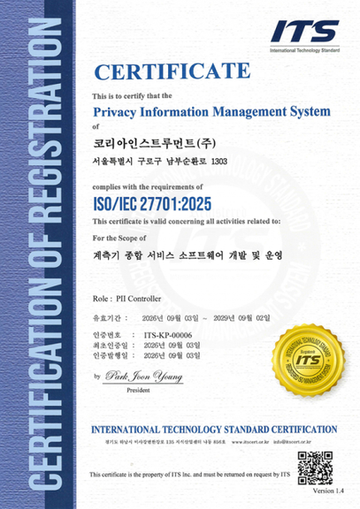
Korea Instrument, KOLAS Accredited Calibration Agency First to Simultaneously Acquire ISO/IEC 27,001·27,701
Korea Instrument has become the first among KOLAS accredited calibration agencies to simultaneously acquire ISO/IEC 27,001 and ISO/IEC 27,701 certifications. Through its proprietary platforms CWIZ Enterprise and CWIZ Partners, the company has embedded information security and personal data protection requirements across all business processes including customer information, equipment data, and calibration reports, with plans to continuously advance its management system through regular audits and security inspections.
2026.10.12by 배종인 기자

TeamViewer One, IT Incident Automation Workflow and Resolution Center Enhanced
TeamViewer has added IT incident automation capabilities and an advanced Resolution Center to its integrated digital workplace management platform 'TeamViewer ONE'. Recurrent service disruptions, configuration errors, and capacity shortages are automatically handled according to preset policies, and device status verification through script deployment can be managed in a unified interface, significantly reducing repetitive tasks for IT teams.
2026.10.12by 배종인 기자











