



2020 Cloud Sector Top 5 Outlook: "Hybrid Multicloud Coming to the Fore"
 Published2020.01.29 09:31
Security Operations Center, Industry-Specific Optimized Cloud,
Increased Kubernetes Utilization and More Expected
IBM announced on the 29th its "Top 5 Cloud Sector Outlook for 2020," identifying edge, automation, and industry-specialized clouds as major cloud keywords for 2020.

Last year, the hybrid multicloud sector experienced significant growth as an increasing number of enterprises sought cost reduction and productivity improvement, vendor lock-in escape, and workload migration to the cloud. The hybrid multicloud market is estimated to present market opportunities worth approximately 1.2 trillion dollars currently.
This trend is expected to accelerate further this year. Enterprises across all sectors are projected to adopt hybrid multicloud strategies to rapidly deploy applications that accelerate digital transformation and provide exceptional experiences to customers.
Accordingly, focus will be placed on advanced encryption and protection solutions to safely secure clouds from increasingly diverse cyber attacks, and technology capabilities are expected to be enhanced by embracing new technologies such as edge. Alongside this, enterprises are expected to begin implementing automation tools to facilitate easy maintenance of the complex cloud ecosystem.
The following details the Top 5 Cloud Sector Outlook for 2020.
1. Edge Utilization Increases Due to 5G
Edge computing technology, which performs computation at locations as close as possible to where data is generated, is a technology that aligns with cloud in multiple respects. It enables faster updates on consumer purchasing trends, predictive maintenance of equipment prone to failure, and support for mobile games and AR services.
As many enterprises integrate edge computing into their hybrid cloud strategies, 5G will become an increasingly important factor. Hybrid cloud aggregates the most relevant data and backend functionality, while edge computing will support real-time analysis and other critical functions where data is generated.
2. Automation Becomes a Critical Element of Hybrid Multicloud
Enterprises are adopting hybrid multicloud strategies that allow them to flexibly migrate critical business applications to any environment. In fact, hybrid cloud possesses market opportunities valued at 1.2 trillion dollars, and approximately 80% of enterprise decision makers are considering hybrid cloud adoption.
However, the strengths of hybrid cloud—resilience, scalability, and support capabilities for diverse applications, APIs, and data types—are inherently complex. Therefore, complexity management will determine the success or failure of enterprise cloud strategies going forward. In 2020, automation tools including AI capable of managing hybrid multicloud environments will attract significant attention.
3. Security Operations Centers Increase
Approximately 60% of IT enterprise decision makers cited security as the most important factor when selecting cloud providers. However, maintaining a high level of security in a hybrid multicloud environment where data is distributed across diverse environments is extremely complex.
In 2020, many tools will emerge that help enterprises derive security insights more quickly and respond to security incidents through dashboards supporting centralized operations. Establishing a unified security command center such as a security operations center is critical.
4. Adoption of Industry-Specific Optimized Cloud Increases
As many enterprises adopt cloud, demand for cloud solutions specialized for specific industries is also increasing. Businesses operating under heavy regulation prefer cloud adoption that provides features reducing burden, such as flexibility.
In 2019, Bank of America migrated major applications and workloads and adopted IBM's public cloud optimized for financial services to support 66 million customers. It is expected that emphasis will be placed on providing cloud services tailored to specific markets, delivering industry-specific value, and providing capabilities to address particular requirements.
5. Kubernetes Utilization Increases
Open source technology is exerting major impact on the cloud. In 2019, enterprises focused on open source software to modernize infrastructure and adopt hybrid multicloud more rapidly. In 2020, more developers are expected to utilize tools enabling rapid application deployment to help enterprises lead digital innovation.
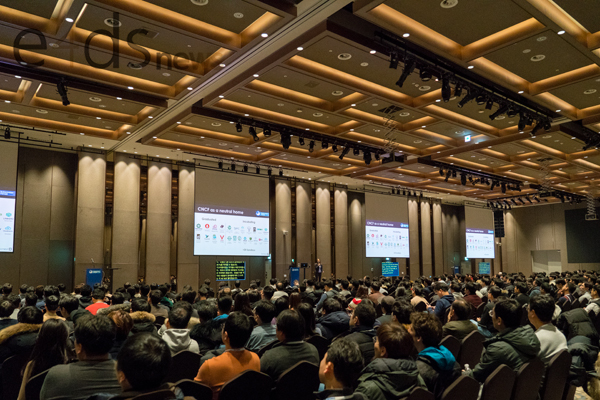
(Photo=Lee Su-min Reporter)
An increasing number of enterprises will adopt the Continuous Delivery (CD) paradigm embracing DevOps philosophy to rapidly build, test, and deploy. The CD model is increasing alongside the advancement of cloud-native applications designed for deployment on containers and Kubernetes.
In 2020, more developers will move to Kubernetes and OpenShift. Accordingly, technologies such as Red Hat Operators will be implemented to become an essential part of the Kubernetes ecosystem.
Comments
Related news
By 2025, 90% of apps will run on cloud native platforms
Cloud native is an approach to building and running applications that leverages the advantages of cloud computing delivery models. Leading companies and organizations worldwide are expediting their adoption of cloud native technologies based on the recognition that they must become software companies regardless of whether they operate a software business. CNCF held the inaugural Kubernetes Forum Seoul on the 9th at Seoul Dragon City Hotel, discussing the present and future of cloud native.
2019.12.09by 이수민 기자

Processing massive IIoT data requires a time-series database, as the cloud alone struggles to handle it.
Cases of integrating cloud into smart factories are increasing. However, since the data volume generated by various sensors and equipment installed in smart factories reaches millions of tags per second, cloud alone has its limitations. Therefore, a data repository capable of collecting and storing vast amounts of data at ultra-high speed and a solution that can compress and store data are necessary.
2020.01.13by 이수민 기자
.png)
Vertiv Announces Top 5 Data Center Technology Trends for 2020
Vertiv has announced the top 5 data center trends for 2020. In recent years, hybrid architecture integrating public and private cloud models and edge assets around the core network has been a frequent topic of conversation among enterprise executives. In 2020, corporate movements are expected to move beyond simple debates about enterprise or cloud deployments.
2020.01.16by 이수민 기자

Camera for Both Humans and Machines: ST BrightSense 5MP Dual Shutter Image Sensor
Video consumed by humans and imagery analyzed by machines impose different requirements on the sensor in terms of shutter method and wavelength band. Until now, sensors had to be separated or supplemented with companion chips and high-performance processors, and this cost and complexity became a bottleneck in vision system design. The ST BrightSense next-generation 5MP image sensor (VD5943, VD1943, VB5943, VB1943) with 2.25 µm pixels supports both global and rolling shutters, and through on-chip staggered HDR (up to 100 dB), on-chip RGB-IR separation and 5MP NIR smart upscaling, and frame-by-frame context switching, absorbs both requirements internally at the sensor level. This white paper describes the rationale, choices, trade-offs, and results of each design decision based on presentation slides and technical Q&A, and specifies application boundaries. The product is scheduled for mass production in February 2026, and evaluation and sampling are currently available.
2026.10.13by 편집부

AI-based Universal Robots Automation Solution
In manufacturing environments where declining labor populations overlap with frequent production item changes, existing programming-based robot automation requires reconfiguration from weeks to several months each time product models change. This white paper takes this flexibility gap as its starting point and synthesizes, based on webinar presentation materials and technical Q&A, what collaborative robots gain and forfeit compared to industrial robots, why process automation is transitioning from rule-based to learning-based (4th generation) approaches, and how Universal Robots' hardware, software, and partner ecosystem implement this. Additionally, it clarifies the application boundaries and limitations, including that AI Accelerator is still at the development kit stage.
2026.10.13by 편집부











