


Successful Domestic Development of Biosignal-Based Biometric Technology
 Published2020.01.31 12:12
Next-generation biometric technology with over 99% accuracy and impossible to duplicate
Based on the fact that everyone has a different physical structure, a domestic research team has developed biometric recognition technology based on biosignals.
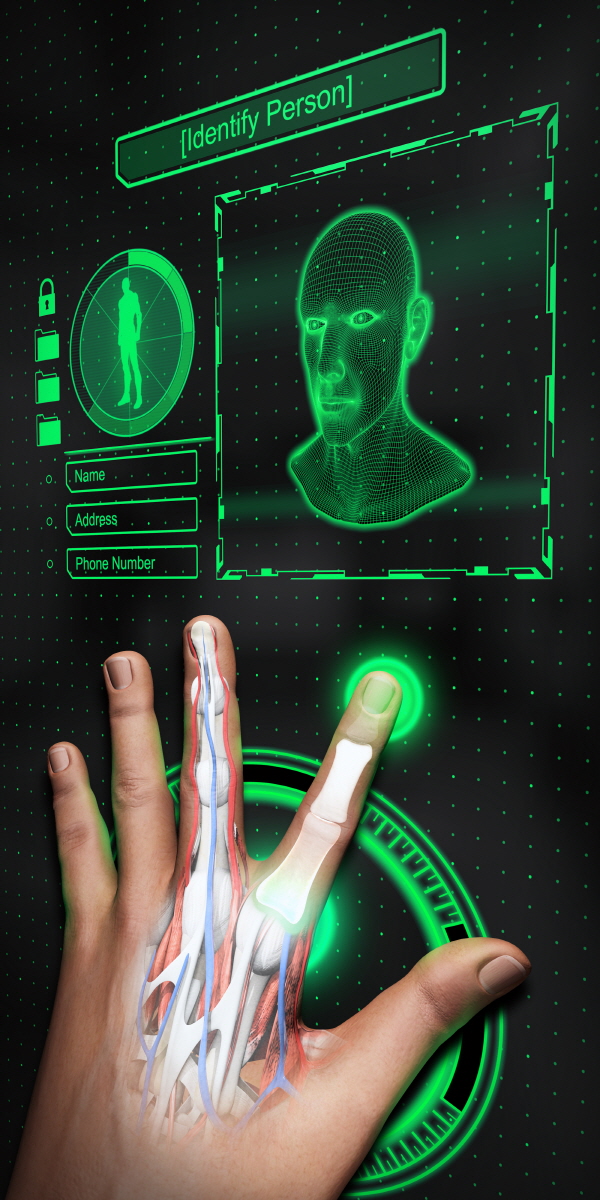
▲ ETRI has developed a biometric recognition system that converts the body's internal structure into a signal system. <Image = Korea Electronics and Telecommunications Research Institute>
The Electronics and Telecommunications Research Institute (ETRI) has implemented a technology that distinguishes individuals by converting the unique characteristics of the human body—such as bones, muscles, fat, blood vessels, blood, and bodily fluids—which differ from person to person and possess high complexity, into a signaling system.
ETRI focused its technology development on resolving the issue that currently commercialized biometric authentication technologies, such as fingerprint, iris, and facial recognition, are susceptible to duplication because they are based on image processing. While existing authentication technologies utilizing fingerprints and similar methods focused on external images, the newly developed technology leverages the internal structural characteristics of the body.
When a finger is set as the authentication target, it reflects signals that vary depending on the anatomical tissue characteristics within the finger. This distinguishes people by utilizing a method of applying mechanical signals, such as vibrations, or electrical signals, such as minute currents, to the fingers, similar to ultrasound imaging or body fat measurement during a health checkup.
The core of the system consists of biological tissue modeling, deep learning biosignal analysis, and vibration and electrode device technologies.
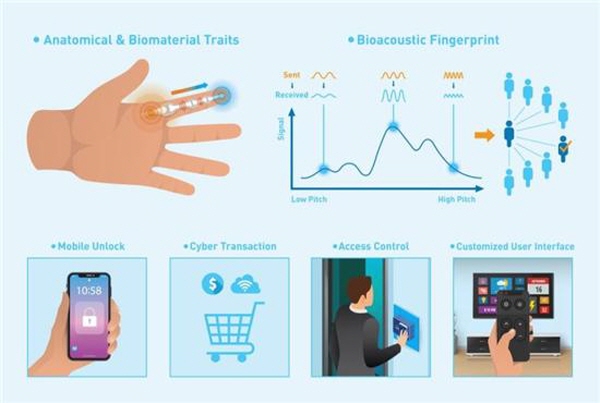
▲ Overview of a novel biometric authentication technology based on human body transmission characteristics <Image = Electronics and Telecommunications Research Institute>
The biometric recognition system is currently designed to be the size of an adult's palm to transmit electrical and acoustic signals to the human body, and consists of an energy converter, sensors, and a signal processing unit. An algorithm has been implemented that maximizes user specificity and reproducibility based on various characteristics through the combination of signals obtained from multiple sensors.
ETRI plans to develop a system in the future that can be made into a wristwatch type so that electrodes can come into contact with the wrist, and to miniaturize it into a sensor or chip form.
In addition, the research team obtained approval from the Institutional Review Board (IRB) to conduct a clinical trial on a total of 54 subjects and secured over 7,000 pieces of clinical data. The results of verifying the secured clinical data using machine learning and deep learning models confirmed that the biometric recognition accuracy exceeded 99%.
Unlike existing biometric technologies, the newly developed technology possesses the advantage of enabling continuous biometric recognition while being fundamentally impossible to duplicate. It also offers excellent convenience, allowing authentication to be performed in various locations without being limited to specific parts of the body. In addition, personal authentication is possible in an unconscious state on wearable or mobile devices.
ETRI plans to expand the scope of application through follow-up research by applying the technology to actual smartphones or wearable devices, including cyber payment, financial payment such as ATM deposits and withdrawals, automatic internet login, access control, car door handles, and the provision of customized IoT services for home use, as well as smart systems for managing patient information in hospitals.
.jpg)
Dr. Chang-Geun Ahn of ETRI’s Medical Information Research Lab stated, “It is also possible to authenticate users when they hold a smartphone or sit on a chair using a computer keyboard or mouse,” adding, “I hope that this newly developed technology will be utilized as a source technology for the future biometric recognition industry.”
Meanwhile, this achievement has been recognized for its excellence by being published in international academic journals such as Scientific Reports and IEE Transactions on Cybernetics.
Comments
Related news
KT Launches World's First 5G Medical Service at Samsung Hospital
KT and Samsung Seoul Hospital are utilizing 5G services in medical procedures for the first time globally. Through enterprise-dedicated 5G, autonomous robots in operating rooms transport supplies and medical waste, while AI services provide patient care in hospital rooms, and 5G sync cameras simultaneously transmit high-definition real-time footage of the surgeon's surgical procedures. Both companies plan to continue their collaboration with the goal of establishing a 5G smart innovative hospital.
2020.01.14by 최인영 기자
SW-led 'digital treatment' to take its first step in 2020
The Software as a Medical Device (SaMD) market continues to show growth as software such as big data, cloud computing, and artificial intelligence are increasingly applied to healthcare. There is a spreading trend of utilizing ICT technology in medical image analysis, post-traumatic stress treatment, and robotic surgery. The healthcare industry represents the sector with the highest CAGR within the overall artificial intelligence market. Korea, having a 5G network infrastructure, possesses significant growth potential in the digital healthcare market.
2020.01.15by 최인영 기자
.png)
AI-powered medical 3D printers can now produce prosthetics.
Medical 3D printing is a technology that manufactures surgical medical devices, implantable medical devices, and pre-simulation instruments in a customized manner for patients by utilizing patients' medical imaging information. ETRI announced that on December 25, 2019, two newly proposed international standards regarding medical imaging-based medical 3D printing modeling were finally approved at an international standardization group meeting.
2020.01.28by 이수민 기자
Intel Unveils Next-Generation 'Core Ultra Series 3' and vPro Platform for Enterprise PCs
Intel has officially unveiled the "Intel Core Ultra Series 3" for next-generation enterprise PCs and the latest vPro platform, addressing a wide range of demands from enterprise notebooks to high-performance workstations.
2026.03.26by 배종인 기자
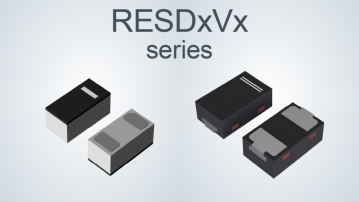
ROHM Launches ESD Protection Diode Compatible with High-Speed Interfaces of 10Gbps or Higher
Semiconductor specialist ROHM has developed the 'RESDxVx series' of ESD (electrostatic discharge) protection diodes capable of responding to next-generation high-speed data communication environments exceeding 10Gbps, simultaneously enhancing both signal quality maintenance required in high-speed interfaces and IC protection performance.
2026.03.26by 배종인 기자











