


Robotic Prosthetic Legs Become a Pillar of Support for Disabled National Merit Recipients
 Published2020.02.04 11:06
Joining hands for the distribution of smart robotic prosthetics developed with domestic technology
Robotic prosthetic legs developed with domestic technology are expected to become reliable legs for disabled national merit recipients.
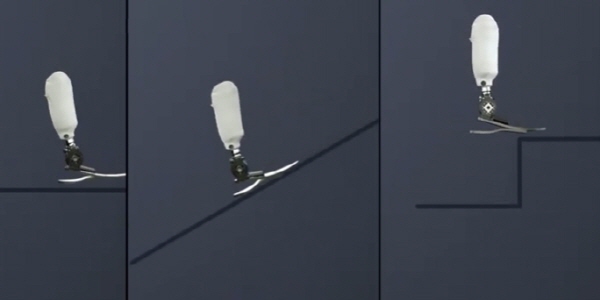
▲ KIMM, the Ministry of Patriots and Veterans Affairs, and the Central Hospital launch distribution of smart robotic prosthetics <Image = Ministry of Science and ICT>
The Korea Institute of Machinery and Materials and the Central Veterans Hospital, under the Ministry of Patriots and Veterans Affairs, will hold a demonstration of a robotic prosthetic leg at the Prosthetics Center of the Central Veterans Hospital in Seoul on the 5th and join forces to promote the distribution of smart robotic prosthetic legs to national merit recipients.
The demonstration will be attended by Minister Park Sam-deuk of the Ministry of Patriots and Veterans Affairs, President Park Cheon-hong of the Korea Institute of Machinery and Materials (KIMM), the Director of the Central Veterans Hospital, the Director of the Prosthetics Center, and Principal Researcher Woo Hyun-soo, who is in charge of research and development.
The Ministry of Patriots and Veterans Affairs has been providing prosthetic devices, such as artificial legs, to persons of national merit who have been injured in war or on official duty. With the recent increase in requests for prosthetic devices incorporating advanced technology, the Ministry has been reviewing the distribution of smart robotic prosthetic legs developed with domestic technology.
Last March, the Ministry of Patriots and Veterans Affairs and the Korea Institute of Machinery and Materials began preliminary suitability tests for robotic prosthetics on five persons of national merit. Starting in August, the scope of subjects was expanded to include Seoul and the Daejeon area, and a total of 8 people were evaluated on whether they could use robotic prosthetic legs in daily life.
Previously, from 2015 to 2017, the Medical Support Robot Research Laboratory at the Daegu Convergence Technology Center of the Korea Institute of Machinery and Materials conducted research on ankle-type robotic prosthetics for lower limb amputees with support from the Ministry of Science and ICT, and succeeded in developing a smart robotic prosthetic in April 2017.
In 2018, we embarked on technology development for the commercialization of robotic prosthetics through the ACE (Advanced Commercialization Enhancement) program, a support program for small and medium-sized enterprises of the Korea Institute of Machinery and Materials, and in 2019, we launched the project in earnest with support from the R&D Special Zone Technology Transfer Commercialization Project.
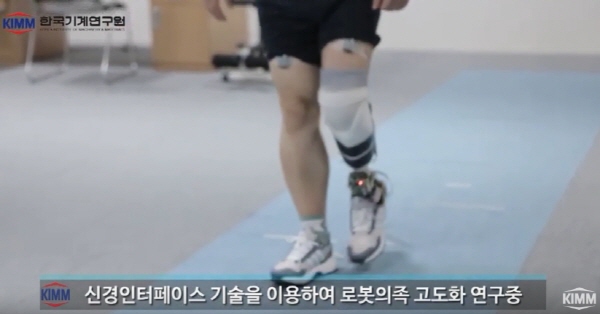
▲ KIMM pursued technology development for the commercialization of robotic prosthetics <Image = Korea Institute of Machinery and Materials>
The Ministry of Patriots and Veterans Affairs plans to continuously improve the quality of robotic prosthetics by receiving recommendations for suitable candidates from local veterans hospitals during the first half of this year and conducting a second trial service. Once quality improvement reaches a certain level, the Ministry plans to select applicants among those eligible for leg prosthetics (calf) and supply robotic prosthetics on a trial basis.
Park Cheon-hong, President of the Korea Institute of Machinery and Materials (KIMM), stated, “We will make active efforts to ensure that smart robotic prosthetics become new feet for those who have dedicated themselves to our country.”
Comments
Related news

SW-led 'digital treatment' to take its first step in 2020
The Software as a Medical Device (SaMD) market continues to show growth as software such as big data, cloud computing, and artificial intelligence are increasingly applied to healthcare. There is a spreading trend of utilizing ICT technology in medical image analysis, post-traumatic stress treatment, and robotic surgery. The healthcare industry represents the sector with the highest CAGR within the overall artificial intelligence market. Korea, having a 5G network infrastructure, possesses significant growth potential in the digital healthcare market.
2020.01.15by 최인영 기자
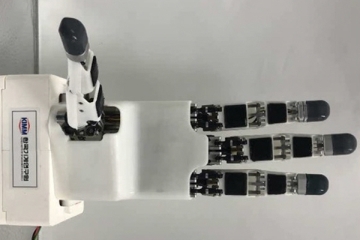
The Korea Institute of Machinery and Materials (KIMM) has developed a "humanoid robotic hand" capable of performing everyday tasks ranging from carrying eggs to cutting with scissors.
The Korea Institute of Machinery and Materials has developed a humanoid robot hand the size of a human hand capable of manipulating objects and tools in everyday life. Manufactured with a universal structure, it can be mounted on various robot arms, and its grasping force relative to weight is at world-leading levels, making it applicable not only in industrial settings but also in everyday life situations.
2020.01.22by 최인영 기자
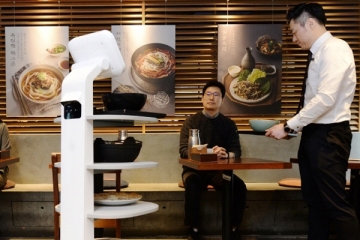
Self-driving robots deliver food from restaurants
LG Electronics and CJ Foodville have launched a service in which robots independently deliver food to customers and retrieve empty dishes. The two companies applied Cloi Servebot, which they showcased at CES 2020, to actual restaurants on January 31st. The robot is equipped with indoor autonomous driving and obstacle avoidance technology, and displays various expressions on its screen to realize a coexistence between people and robots.
2020.02.03by 최인영 기자

Nvidia invests $5 billion in Intel
NVIDIA and Intel, leaders in global AI computing technology, are now forging ahead in providing cutting-edge solutions through NVLink-based architecture integration. NVIDIA and Intel have officially announced a strategic partnership and stated that they will jointly develop customized data center and personal computing products to accelerate diverse applications and workloads ranging from hyperscale to enterprise and consumer markets, thereby laying the foundation for the next generation computing era.
2025.09.22by 배종인 기자
.jpg)
Applied Materials Launches Environmental Protection Campaign to Mark World Cleanup Day
Applied Materials Korea (CEO Park Kwang-seon) is carrying out environmental cleanup activities with employees and their families around the Dongtan Sinricheon area on the occasion of World Cleanup Day, evolving into a company that engages with the local community beyond technological innovation.
2025.09.22by 명세환 기자











