



'Korea Leads' in International Standards for Robot Modularization
 Published2020.02.07 11:38
Completed procedures for service robot modularization standard approval
Production and distribution of modular robot parts possible
Korea has taken the lead in developing international standards in the field of robot modularity, which standardizes the parts that make up robots.
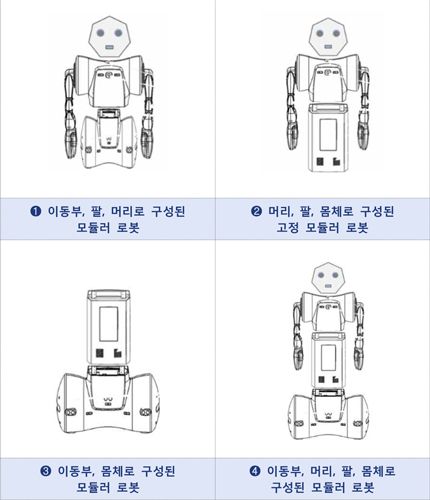
(Source = Intelligent Robot Standard Forum Standard (KOROS 1106-1))
The Ministry of Trade, Industry and Energy's National Institute of Standards and Technology announced that the international standard draft for the 'General Requirements for Modularization of Service Robots' proposed by Professor Hongseong Park of Kangwon National University at the 'Service Robot International Standardization Conference' held in Jeju from the 3rd to the 7th has completed the procedure for standard approval (Final Draft International Standard; FDIS). This document is expected to be registered as an international standard after final circulation to member countries.
This international standard defines a 'robot module' that is functionally independent among robot system components and can be partially developed, replaced, and recycled. It is a technology that is directly related to compatibility between manufacturers and the economic feasibility of robot development.
If the modularization standards for service robots are internationally standardized under the leadership of Korea, it will be possible to produce and distribute robot parts with guaranteed compatibility in a modular form, which will allow our small and medium-sized enterprises to enter the robot market more easily and is expected to promote the development of new products for various service robots.
Professor Hongseong Park of Kangwon National University proposed it as a new international standard to the International Organization for Standardization (ISO) in February 2017, and discussions have continued for the past three years. This standard is scheduled to pass the FDIS stage, the final gateway to the international standardization process, in June and be established as an international standard within this year.
In addition, Korea has laid the foundation for preempting international standards in the field of modularization of service robots by conducting detailed discussions on proposing two follow-up standards for this international standard as new international standard tasks (New Proposals; NPs) at this meeting.
Two international standard proposals specifying 'Interfaces between modules of service robots' and 'Common information for software interfaces' are scheduled to be proposed as new tasks in May and November, respectively.
In addition, Korea, led by Professor Seungbin Moon of Sejong University, proposed a revision to the 'International Standard for Service Robot Driving Performance (ISO18646-2)' in October of this year by adding performance items such as 'path accuracy', which enabled Korea to take the lead in developing a revision to the international standard for driving performance.
In the field of service robot safety standardization, LG Electronics has been at the forefront of activities to propose revised items to improve the 'excessive safety requirements that may be detrimental to the domestic industry' in the 'International Standard for Safety Requirements for Personal Assistance Robots (ISO 13482)'.
Meanwhile, around 20 experts were unable to attend this meeting due to the coronavirus outbreak, including the Chinese (7 people) and German (4 people) delegations. However, in accordance with ISO's guidelines for holding meetings, the experts who were unable to attend participated in the meeting through a web meeting.
Comments
Related news
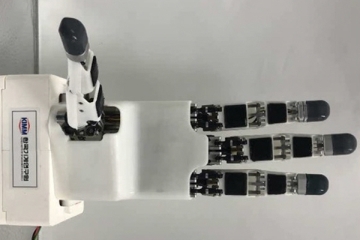
The Korea Institute of Machinery and Materials (KIMM) has developed a "humanoid robotic hand" capable of performing everyday tasks ranging from carrying eggs to cutting with scissors.
The Korea Institute of Machinery and Materials has developed a humanoid robot hand the size of a human hand capable of manipulating objects and tools in everyday life. Manufactured with a universal structure, it can be mounted on various robot arms, and its grasping force relative to weight is at world-leading levels, making it applicable not only in industrial settings but also in everyday life situations.
2020.01.22by 최인영 기자
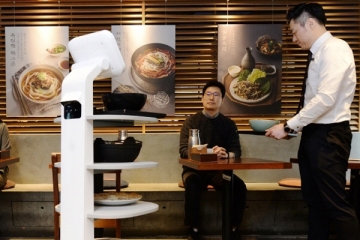
Self-driving robots deliver food from restaurants
LG Electronics and CJ Foodville have launched a service in which robots independently deliver food to customers and retrieve empty dishes. The two companies applied Cloi Servebot, which they showcased at CES 2020, to actual restaurants on January 31st. The robot is equipped with indoor autonomous driving and obstacle avoidance technology, and displays various expressions on its screen to realize a coexistence between people and robots.
2020.02.03by 최인영 기자

Robotic Prosthetic Legs Become a Pillar of Support for Disabled National Merit Recipients
The Korea Institute of Machinery and Materials, the Korea Veterans Health Service and Medical Corporation (a subsidiary of the Ministry of Patriots and Veterans Affairs), and the Central Veterans Hospital are taking active steps to distribute domestically developed smart robotic prosthetic legs to veterans with disabilities. A robotic prosthetic leg demonstration will be held at the Central Veterans Hospital's Prosthetics Center on the 5th, and suitable candidates will be recommended by each veterans hospital to proceed with a second experience service during the first half of this year.
2020.02.04by 최인영 기자
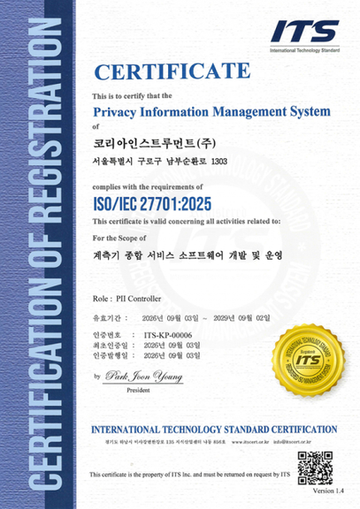
Korea Instrument, KOLAS Accredited Calibration Agency First to Simultaneously Acquire ISO/IEC 27,001·27,701
Korea Instrument has become the first among KOLAS accredited calibration agencies to simultaneously acquire ISO/IEC 27,001 and ISO/IEC 27,701 certifications. Through its proprietary platforms CWIZ Enterprise and CWIZ Partners, the company has embedded information security and personal data protection requirements across all business processes including customer information, equipment data, and calibration reports, with plans to continuously advance its management system through regular audits and security inspections.
2026.10.12by 배종인 기자
TeamViewer One, IT Incident Automation Workflow and Resolution Center Enhanced
TeamViewer has added IT incident automation capabilities and an advanced Resolution Center to its integrated digital workplace management platform 'TeamViewer ONE'. Recurrent service disruptions, configuration errors, and capacity shortages are automatically handled according to preset policies, and device status verification through script deployment can be managed in a unified interface, significantly reducing repetitive tasks for IT teams.
2026.10.12by 배종인 기자











