


LG Uplus Announces 2019 Earnings: "5G B2B & B2C to Become Future Growth Engines"
 Published2020.02.07 14:55
Wireless subscriptions increased by 1.128 million, IPTV by 458,000
Performing well in the mobile and smart home businesses
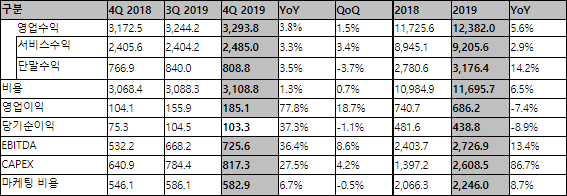
LG Uplus disclosed on the 7th that it achieved sales of 12.382 trillion won, service revenue of 9.2056 trillion won, and operating profit of 686.2 billion won in 2019. Service revenue is calculated by excluding terminal revenue from sales and adding up wired and wireless revenue.

Sales and service revenue increased by 5.6% and 2.9%, respectively, compared to the previous year. Operating profit decreased by 7.4%. Among service revenues, wireless revenue recorded 5.5168 trillion won, a 1.4% increase year-on-year.
The number of subscribers increased by 8% compared to last year, exceeding 15,256,000.
The number of budget phone subscribers increased by 42.1% year-on-year to 1,091,000. This is the result of providing a total of six types of roaming plans, including unlimited data and time-based plans, and 150GB of large-capacity LTE data every month, as well as partnering with KB Kookmin Bank to launch the financial industry's first budget phone.
Wired revenue, which is the combined revenue of smart home and enterprise, reached 4.0289 trillion won, up 4.5% from 3.8551 trillion won in the previous year due to the increase in smart home revenue.
Smart home revenue, which is the sum of revenue from IPTV, high-speed internet, and internet phone, rose 10.9% year-on-year to record 2.0462 trillion won. IPTV revenue surpassed 1 trillion won for the first time. IPTV achieved 1.0323 trillion won, a 16.6% increase from last year, while high-speed internet revenue reached 813.5 billion won, a 9% increase.
IPTV subscribers reached 4,477,000, an increase of 458,000, or 11.4%, compared to the previous year.
Enterprise revenue, which is the sum of e-Biz, IDC, dedicated lines, and telephone, recorded 1.9827 trillion won, a 1.3% decrease from the previous year. The growth of the IDC business, driven by continued orders from large domestic and global clients, minimized the impact of declining revenue in e-Biz (such as electronic payments), dedicated lines, and telephone.
Annual marketing expenses recorded 2.246 trillion won, an 8.7% increase from the previous year, driven by factors such as increased advertising and promotional costs due to the commercialization of 5G services and an increase in the total amount of official subsidies. In the fourth quarter, it decreased by 0.5% compared to the previous quarter due to the continued reduction in the cost of acquiring subscribers per person.
CAPEX amounted to 2.6085 trillion won, an 86.7% increase compared to the previous year, driven by network investments due to the full-scale construction of 5G base stations.
Driving Innovation in 2020 through Digital Transformation
LG Uplus has decided to identify future growth engines in its 5G B2C and B2B businesses. It plans to lead service competition in the B2C market through the launch of 5G 3.0 services and expand business opportunities in the B2B sector into areas such as smart factories, remote control, connected cars, smart schools, and drones.
The plan is to improve call quality through the full-scale deployment of in-building cells for the 5G network and to accelerate preparations for SA-based 5G commercialization.
We will also continue the sustained growth of smart home businesses, including IPTV and AIoT. We are also improving user convenience by introducing a new AIoT platform that enables seamless connectivity between the home and mobile devices.
We also plan to accelerate the creation of synergies by discovering various convergence services together with LG HelloVision, which was acquired last year.
Comments
Related news
LG Innotek's operating profit doubled in 2019 compared to 2018.
LG Innotek's 2019 annual revenue reached 8.3021 trillion won, with operating profit of 403.1 billion won. Revenue increased 4% year-over-year, while operating profit grew 53%. The optical solutions business, which produces camera modules, and the substrate materials business, which produces semiconductor substrates, led the performance growth.
2020.01.31by 이수민 기자
KT, operating profit 'surpasses 1 trillion' for 5 consecutive years 5G SA to be introduced within this year
KT announced that its consolidated revenue based on K-IFRS reached 24.342 trillion won in 2019, with operating profit of 1.151 trillion won. Revenue increased 3.8% year-over-year driven by growth in wired and wireless telecommunications business including 5G and media business. Operating profit decreased 8.8% year-over-year as costs increased due to network investment and marketing expenses.
2020.02.06by 이수민 기자
SKT Exceeds 1 Trillion Won in Operating Profit in 2019; "Will Refine 5G B2B Model"
SK Telecom reported annual results for 2019 on a K-IFRS basis, recording revenue of 17.7437 trillion won, operating profit of 1.11 trillion won, and net income of 861.9 billion won. Revenue reached an all-time high on an annual basis, increasing 5.2% year-over-year. Operating profit declined 7.6% year-over-year due to increased 5G network investments including 5G spectrum costs. Net income decreased 72.5% due to factors including the equity method profit impact from SK Hynix.
2020.02.07by 이수민 기자
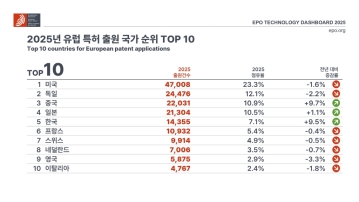
European Patent Applications Surpass 200,000 for the First Time… South Korea Maintains 5th Place, Led by Batteries and Telecommunications
According to the European Patent Office (EPO)'s 'Technology Dashboard 2025', European patent applications last year reached 201,974, surpassing 200,000 for the first time. Korean companies and inventors filed 14,355 applications, representing a 9.5% increase from the previous year and maintaining 5th place by country. Battery, digital communication, and semiconductor technologies led the growth, with Samsung ranking as the top EPO applicant for the second consecutive year and LG reaching 3rd place. The presence of major domestic cities such as Seoul, Suwon, and Yongin was also confirmed. It was also revealed that Korea's European patent strategy is expanding beyond individual technologies to span the entire industry.
2026.03.24by 명세환 기자

SK Telecom First Applies AI-Based Network Operations at Gwanghwamun K-Pop Concert
SK Telecom announced that it applied an AI-based network operation system for the first time at a large-scale K-pop concert held in the Gwanghwamun area of Seoul on March 21st, managing communication quality throughout the event. Mobile data usage during the three hours before and after the concert reached 12.15TB, approximately doubling compared to the same time slot the previous weekend. SK Telecom monitored traffic using the AI system 'A-One' in five-minute and 50-meter units to respond to potential overload situations, while also operating temporary communication facilities and on-site personnel in parallel. This case is interpreted as confirmation of the practical applicability of AI-based autonomous network operation in an environment where demand from dense events and foreign users increases simultaneously.
2026.03.23by 명세환 기자











