


Foldable phones with less screen creasing at the hinge are imminent.
 Published2020.02.07 15:15
Successful independent development of cover window manufacturing technology
On the 7th, the Korea Institute of Industrial Technology independently developed a new flexible hard-coating material applicable to foldable displays and succeeded in manufacturing a cover window with a composite structure using it.
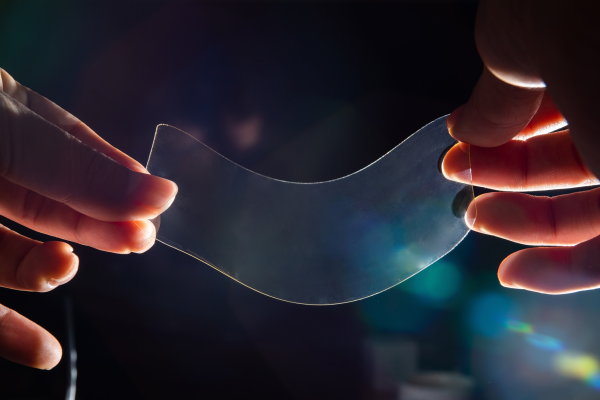
Most displays on various IT devices, such as smartphones, are equipped with a 'cover window' made of glass. This component protects the display substrate from external impacts, contamination, and fingerprints, and is an essential part of the display manufacturing process.
Tempered glass has been primarily used for IT devices that frequently utilize touch functions. On the other hand, foldable phones are applying 'Colorless Polyimide (CPI),' a plastic material with excellent flexibility that allows them to be folded and unfolded, instead of conventional glass materials.
Cover windows made of CPI have high light transmittance, do not break, and are durable enough to withstand hundreds of thousands of folds. However, it is more susceptible to scratches than glass material, and there is a high possibility of deformation, such as wrinkles, occurring in the hinge part that acts as a joint when folding or unfolding.
The industry is pushing for the development of Ultra Thin Glass (UTG), a foldable ultra-thin tempered glass, but is facing difficulties in mass production due to a lack of technology to make the glass thin and low yields.
A research team led by Dr. Yong-Cheol Jeong of the Micro-Nano Process Group at the Institute of Science and Technology launched research in 2015 to address the shortcomings of these materials, and after five years of effort, developed a new flexible hard-coating material capable of simultaneously achieving glass-level hardness and plastic-level flexibility.
The newly developed material is a type of glass material that allows for free molding and processing; it is a nanostructure artificially formed to possess properties intermediate between silicate (SiO2), which is close to ceramic, and silicon oil (SiO).
By controlling the connection structure and ratio between silicon (Si) and oxygen (O), desired properties ranging from hard to soft, such as ceramics, rubber, and oil, can be easily produced, and in particular, conflicting properties such as hardness and flexibility can be realized on a single sheet.
The research team succeeded in fabricating a cover window in the form of a composite structure (Rigid-Soft-Rigid; RSR) in which the flat sides of the foldable phone are rigid but the hinge area is flexible by controlling the physical properties of this new material.
The hardness of the manufactured cover window is high at the 9H level, which is close to that of tempered glass, so it does not get scratched even if it is scratched hard multiple times with a car key or similar object. In addition, it does not break even when bent up to a radius of curvature of 1R, possessing flexibility equivalent to CPI material, and maintains durability even after approximately 200,000 repeated uses. Among foldable methods, it is possible to apply both in-folding (folding inward) and out-folding (folding outward), making it highly versatile.
In addition, the research team verified the feasibility of mass production based on a roll-to-roll process by successfully producing cover windows continuously using a self-developed slot coater.
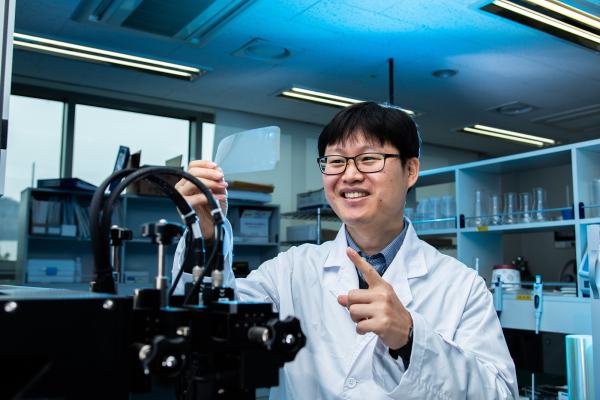
Dr. Jeong Yong-cheol predicted, “In addition to foldable phones, the application range of new flexible materials will be extensive, including secondary battery separators, optical module coatings, automotive curved foam molding, and the construction and furniture sectors.”
Meanwhile, market research firm Counterpoint Research projected that foldable phone sales would surge from 400,000 units in 2019 to 36.8 million units in 2023.
Comments
Related news
OLED displays for VR and AR are manufactured on glass substrates.
To implement vivid image quality in VR·AR device displays, PPI must be increased, and it must be proportionally improved as the display comes closer to the eyes. The Korea Institute of Science and Technology has successfully developed process technology capable of manufacturing VR·AR OLED pixels in RGB format on a glass substrate, achieving a resolution of 1,867 PPI.
2019.11.25by 이수민 기자
Commercialization of next-generation micro LED roll transfer technology is underway.
Micro LED roll transfer technology, which is expected to improve the productivity of micro LED displays attracting attention as the next-generation display following OLED, is being commercialized. Micro LED roll transfer technology is a process that manufactures micro LED panels by using a roll stamp to pick up micro LED devices from a temporary substrate and place them at desired positions on a flexible circuit board.
2019.12.19by 이수민 기자
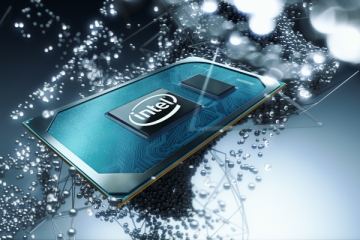
Will Foldable Laptops Be Commercialized? Intel CES 2020 Highlights
Intel held a press briefing at CES 2020 in Las Vegas, USA, and made announcements on autonomous driving AI, mobile computing innovation, and enhanced immersion in sports and entertainment together with subsidiaries such as Mobileye and partners including Lenovo, Netflix, and the American Red Cross.
2020.01.07by 이수민 기자
ESP32 Development Environment Selection and GPS Application Implementation
The ESP32 is a microcontroller that integrates Wi-Fi, Bluetooth, 12-bit ADC, capacitive touch, PWM, DAC, and UART in a single SoC. However, the abundance of features does not by itself solve the designer's problems. The real challenges lie in selecting the appropriate development environment, determining which pins can be used and which must be avoided, and converting raw data from modules into usable information. This document addresses ESP32 peripheral constraints (ADC2 and Wi-Fi coexistence limitation, UART1 occupancy, ADC non-linear regions), the trade-offs between Arduino IDE and ESP-IDF, and the process from connecting NEO-6M/NEO-M8N GPS modules to UART2, parsing NMEA sentences, and visualizing routes in Google Earth, all organized based on documented references.
2026.10.12by 편집부
MIPI CSI-2, DSI-2, C-PHY, D-PHY Test Solution Technical White Paper
The MIPI interface adopts a burst mode that transitions between low-power (LP) and high-speed (HS) states for low-power consumption, and in return, strict timing rules are imposed on state transitions. Additionally, the high-speed section operates as a packet-based protocol with headers, ECC, and CRC, so verification engineers must handle waveforms and protocols simultaneously. Traditional configurations combining general-purpose oscilloscopes and AWGs reveal limitations in setup complexity, measurement uncertainty, and lack of reproducibility when faced with these requirements. This white paper, based on webinar materials, organizes the structure of this problem and describes how the SV5C-DPTXCPTX generator for receiver testing and SV5C-DPRXCPRX analyzer for transmitter testing integrate state transition testing, stressed eye testing, and protocol analysis into a single bench, along with their application boundaries.
2026.10.12by 편집부











