


Thermal imaging cameras provide safe speed information in icy areas.
 Published2020.02.13 10:37
Reduce the possibility of accidents by considering the characteristics of the icy section and weather conditions.
In the future, when driving through icy sections of the road, drivers will be able to receive speed limits in advance through variable speed limit signs or variable message signs (VMS).
On February 13, the Ministry of Land, Infrastructure and Transport and the National Police Agency established a plan to adjust the speed limit in 403 ice-prone management sections to allow drivers to drive at an appropriate speed according to the characteristics of the sections and weather conditions.
This follows the winter road traffic safety enhancement measures announced last January, and aims to reduce the possibility of accidents by adjusting vehicle speeds depending on areas and times vulnerable to ice formation.
While the previous measures focused on eliminating blind spots in winter traffic accidents by establishing a preventive snow removal system on all road sections and expanding safety facilities such as automatic salt spray facilities in ice-prone management sections, this speed limit adjustment plan focuses on encouraging drivers to drive at an appropriate speed by flexibly adjusting the speed limit according to the ice-prone management sections and characteristics, weather conditions, etc.
The speed limit adjustment plan includes ▲establishing a speed limit adjustment system in ice-prone management sections ▲providing drivers with information on the adjusted speed limit ▲inducing them to drive within the adjusted speed limit, etc.
Establishment of a speed limit adjustment system
For sections vulnerable to ice managed by road management agencies, the speed limit will be reduced in the future after consultation with the National Police Agency.
If it is predicted that black ice will form on the road due to snowfall or rain, or if there is a risk of freezing due to fog or frost, or if the road surface temperature is below 2℃ during rain, When the air temperature is below 4℃, the road management agency classifies the area as a vulnerable area to ice formation according to the standards for pre-spraying deicing agents.
According to this speed limit adjustment plan, the principle is to reduce the speed by 50% of the original speed limit, but if necessary, the speed will be adjusted to less than that, taking into account the characteristics of the section and weather conditions.
Additionally, an intelligent speed control system will be introduced that automatically detects road surface temperature using thermal imaging cameras and other devices, enabling real-time response to weather conditions.
This year, we plan to conduct a pilot project (20 locations) focusing on the most vulnerable areas to freezing, and expand it to other areas after verifying accuracy.
The Ministry of Land, Infrastructure and Transport and the National Police Agency plan to jointly establish a manual (tentative name) for operating speed limits in ice-prone areas, including details such as speed limit reduction, operation, and readjustment, by June, and apply it to the field starting in the second half of the year.
Provide speed limit information
As soon as the speed limit is adjusted, variable speed limit signs and variable message signs (VMS) are installed in the entire ice-prone management section to provide guidance to drivers.
Remotely controllable variable speed limit signs are installed annually according to the ice vulnerability level, and at regular intervals (800 m on expressways, 400 m on national roads) within ice vulnerability management sections. Auxiliary signs are installed at the start and end points of each section.
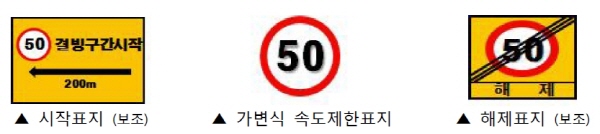
In addition, VMS is installed in front of the entire ice-vulnerable management section to display the adjusted speed limit on the screen, and speed limit information is also notified to drivers through the navigation route guidance screen using a smartphone application.
.jpg)
Encourage speed limit driving
Speed cameras are installed in sections vulnerable to ice management and sections with a high risk of ice formation to prevent speeding.
By immediately linking and operating speed cameras when adjusting the speed limit, drivers are encouraged to comply with the speed limit.
Kim Yong-seok, director of the Ministry of Land, Infrastructure and Transport’s Road Bureau, said, “Through this speed limit adjustment plan, we will be able to lower vehicle speeds in areas and times vulnerable to freezing, thereby reducing the possibility of accidents caused by black ice on the roads.” He added, “We will do our best to ensure road traffic safety during the winter by smoothly implementing follow-up measures to the measures announced last January.”
Comments
Related news
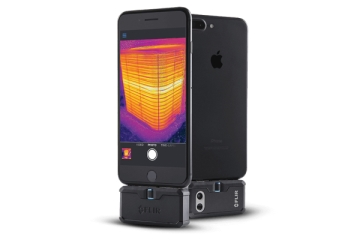
Professional-grade thermal imaging camera that fits on your smartphone
Flir has launched the FLIR ONE Pro LT, a low-cost thermal imaging camera that can be used in conjunction with a smartphone. It offers various thermal imaging camera functions and professional-grade tools that can be expected from the existing FLIR ONE Pro series at a price point in the 300,000 won range.
2018.08.07by 이수민 기자
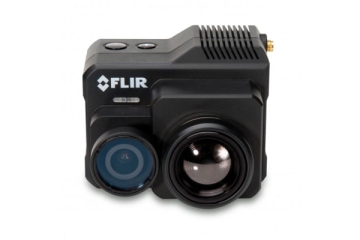
FLIR Delivers Thermal Imaging Camera-Equipped Drones to Korea South-East Power
FLIR Systems Korea announced that Korea South-East Power has improved inspection efficiency for its photovoltaic power generation facilities by utilizing drone equipment equipped with FLIR Duo Pro R thermal imaging camera modules, and is currently reviewing plans to introduce drone-type thermal imaging camera equipment to additionally planned photovoltaic power generation facilities.
2019.10.03by 최인영 기자
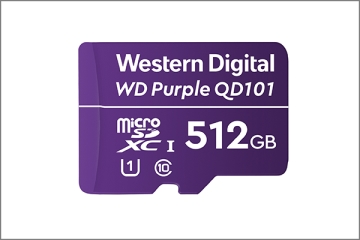
Western Digital Announces Two Purple Storage Products for 24/7 Recording Cameras
According to IHS Markit, global shipments of professional video security surveillance cameras are projected to increase from 140 million units in 2018 to 224 million units in 2023. Accordingly, storage installed in cameras is also expected to grow at an average annual rate of approximately 17%. In response, Western Digital has introduced two types of security surveillance storage optimized for video and AI analytics at the network edge: the WD Purple SC QD101 Ultra Endurance microSD card and the WD Purple 14TB HDD.
2019.11.07by 이수민 기자

[e4ds Tech Day 2026 ⑨] Sim Sang-gyu, Autocrypt CTO: "In the Physical AI Era, Automotive Security Must Extend Beyond the Vehicle"
At e4ds Tech Day 2026, Sim Sang-gyu, CTO of Autocrypt, explained automotive cybersecurity strategies in the era of Physical AI and SDV (Software-Defined Vehicle). Automobiles are evolving as part of an ecosystem connected to AI, cloud, chargers, IoT, and robots, and he emphasized that the scope of security must expand beyond the vehicle interior to the entire connected environment. In particular, AI model tampering, adversarial attacks, OTA updates, and EV charger hacking were identified as major threats. He explained that response measures require zero trust, AI model integrity protection, intrusion detection, Security by Design and Default, and full lifecycle security management, and that proactive security system establishment beyond regulatory compliance is critical for securing future mobility competitiveness.
2026.10.12by 배종인 기자
Practical HIL Construction Strategy for Automotive and Off-Highway Controller Validation
As vehicle E/E architecture transitions to zonal structures and shifts to software-defined vehicles (SDV), the number of controllers (ECUs) requiring validation and software complexity are surging dramatically. Meanwhile, real vehicle testing cannot provide repeated verification under identical conditions and entails lead time and safety concerns. This white paper explains the principles of HIL (Hardware-in-the-Loop) validation and the structure of the NI platform composed of PXI, SLSC, and VeriStand, and through two actual implementation cases—Camera Record & Replay HIL for In-Cabin Monitoring Controller (ICMU) and Forklift Controller (VCU) HILS—describes how controller-level regression testing becomes possible. Additionally, it explicitly states application boundaries and limitations, such as lack of A2B support.
2026.10.12by 편집부











