This page was machine-translated and may differ from the original. View original
What are the key issues that determine success and failure for PAV (Personal Air Vehicle), the future transportation means taking to the skies?

Commute time reduction of up to 80~90% during peak hours
Ministry of Science and Technology pursuing Data·Network·AI drone technology development
Drone taxi and other sectors expected to grow to 1.5 trillion dollars by 2040
In films such as Back to the Future (1987), The Fifth Element (1997), and Blade Runner 2049 (2017), flying cars commonly appear. Beginning with the Autoplane developed by American aircraft designer Glenn Curtiss approximately 100 years ago, humanity's aspiration to take to the skies is now becoming a reality.
.jpg)
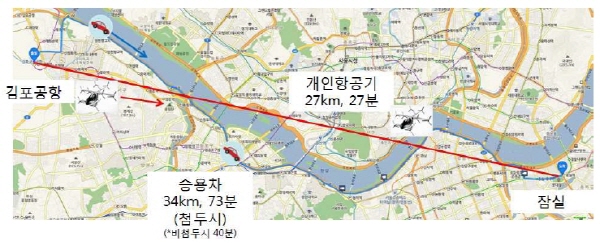
▲ Conceptual image of OPPAV operation over Seoul airspace <Image=Ministry of Science and Technology, ICT and Future Planning>
An era is expected to arrive in 2023 where commuting by flying car becomes possible.
Global companies including Boeing, Airbus, Audi, Mercedes-Benz, Porsche, and Hyundai Motor are already viewing drone taxis as a new growth driver and conducting large-scale investments. Uber announced in June that it plans to launch Uber Air, a commercial service operating vertical takeoff and landing aircraft in the same manner as existing Uber, beginning in 2023.
The Korean government is also actively working to secure dedicated drone routes and establish traffic management systems by converging core 4th Industrial Revolution technologies such as 5G, AI, and cloud.
Relevant government departments including the Ministry of Land, Infrastructure and Transport and the Ministry of Science and Technology, ICT and Future Planning are implementing a 5-year plan for unmanned vehicle development (2016), a 10-year roadmap for unmanned vehicle technology innovation and growth (2017), an unmanned vehicle fundamental technology development project (2018), and an unmanned vehicle future-leading core technology development project implementation plan (2019).

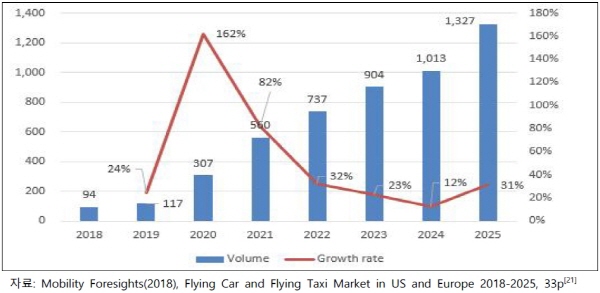
▲ PAV aerial taxi and individual PAV market size and growth rate by demand units from 2018 to 2025 <Source=KARI>
According to data released by global investment specialist Morgan Stanley in January of last year, the global market for autonomous vertical takeoff and landing aircraft such as drone taxis is expected to grow to 1.5 trillion dollars (approximately 1,774 trillion Korean won) by 2040.
A Ministry of Land, Infrastructure and Transport official stated, "Drone taxi commercialization could reduce commute times by 80~90 percent," and added, "While a private vehicle journey from Gimpo Airport to Jamsil during commute hours takes 73 minutes, using a drone would take only 12 minutes. Similarly, a public transit journey from Incheon Airport to the Gwacheon Government Complex takes 122 minutes, but a drone could complete it in 17 minutes, which will help alleviate traffic congestion in the Seoul metropolitan area."

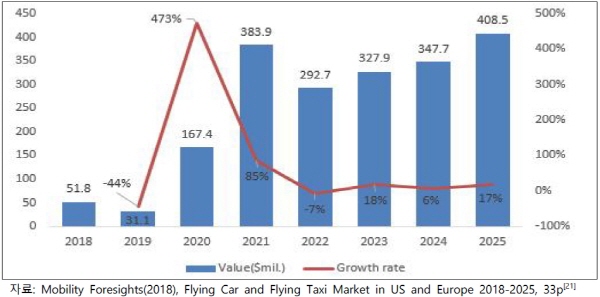
▲ Overall PAV market value and growth rate including the aerial taxi sector from 2018 to 2025 <Source=KARI>
Recently at CES 2020, numerous technologies related to urban air mobility taking to the skies—including personal aircraft (PAV) and flying taxis—were unveiled, drawing attention to PAV (Personal Air Vehicle) as a future transportation mode. Hyundai Motor showcased the personal aircraft S-A1 in collaboration with Uber, a 5-seater electric vertical takeoff and landing aircraft.
For PAV development, Hanwha Systems invested approximately 29.5 billion won in U.S.-based K4 Aeronautics, and the Korea Aerospace Research Institute recently began development of a 1-2 seater personal aircraft with a maximum speed of 200 km/h.

▲ Overall PAV market value and growth rate including the aerial taxi sector from 2018 to 2025 <Source=KARI>
Core Technologies for PAV Realization
To establish three-dimensional traffic networks, it is necessary to refine relevant laws and systems and establish core technologies such as detection and recognition, autonomous intelligence, and system technologies, as well as fundamental technologies including navigation sensors, mission sensors, condition diagnosis and prediction, and remote control.
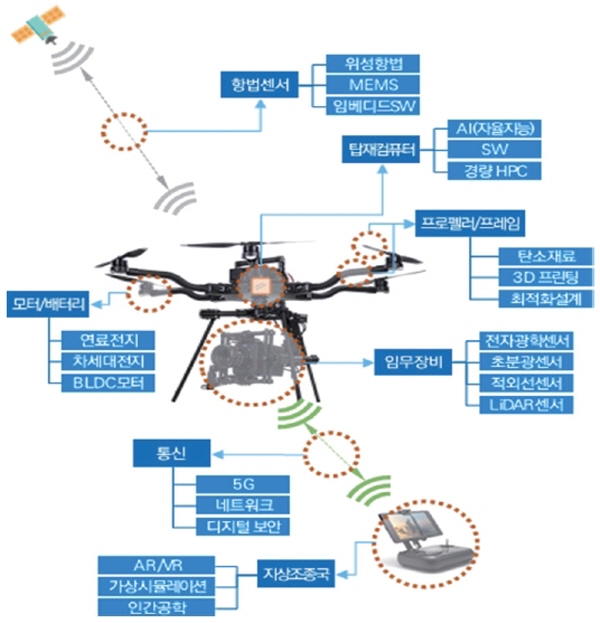
PAV core technologies are being developed in areas including ▲propulsion systems ▲materials and structure ▲control and safety ▲aerodynamics ▲navigation and communication ▲batteries ▲cybersecurity.

▲ Drone configuration <Image=Ministry of Science and Technology, ICT and Future Planning>
For propulsion systems, technologies needed include electric vertical takeoff and landing (eVTOL), improved engine output efficiency, noise reduction technologies for power and thrust systems (such as Ducted Fan), next-generation rotor and propeller technologies (Bladeless Propeller), and power electronics devices (Power Drive).
In the materials and structure sector, lightweight high-strength composite material development and application, optimal design technology for lightweight airframes (such as Fly by Wire), and shape-changing technology for Dual Mode (road and flight) movement (such as Tiltable Fan) must be developed.
The control and safety domain requires prior research on improved controllability and thrust control, complex safety structure mechanism (Fail-Safe Mechanism) design, pilot ejection systems and ballistic recovery parachutes, and biometric sensors.
The navigation and communication field requires automatic flight and autonomous flight technologies, optimal route prediction technology, multi-PAV control technology, obstacle detection and collision avoidance algorithms and sensors, and technologies such as GPS.
Additionally, lift maximization and drag minimization technology through optimal body shape design, along with next-generation battery technologies including fuel cells, nickel-metal hydride batteries, and lithium-ion batteries, and research on improved energy density must be conducted.
.jpg)
▲ Classification of vehicles according to operating environment and intended use <Source=Ministry of Science and Technology, ICT and Future Planning>
Preconditions for PAV Commercialization
For PAV to be commercialized, noise issues generated during flight from engines and rotor blades must be resolved. PAVs to be released to the market in the future are expected to apply distributed electric propulsion, which is advantageous for noise reduction. Recently, blade-free propeller (Bladeless Propeller) technology is also under development.

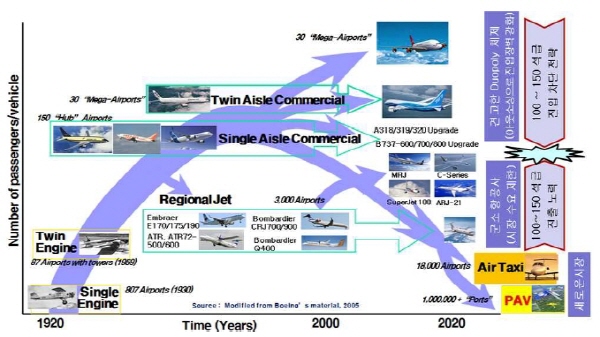
▲ Market bifurcation in civil aviation <Source=Ministry of Science and Technology, ICT and Future Planning>
For multiple PAVs to operate through autonomous or advanced automatic flight, cybersecurity is an equally important aspect that cannot be overlooked. Implementation of a connected system based on stable communication technology between aircraft is necessary.
If a single PAV is exposed to external cyber-hacking attacks, not only connected other PAVs but also all infrastructure in an IoT environment such as air traffic control could face serious security issues.
To realize communication and autonomous flight technologies, infrastructure connected to PAVs will become increasingly digitalized, and functions implemented on a software basis will increase. As the number of electronic control units (ECUs) within PAVs increases significantly, the potential attack points for cyber-hacking targets will also multiply.

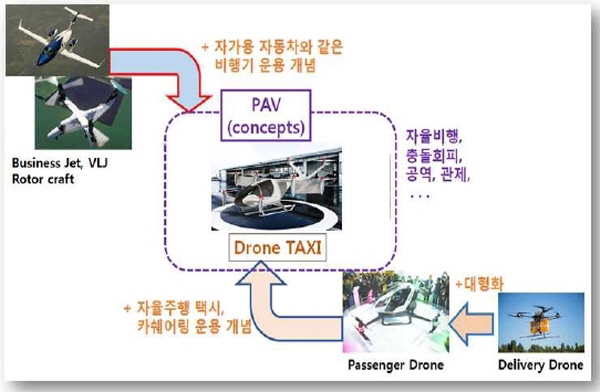
▲ OPPAV development approach <Source=Ministry of Science and Technology, ICT and Future Planning>
Furthermore, for PAV to be utilized as a resource for military and police operations, next-generation high-performance control technologies must be secured to enable turboprop engines like tilting ducts to rotate and propel in multiple directions.
Moreover, for PAV to gain sufficient public trust, it must be equipped with systems capable of predicting and diagnosing failures based on data transmitted from sensors within the PAV body, emergency ejection systems to evacuate pilots or passengers in case of emergency, and ballistic recovery parachutes that deploy on the PAV itself in case of problems to prevent casualties. Various high-reliability multi-stage fail-safe technologies including biometric sensors enabling automatic PAV landing must accompany these measures.

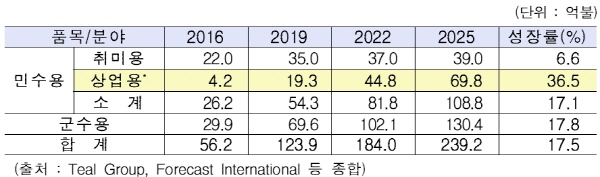
▲ Global unmanned aircraft market forecast <Source=Ministry of Science and Technology, ICT and Future Planning>
PAV Market Outlook
The PAV market has recently surged due to the maturation of drone-related technologies and large service providers' service provision plans aimed at promoting increased personal mobility freedom.
According to a report by global mobility consulting specialist Mobility Foresights, PAVs supplied to aerial taxi services and individual PAVs totaled 94 units as of 2018. Assuming a compound annual growth rate (CAGR) of 46%, this is projected to reach 1,327 units by 2025.
Additionally, the overall PAV market value is expected to grow from approximately 50 million dollars in 2018 to approximately 400 million dollars by 2025, assuming a CAGR of 34.3%. The future market value for PAV is expected to vary significantly based on the development trajectory of core technology mix according to business type and the resulting legal and regulatory framework.
Global investment specialist Morgan Stanley forecasted that the PAV market will grow to 2.9 trillion dollars by 2040.

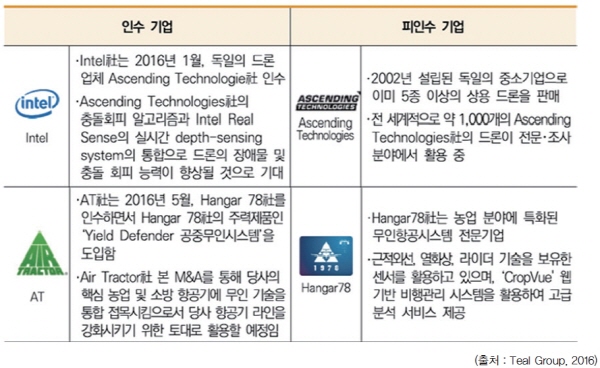
▲ Global company drone market acquisition examples <Source=Ministry of Science and Technology and Job Promotion Institute>
As technologies related to low-noise, zero-emission distributed electric motors and batteries, autonomous flight (AI), and IoT continue to advance, and large personal transportation service providers such as Uber in the United States proceed with their business plans, the PAV market is drawing worldwide attention.
NASA (U.S. National Aeronautics and Space Administration) forecasted that the PAV market will reach 250,000 units annually by 2030 (approximately 3% of the global automobile market), while the Korea Industrial Development Institute predicted that by 2030 a global market of approximately 190,000 units annually (approximately 6,200 units domestically annually) will form with an annual average growth rate of 5.6%.

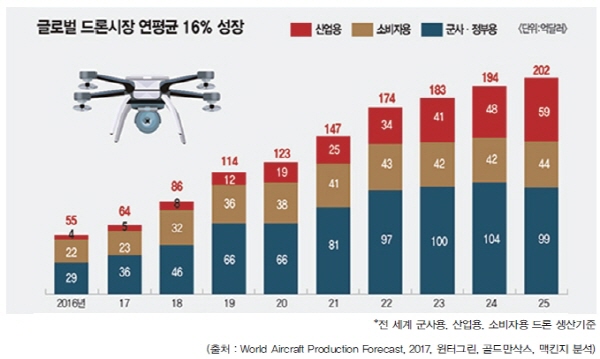
▲ Global drone market growth rate <Source=Ministry of Science and Technology and Job Promotion Institute>
Drones are an aggregate of core 4th Industrial Revolution technologies, incorporating technologies such as artificial intelligence, embedded sensors, software, and 5G communication. As the scope of drone applications and utilization expands, the importance of location-based information increases, and research and development into precision navigation systems is actively underway.
Along with this, commercialization of open-source platforms for drone operation and control is actively progressing. Open-source platforms include ArduPilot, MultiWii, Flexbot, and OpenPilot.
As drones become more active, misuse cases such as illegal recording and terrorist threats are expected to increase. Accordingly, technology development for comprehensive anti-drone systems equipped with counter-unmanned aircraft air defense solutions is also underway. This includes detection technology according to sensors (acoustic, directional, visual, LIDAR, etc.), flight neutralization technology (radio jamming, drone destruction, capture, etc.), and detection and identification technology.
.jpg)
▲ Current status of drone manufacturers by country <Source=Ministry of Science and Technology and Job Promotion Institute>
In December, the Ministry of Science and Technology, ICT and Future Planning announced the "2020 Unmanned Vehicle Technology Development Project Implementation Plan" and will invest a total of 26.9 billion won to develop common component technologies applicable to all land, sea, and air unmanned vehicles and to implement an integrated operation system for autonomous cooperation among multiple unmanned vehicles.
To create new drone service models, DNA+ drone technology development incorporating ▲Data ▲Network ▲AI technologies will be conducted from 2020 to 2024, for which the Ministry of Science and Technology, ICT and Future Planning allocated a total of 45 billion won. Additionally, it will invest 3 billion won in 2020 for low-altitude unmanned aircraft traffic management system technology development, 2.5 billion won in growth support for unmanned vehicle small and medium enterprises, and 1.7 billion won in unmanned aircraft development for disaster prevention and response.

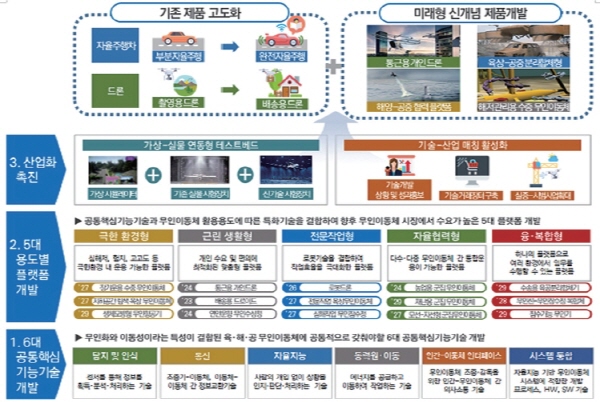
▲ 10-year roadmap for unmanned vehicle technology innovation and growth <Source=Ministry of Science and Technology, ICT and Future Planning>
Previously in 2017, the 10-year roadmap for unmanned vehicle technology innovation and growth was announced, and plans for development of 6 core functional technologies and 5 use-specific platforms were disclosed.
The 6 common core functional technologies are ▲detection and recognition ▲autonomous intelligence ▲human-vehicle interface ▲communication ▲movement and operations ▲system integration, and the 5 use-specific platforms include ▲operation in extreme environments such as deep sea, contaminated areas, and high altitude (extreme environment type) ▲optimization for individual needs and convenience (local living type) ▲maximization of operational efficiency through robot technology integration (professional operation type) ▲integrated operation capability among multiple and diverse unmanned vehicles (autonomous cooperation type) ▲convergence and fusion type.
Ministry of Science and Technology pursuing Data·Network·AI drone technology development
Drone taxi and other sectors expected to grow to 1.5 trillion dollars by 2040
In films such as Back to the Future (1987), The Fifth Element (1997), and Blade Runner 2049 (2017), flying cars commonly appear. Beginning with the Autoplane developed by American aircraft designer Glenn Curtiss approximately 100 years ago, humanity's aspiration to take to the skies is now becoming a reality.
.jpg)
▲ Conceptual image of OPPAV operation over Seoul airspace <Image=Ministry of Science and Technology, ICT and Future Planning>
An era is expected to arrive in 2023 where commuting by flying car becomes possible.
Global companies including Boeing, Airbus, Audi, Mercedes-Benz, Porsche, and Hyundai Motor are already viewing drone taxis as a new growth driver and conducting large-scale investments. Uber announced in June that it plans to launch Uber Air, a commercial service operating vertical takeoff and landing aircraft in the same manner as existing Uber, beginning in 2023.
The Korean government is also actively working to secure dedicated drone routes and establish traffic management systems by converging core 4th Industrial Revolution technologies such as 5G, AI, and cloud.
Relevant government departments including the Ministry of Land, Infrastructure and Transport and the Ministry of Science and Technology, ICT and Future Planning are implementing a 5-year plan for unmanned vehicle development (2016), a 10-year roadmap for unmanned vehicle technology innovation and growth (2017), an unmanned vehicle fundamental technology development project (2018), and an unmanned vehicle future-leading core technology development project implementation plan (2019).

▲ PAV aerial taxi and individual PAV market size and growth rate by demand units from 2018 to 2025 <Source=KARI>
According to data released by global investment specialist Morgan Stanley in January of last year, the global market for autonomous vertical takeoff and landing aircraft such as drone taxis is expected to grow to 1.5 trillion dollars (approximately 1,774 trillion Korean won) by 2040.
A Ministry of Land, Infrastructure and Transport official stated, "Drone taxi commercialization could reduce commute times by 80~90 percent," and added, "While a private vehicle journey from Gimpo Airport to Jamsil during commute hours takes 73 minutes, using a drone would take only 12 minutes. Similarly, a public transit journey from Incheon Airport to the Gwacheon Government Complex takes 122 minutes, but a drone could complete it in 17 minutes, which will help alleviate traffic congestion in the Seoul metropolitan area."

▲ Overall PAV market value and growth rate including the aerial taxi sector from 2018 to 2025 <Source=KARI>
Recently at CES 2020, numerous technologies related to urban air mobility taking to the skies—including personal aircraft (PAV) and flying taxis—were unveiled, drawing attention to PAV (Personal Air Vehicle) as a future transportation mode. Hyundai Motor showcased the personal aircraft S-A1 in collaboration with Uber, a 5-seater electric vertical takeoff and landing aircraft.
For PAV development, Hanwha Systems invested approximately 29.5 billion won in U.S.-based K4 Aeronautics, and the Korea Aerospace Research Institute recently began development of a 1-2 seater personal aircraft with a maximum speed of 200 km/h.

▲ Overall PAV market value and growth rate including the aerial taxi sector from 2018 to 2025 <Source=KARI>
Core Technologies for PAV Realization
To establish three-dimensional traffic networks, it is necessary to refine relevant laws and systems and establish core technologies such as detection and recognition, autonomous intelligence, and system technologies, as well as fundamental technologies including navigation sensors, mission sensors, condition diagnosis and prediction, and remote control.
PAV core technologies are being developed in areas including ▲propulsion systems ▲materials and structure ▲control and safety ▲aerodynamics ▲navigation and communication ▲batteries ▲cybersecurity.

▲ Drone configuration <Image=Ministry of Science and Technology, ICT and Future Planning>
For propulsion systems, technologies needed include electric vertical takeoff and landing (eVTOL), improved engine output efficiency, noise reduction technologies for power and thrust systems (such as Ducted Fan), next-generation rotor and propeller technologies (Bladeless Propeller), and power electronics devices (Power Drive).
In the materials and structure sector, lightweight high-strength composite material development and application, optimal design technology for lightweight airframes (such as Fly by Wire), and shape-changing technology for Dual Mode (road and flight) movement (such as Tiltable Fan) must be developed.
The control and safety domain requires prior research on improved controllability and thrust control, complex safety structure mechanism (Fail-Safe Mechanism) design, pilot ejection systems and ballistic recovery parachutes, and biometric sensors.
The navigation and communication field requires automatic flight and autonomous flight technologies, optimal route prediction technology, multi-PAV control technology, obstacle detection and collision avoidance algorithms and sensors, and technologies such as GPS.
Additionally, lift maximization and drag minimization technology through optimal body shape design, along with next-generation battery technologies including fuel cells, nickel-metal hydride batteries, and lithium-ion batteries, and research on improved energy density must be conducted.
.jpg)
▲ Classification of vehicles according to operating environment and intended use <Source=Ministry of Science and Technology, ICT and Future Planning>
Preconditions for PAV Commercialization
For PAV to be commercialized, noise issues generated during flight from engines and rotor blades must be resolved. PAVs to be released to the market in the future are expected to apply distributed electric propulsion, which is advantageous for noise reduction. Recently, blade-free propeller (Bladeless Propeller) technology is also under development.

▲ Market bifurcation in civil aviation <Source=Ministry of Science and Technology, ICT and Future Planning>
For multiple PAVs to operate through autonomous or advanced automatic flight, cybersecurity is an equally important aspect that cannot be overlooked. Implementation of a connected system based on stable communication technology between aircraft is necessary.
If a single PAV is exposed to external cyber-hacking attacks, not only connected other PAVs but also all infrastructure in an IoT environment such as air traffic control could face serious security issues.
To realize communication and autonomous flight technologies, infrastructure connected to PAVs will become increasingly digitalized, and functions implemented on a software basis will increase. As the number of electronic control units (ECUs) within PAVs increases significantly, the potential attack points for cyber-hacking targets will also multiply.

▲ OPPAV development approach <Source=Ministry of Science and Technology, ICT and Future Planning>
Furthermore, for PAV to be utilized as a resource for military and police operations, next-generation high-performance control technologies must be secured to enable turboprop engines like tilting ducts to rotate and propel in multiple directions.
Moreover, for PAV to gain sufficient public trust, it must be equipped with systems capable of predicting and diagnosing failures based on data transmitted from sensors within the PAV body, emergency ejection systems to evacuate pilots or passengers in case of emergency, and ballistic recovery parachutes that deploy on the PAV itself in case of problems to prevent casualties. Various high-reliability multi-stage fail-safe technologies including biometric sensors enabling automatic PAV landing must accompany these measures.

▲ Global unmanned aircraft market forecast <Source=Ministry of Science and Technology, ICT and Future Planning>
PAV Market Outlook
The PAV market has recently surged due to the maturation of drone-related technologies and large service providers' service provision plans aimed at promoting increased personal mobility freedom.
According to a report by global mobility consulting specialist Mobility Foresights, PAVs supplied to aerial taxi services and individual PAVs totaled 94 units as of 2018. Assuming a compound annual growth rate (CAGR) of 46%, this is projected to reach 1,327 units by 2025.
Additionally, the overall PAV market value is expected to grow from approximately 50 million dollars in 2018 to approximately 400 million dollars by 2025, assuming a CAGR of 34.3%. The future market value for PAV is expected to vary significantly based on the development trajectory of core technology mix according to business type and the resulting legal and regulatory framework.
Global investment specialist Morgan Stanley forecasted that the PAV market will grow to 2.9 trillion dollars by 2040.

▲ Global company drone market acquisition examples <Source=Ministry of Science and Technology and Job Promotion Institute>
As technologies related to low-noise, zero-emission distributed electric motors and batteries, autonomous flight (AI), and IoT continue to advance, and large personal transportation service providers such as Uber in the United States proceed with their business plans, the PAV market is drawing worldwide attention.
NASA (U.S. National Aeronautics and Space Administration) forecasted that the PAV market will reach 250,000 units annually by 2030 (approximately 3% of the global automobile market), while the Korea Industrial Development Institute predicted that by 2030 a global market of approximately 190,000 units annually (approximately 6,200 units domestically annually) will form with an annual average growth rate of 5.6%.

▲ Global drone market growth rate <Source=Ministry of Science and Technology and Job Promotion Institute>
Drones are an aggregate of core 4th Industrial Revolution technologies, incorporating technologies such as artificial intelligence, embedded sensors, software, and 5G communication. As the scope of drone applications and utilization expands, the importance of location-based information increases, and research and development into precision navigation systems is actively underway.
Along with this, commercialization of open-source platforms for drone operation and control is actively progressing. Open-source platforms include ArduPilot, MultiWii, Flexbot, and OpenPilot.
As drones become more active, misuse cases such as illegal recording and terrorist threats are expected to increase. Accordingly, technology development for comprehensive anti-drone systems equipped with counter-unmanned aircraft air defense solutions is also underway. This includes detection technology according to sensors (acoustic, directional, visual, LIDAR, etc.), flight neutralization technology (radio jamming, drone destruction, capture, etc.), and detection and identification technology.
.jpg)
▲ Current status of drone manufacturers by country <Source=Ministry of Science and Technology and Job Promotion Institute>
In December, the Ministry of Science and Technology, ICT and Future Planning announced the "2020 Unmanned Vehicle Technology Development Project Implementation Plan" and will invest a total of 26.9 billion won to develop common component technologies applicable to all land, sea, and air unmanned vehicles and to implement an integrated operation system for autonomous cooperation among multiple unmanned vehicles.
To create new drone service models, DNA+ drone technology development incorporating ▲Data ▲Network ▲AI technologies will be conducted from 2020 to 2024, for which the Ministry of Science and Technology, ICT and Future Planning allocated a total of 45 billion won. Additionally, it will invest 3 billion won in 2020 for low-altitude unmanned aircraft traffic management system technology development, 2.5 billion won in growth support for unmanned vehicle small and medium enterprises, and 1.7 billion won in unmanned aircraft development for disaster prevention and response.

▲ 10-year roadmap for unmanned vehicle technology innovation and growth <Source=Ministry of Science and Technology, ICT and Future Planning>
Previously in 2017, the 10-year roadmap for unmanned vehicle technology innovation and growth was announced, and plans for development of 6 core functional technologies and 5 use-specific platforms were disclosed.
The 6 common core functional technologies are ▲detection and recognition ▲autonomous intelligence ▲human-vehicle interface ▲communication ▲movement and operations ▲system integration, and the 5 use-specific platforms include ▲operation in extreme environments such as deep sea, contaminated areas, and high altitude (extreme environment type) ▲optimization for individual needs and convenience (local living type) ▲maximization of operational efficiency through robot technology integration (professional operation type) ▲integrated operation capability among multiple and diverse unmanned vehicles (autonomous cooperation type) ▲convergence and fusion type.
To request a correction, reply or follow-up report on this article, see how to file a request. Previously published statements are collected in corrections & replies.
최인영 Reporter