



20% of smartphone users experience problems in daily life
 Published2020.02.20 12:44
Up 20% year-on-year · Infants and children in dual-income households show the largest increase
It was found that 20% of smartphone users in Korea prioritize smartphone use in their daily lives and are experiencing problems.
According to the '2019 Survey on Smartphone Overdependence' conducted by the Ministry of Science and ICT and the National Information Society Agency on 28,592 smartphone and internet users aged 3 to 69 in 10,000 households nationwide, the proportion of smartphone users in Korea at risk of overdependence (high-risk group, potential-risk group) was 20.0%, an increase of 0.9%p compared to the previous year.
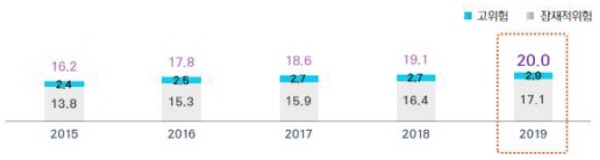
▲ Status of smartphone overdependence risk groups by year <Source: Ministry of Science and ICT>
By age group, the group at risk of overdependence among young children (ages 3 to 9) increased by 2.2 percentage points compared to the previous year, showing the largest increase. The proportion of adults (ages 20–59) and those in their 60s was also found to be increasing every year, and the proportion of youth (ages 10–19), which had slowed down somewhat in 2018, also shifted to an upward trend in 2019.
The risk of overdependence among young children and adolescents was relatively vulnerable when parents were in the overdependence risk group or when they were from dual-income households.
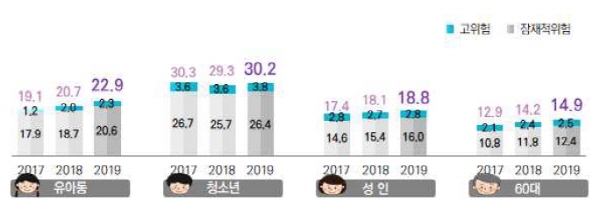
▲ Status of smartphone overdependence risk groups by year and target group <Source: Ministry of Science and ICT>
In a survey asking about perceptions of smartphone overdependence, 78.7% of respondents answered that it was serious, and it was found that the overdependence risk group (83.9%) perceived the smartphone overdependence problem as more serious than the general user group (77.5%).
As solutions to resolve overdependence, alternative leisure activities (when the problem-solving entity is an individual), guidance and warnings regarding excessive use (when the problem-solving entity is a company), and education to resolve smartphone overdependence (when the problem-solving entity is the government) were each ranked as the top priority.
The rate of experience with smartphone overdependence prevention education was 18.7%, an increase of 0.9p from the previous year, and among those who experienced the prevention education, the percentage of respondents who said it was helpful also increased to 70.6%, up 5.9%p from last year.
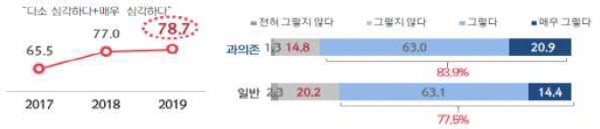
▲ Perception of the severity of smartphone overdependence in our society <Source: Science and Technology Information Center>Ordinary Bride
The Ministry of Science and ICT plans to expand experiential preventive education for young children to help them form proper smartphone usage habits early on, and plans to build and operate a website within this year that can provide integrated guidance on services for preventing and resolving digital dysfunctions in cooperation with relevant ministries.
Park Yoon-kyu, Director General of Information and Communication Policy at the Ministry of Science and ICT, stated, “In this digital age where the frequency of exposure to various digital devices, such as smartphones, is increasing, we need to reflect on our own dependency levels,” adding, “We will pursue various policies, including customized preventive education for each life stage, the development of content to prevent over-dependence, and public-private cooperation to raise awareness.”
Meanwhile, this survey scored the subjects' condition using a smartphone overdependence scale and classified them into high-risk, potential-risk, and general user groups based on the standard score for each age group. The high-risk group refers to cases where there are serious problems in interpersonal relationships, health, and daily life due to a loss of control over smartphone use, while the potential-risk group refers to cases where control over smartphone use has weakened, causing problems in interpersonal relationships, health, and daily life to begin to occur.
Comments
Related news
5G will cover 65% of the world's population by 2025.
By 2025, 5G services are projected to cover 65% of the global population and handle 45% of mobile data traffic. Average monthly data traffic per smartphone is expected to increase from 7.2GB to 24GB, and IoT connections are anticipated to grow from 1.3 billion at the end of 2019 to 5 billion by the end of 2025.
2019.12.19by 최인영 기자

Maintaining Global 5G Dominance with Three Key 5G Investment Promotion Packages
Domestic 5G subscribers surpassed approximately 4.49 million as of December 14, 2019, and base stations exceeded 94,407 units as of the completion report date on December 20, 2019. Terminal device sales performance was also significant. Samsung Electronics held the top position with a 74.2% global 5G smartphone market share as of the third quarter of 2019, and LG Electronics recorded 5.6%. In global 5G equipment market share, Samsung Electronics ranked second with 23.3% as of the third quarter of 2019. The Ministry of Science and ICT announced that it will actively pursue industrial promotion policies for 5G-related sectors to maintain this market advantage.
2020.01.02by 이수민 기자
Smartphone Sales Rebound in 2020... Up 3% Year-on-Year
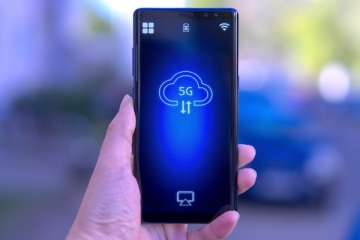
As many countries introduce 5G network coverage, global smartphone sales in 2020 are expected to reach 1.57 billion units, representing a 3% increase compared to the previous year. Gartner forecasts that Apple's first 5G phone launch will influence consumers in China and emerging Asia-Pacific regions, with global 5G mobile phone sales projected to reach 221 million units in 2020 and 489 million units in 2021.
2020.01.29by 최인영 기자
European Patent Applications Surpass 200,000 for the First Time… South Korea Maintains 5th Place, Led by Batteries and Telecommunications
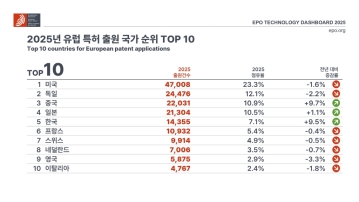
According to the European Patent Office (EPO)'s 'Technology Dashboard 2025', European patent applications last year reached 201,974, surpassing 200,000 for the first time. Korean companies and inventors filed 14,355 applications, representing a 9.5% increase from the previous year and maintaining 5th place by country. Battery, digital communication, and semiconductor technologies led the growth, with Samsung ranking as the top EPO applicant for the second consecutive year and LG reaching 3rd place. The presence of major domestic cities such as Seoul, Suwon, and Yongin was also confirmed. It was also revealed that Korea's European patent strategy is expanding beyond individual technologies to span the entire industry.
2026.03.24by 명세환 기자

SK Telecom First Applies AI-Based Network Operations at Gwanghwamun K-Pop Concert
SK Telecom announced that it applied an AI-based network operation system for the first time at a large-scale K-pop concert held in the Gwanghwamun area of Seoul on March 21st, managing communication quality throughout the event. Mobile data usage during the three hours before and after the concert reached 12.15TB, approximately doubling compared to the same time slot the previous weekend. SK Telecom monitored traffic using the AI system 'A-One' in five-minute and 50-meter units to respond to potential overload situations, while also operating temporary communication facilities and on-site personnel in parallel. This case is interpreted as confirmation of the practical applicability of AI-based autonomous network operation in an environment where demand from dense events and foreign users increases simultaneously.
2026.03.23by 명세환 기자











