


Actively utilize ICT technologies such as robots, drones, and VR in national defense.
 Published2020.03.04 11:17
A total investment of KRW 177.2 billion, a 15% increase over the previous year.
Developing private sector models and strengthening support for small and medium-sized enterprises
The government will invest a total of 177.2 billion won this year to apply core technologies of the 4th industrial revolution, such as robots, drones, 3D printing, AR, VR, and MR, to the defense sector.
To implement advanced national defense and secure competitiveness in new industries, 14 ministries, including the Ministry of Science and ICT, the Ministry of Trade, Industry and Energy, and the Defense Acquisition Program Administration, deliberated and finalized the "2020 Civilian-Military Technology Cooperation Project Implementation Plan" in writing through the Civilian-Military Technology Council on March 4.
This year's investment volume is KRW 177.2 billion (KRW 154 billion in 2019), a 15% increase from the previous year. Ten ministries will invest in a total of 195 projects (including 44 new projects). By project, KRW 159.3 billion will be invested in the Civilian-Military Dual-Use Technology Development Project and KRW 11 billion in the Civilian Technology Transfer Project.
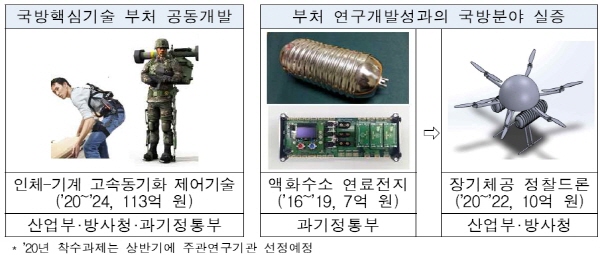
▲ Case study of inter-ministerial R&D projects <Source: Ministry of Science and ICT>
The project focuses on developing high-speed human-machine synchronization control technology based on complex signals for wearable robot development, as well as projects applicable to actual defense fields such as reconnaissance drones and information-gathering gliders. The developed technology secures a track record by going through the process of being utilized in the defense field.
To promote civilian use of defense technology, along with verification in the defense sector, we will actively identify key leading models and expand pilot projects.
To this end, a fast-track system will be established to enable projects requiring rapid implementation and with a high potential for commercialization within a short period of time to be implemented in the same year, thereby promoting the transfer and utilization of high-impact, cutting-edge defense technologies to the private sector.
At the same time, in the case of the development of items related to weapons systems, the reliability of evaluation results and their usability in the defense field will be increased by establishing a new National Defense Power Development Work Instruction as an institutional foundation so that the military can directly conduct testing and evaluation, and in order to shorten the acquisition period, a basis (Defense Acquisition Program Act Enforcement Regulation) will be established to allow civil-military technology cooperation results to be submitted for medium-term (3-7 years) or emergency (2 years) requirements rather than the current long-term requirements (7 years or more).
In order to encourage participation by demand companies, regardless of the type of company, for small and medium-sized enterprises, the contribution amount is 75% or less of the project cost, the cash burden ratio is 10% or more of the private burden, and the fixed technology fee is within the range of 10% of the contribution amount.
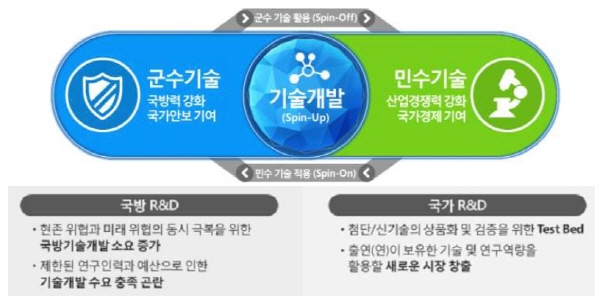
▲ Overview of the 2020 Civilian-Military Technology Cooperation Project <Image = Ministry of Science and ICT>
The Civilian-Military Technology Cooperation Project is an inter-ministerial cooperation project that has been ongoing since 1999. It has contributed to improving the performance of weapons systems in the defense sector and to driving future growth engines in the private sector.
A total of KRW 1.3441 trillion has been invested as of 2019, and the project has shown business performance, including achieving a cumulative technology development commercialization rate of 69% over the past five years.
> In particular, the development of high-performance, high-functional composite fiber materials and small and medium-sized water jet propulsion systems have contributed significantly to the domestic production of weapon systems, and in the non-weapon system business, the development and mass production of winter naval uniforms with significantly improved functionality have been successful in supplying them to the Navy this year.
Comments
Related news
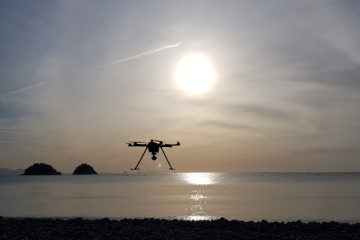
LG U+ Demonstrates Military Drone Maritime Operation Capabilities
LG Uplus conducted a demonstration of maritime operations based on military drones for approximately 10 minutes with the 31st Infantry Division near Jukdo and Hyeoldo islands, located 1.6km west of Musulmok in Yeosu City, Jeollanam-do. The maritime operations demonstration, which took place in the afternoon on the 16th, showcased real-time response to maritime situations through U+ Smart Drone, coastal search and reconnaissance, rapid infiltration response, building interior search, outpost surveillance, and aerial search within cordoned areas, presenting various drone utilization methods. LG Uplus plans to continue expanding drone applications by integrating AI and big data into the control system and through civil-military-defense cooperation going forward.
2019.04.17by 이수민 기자
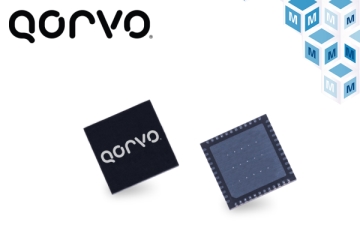
Corvo Supplies QPA3069 Power Amplifiers for Defense and Aerospace
Mauser Electronics supplies Cree's QPA3069 power amplifier. The 100W QPA3069, designed for defense and aerospace applications, delivers high output power density and power added efficiency when designing 2.7–3.5 GHz RF-based circuits. It is manufactured using Cree's 0.25 μm gallium nitride on silicon carbide (GaN-on-SiC) process, and the package is compact at 7.0 × 7.0 × 0.85 mm.
2020.01.23by 이수민 기자
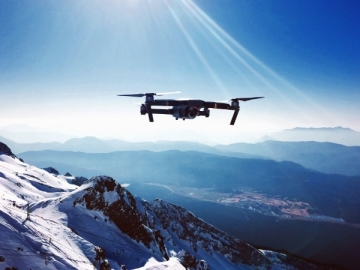
Domestic development of high-performance turbofan engines for unmanned aerial vehicles
The Ministry of Trade, Industry and Energy and the Defense Acquisition Program Administration will leverage their core capabilities to develop high-performance turbofan engines for future defense unmanned aircraft. On January 30th, the two agencies concluded a memorandum of understanding with key contents including the establishment of an inter-ministerial coordination body and intellectual property protection. They announced plans to invest approximately 88 billion won through 2025.
2020.01.30by 최인영 기자
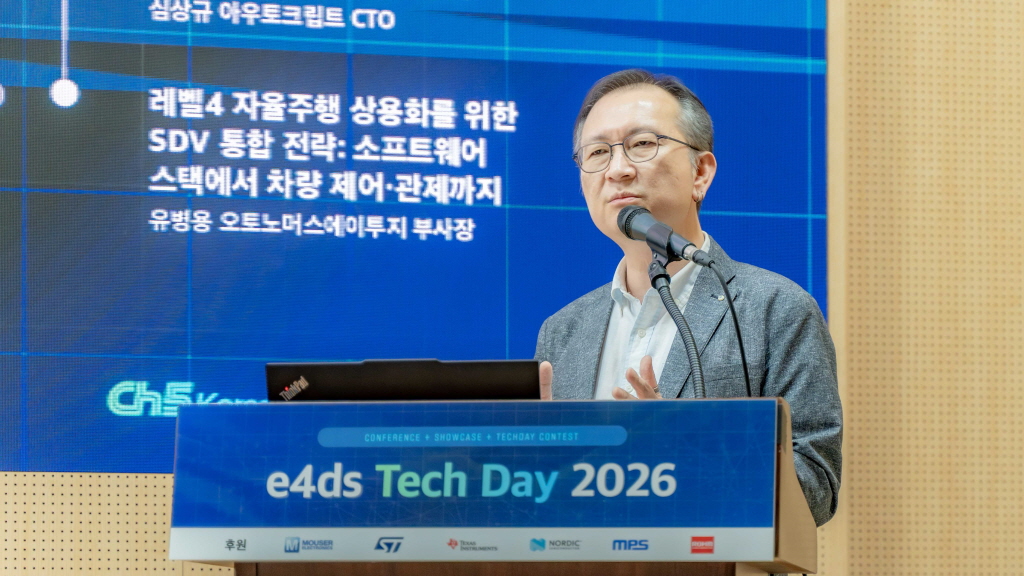
[e4ds Tech Day 2026 ⑨] Sim Sang-gyu, Autocrypt CTO: "In the Physical AI Era, Automotive Security Must Extend Beyond the Vehicle"
At e4ds Tech Day 2026, Sim Sang-gyu, CTO of Autocrypt, explained automotive cybersecurity strategies in the era of Physical AI and SDV (Software-Defined Vehicle). Automobiles are evolving as part of an ecosystem connected to AI, cloud, chargers, IoT, and robots, and he emphasized that the scope of security must expand beyond the vehicle interior to the entire connected environment. In particular, AI model tampering, adversarial attacks, OTA updates, and EV charger hacking were identified as major threats. He explained that response measures require zero trust, AI model integrity protection, intrusion detection, Security by Design and Default, and full lifecycle security management, and that proactive security system establishment beyond regulatory compliance is critical for securing future mobility competitiveness.
2026.10.12by 배종인 기자

Practical HIL Construction Strategy for Automotive and Off-Highway Controller Validation
As vehicle E/E architecture transitions to zonal structures and shifts to software-defined vehicles (SDV), the number of controllers (ECUs) requiring validation and software complexity are surging dramatically. Meanwhile, real vehicle testing cannot provide repeated verification under identical conditions and entails lead time and safety concerns. This white paper explains the principles of HIL (Hardware-in-the-Loop) validation and the structure of the NI platform composed of PXI, SLSC, and VeriStand, and through two actual implementation cases—Camera Record & Replay HIL for In-Cabin Monitoring Controller (ICMU) and Forklift Controller (VCU) HILS—describes how controller-level regression testing becomes possible. Additionally, it explicitly states application boundaries and limitations, such as lack of A2B support.
2026.10.12by 편집부











