


Data centers to be included in broadcasting and telecommunications disaster management
 Published2020.03.04 16:53
Including data providers such as cloud service providers in line with the 5G era
A claim was raised in the National Assembly that major data centers should be included in broadcasting and telecommunications disaster management to protect data, a core resource of the digital economy.
Representative Park Sun-sook (Minseong Party, proportional representation) of the National Assembly Science, Technology, Information and Communications Committee proposed an amendment to the Framework Act on Broadcasting and Telecommunications Development on March 4 to include the protection of key data in the scope of preparedness for broadcasting and telecommunications disasters.
This bill was proposed based on the case that proved the safety vulnerability of domestic telecommunication networks through the fire in the underground telecommunications tunnel at KT’s Ahyeon branch in November 2018.
In the era of 5G hyper-connectivity, data centers are important locations serving as the foundation for various convergence services; therefore, if they are destroyed or damaged by a disaster, the socioeconomic losses resulting from the interruption of data services can be severe.
Data centers, which store data—a core resource of the digital economy—also need to be included in disaster management targets to ensure they are safely protected from disasters.

An amendment to the Framework Act on Broadcasting and Telecommunications Development, including the protection of key data, has been proposed.
According to data released by the Korea Data Center Association on January 13, as of the end of last year, there were 158 data centers built and operating in Korea, and total revenue was estimated at approximately 2.4 trillion won as of 2018.
Future countryThe domestic data center market is expected to grow rapidly. It is anticipated that 32 new data centers will be built by 2025, and among them, SK Telecom, KT, LG Uplus, and Naver are reportedly planning to construct large-scale hyperscale data centers with over 100,000 servers.
In the case of overseas operators, not only IT companies such as Amazon, Microsoft, Oracle, IBM, Equinix, and Google, but also investment firms like Macquarie are planning to build data centers in Korea.
Despite the growing importance of cloud services in the industry, legal and institutional preparations for disaster response in data centers are currently lacking.
The current Framework Act on Broadcasting and Telecommunications Development designates the operators subject to the Basic Plan for Broadcasting and Telecommunications Disaster Management established by the Ministry of Science and ICT and the Korea Communications Commission as ▲key telecommunications operators ▲terrestrial broadcasters ▲general programming broadcasters. The requirements necessary for preparing for broadcasting and telecommunications disasters include securing alternative broadcasting and telecommunications routes, establishing an information system for the interconnected operation of broadcasting and telecommunications facilities, and securing materials for damage recovery.
.jpg)
The amendment includes provisions to expand disaster management measures, currently concentrated on major telecommunications companies, to include data service providers.
The proposed amendment aims to expand existing disaster management measures, which are currently concentrated on terrestrial broadcasters and major telecommunications companies, to include data service providers such as cloud service providers.
The amendment includes value-added telecommunications business operators (data center operators) that provide servers, storage devices, and networks of a certain scale or larger as major broadcasting and telecommunications business operators subject to the Basic Plan for Broadcasting and Telecommunications Disaster Management, and adds the protection of key data to the disaster preparedness items.
Representative Park Sun-sook stated, “Data is an object that requires consideration of the possibility of loss, going beyond a simple leakage issue,” adding, “As our society enters the hyper-connected era of 5G, there is a strong demand for stability in terms of cyber security, such as data leakage and hacking, but the surrounding environment remains exposed to physical disasters.”
He continued, “Data is a physical asset that we must protect,” adding, “Institutional safeguards must be established to ensure both the cyber and physical safety of data are satisfied simultaneously.”
Meanwhile, during an emergency briefing on the fire incident in the underground telecommunications tunnel at KT's Ahyeon branch held on November 26, 2018, Rep. Park stated that given the massive amount of information transmitted in the 5G era, there is a possibility of widespread accidents.He argued that measures should be prepared based on that premise.
Comments
Related news
Google Cloud Platform Officially Opens Seoul Region
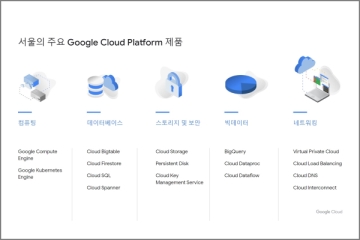
Google has launched the Google Cloud Platform (GCP) Seoul Region. The opening of the GCP Seoul Region is expected to reduce data access latency and application response times for domestic and global companies conducting business in Korea. The Seoul Region is configured with three availability zones from its initial launch, enabling Google Cloud customers and partners to run high-availability workloads and store data domestically.
2020.02.19by 이수민 기자
Promotion of AI, Big Data, and Smart Service Support Projects for SMEs
The Ministry of SMEs and Startups announced that it will promote projects including the Smart Service Support Program for SMEs, AI-based High-Value New Product Technology Development Project, and Big Data-based Service Development R&D Project to help small and medium-sized enterprises enhance productivity and competitiveness by leveraging emerging technologies such as AI and big data. The ministry plans to discover representative cases for each project by supporting consortium composition and collaborative projects to enable SMEs to carry out tasks through open innovation.
2020.02.25by 이수민 기자
Xilinx Launches SmartNIC Turnkey Platform for Data Centers
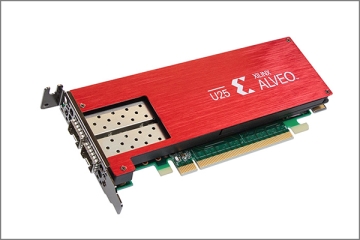
Cloud service providers are increasingly deploying SmartNICs to reduce the load on CPU cores critical to running business applications as capacity scales, and to optimize server utilization. The Xilinx Alveo U25 SmartNIC is designed to deliver SmartNIC efficiency to cloud service providers, telecom operators, and private cloud data center operators.
2020.03.04by 이수민 기자
European Patent Applications Surpass 200,000 for the First Time… South Korea Maintains 5th Place, Led by Batteries and Telecommunications
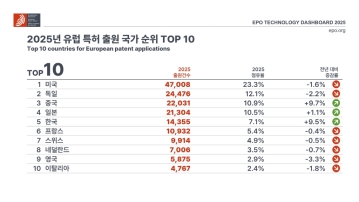
According to the European Patent Office (EPO)'s 'Technology Dashboard 2025', European patent applications last year reached 201,974, surpassing 200,000 for the first time. Korean companies and inventors filed 14,355 applications, representing a 9.5% increase from the previous year and maintaining 5th place by country. Battery, digital communication, and semiconductor technologies led the growth, with Samsung ranking as the top EPO applicant for the second consecutive year and LG reaching 3rd place. The presence of major domestic cities such as Seoul, Suwon, and Yongin was also confirmed. It was also revealed that Korea's European patent strategy is expanding beyond individual technologies to span the entire industry.
2026.03.24by 명세환 기자
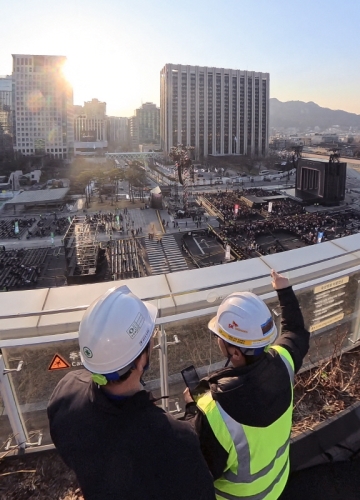
SK Telecom First Applies AI-Based Network Operations at Gwanghwamun K-Pop Concert
SK Telecom announced that it applied an AI-based network operation system for the first time at a large-scale K-pop concert held in the Gwanghwamun area of Seoul on March 21st, managing communication quality throughout the event. Mobile data usage during the three hours before and after the concert reached 12.15TB, approximately doubling compared to the same time slot the previous weekend. SK Telecom monitored traffic using the AI system 'A-One' in five-minute and 50-meter units to respond to potential overload situations, while also operating temporary communication facilities and on-site personnel in parallel. This case is interpreted as confirmation of the practical applicability of AI-based autonomous network operation in an environment where demand from dense events and foreign users increases simultaneously.
2026.03.23by 명세환 기자











