


Future Automotive Industry Workforce Demand to Reach Approximately 89,000 by 2028
 Published2020.03.11 16:41
참여기업 78%·매출액 53.1% 친환경차로 집계
자율주행차 및 인프라 분야 인력수요 가장 높아
전기차, 수소차, 자율주행차 등 미래형 자동차 산업에 종사 중인 산업기술인력은 지난 2018년 말 기준 총 5만533명으로 2015년 말 9,467명보다 5.3배 증가했다.
2015년 말 이후 미래형 자동차 산업에 참여하는 신규 기업 수가 증가하고 기존 기업의 미래형 자동차 사업 영역이 성장하는 동시에 산업간 융복합에 따른 산업 범위 확장이 연평균증가율 74.7%를 견인했다.
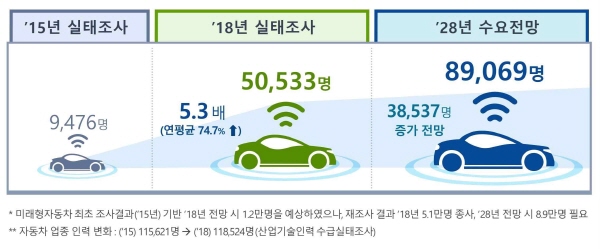
▲ 미래형 자동차 산업의 연평균증가율이 74.7%를 기록했다 <자료=산업통상자원부>
산업통상자원부는 최근 미래형 자동차 산업에 참여하고 있는 근로자 10인 이상 사업체를 대상으로 실시한 산업기술인력 실태조사 결과를 발표했다.
미래형 자동차 산업에 참여 중인 기업은 2018년 말 기준 약 1,740개(2015년 말 166개)로 이들은 전체 매출의 22.9%(2015년 말 5.3%)를 미래형 자동차 분야에 투자하고 있는 것으로 파악된다.
분야별로 보면 ▲친환경차(그린카) 4만2,443명 ▲자율주행차(스마트카) 5,021명 ▲인프라 3,068명으로 2015년 말 대비 친환경차 관련 인력이 7.3배 수준으로 가장 큰 폭으로 증가했다.
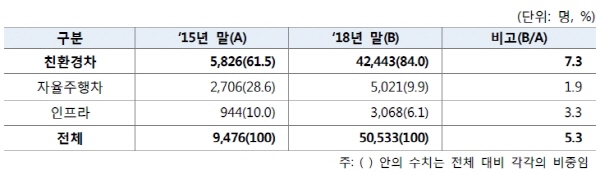
▲ 분야별 현황 <자료=산업통상자원부>
직무별로는 ▲생산기술 2만3,438명 ▲연구개발 1만7,186명 순으로 2015년 말보다 연구개발 인력(2,114명)이 8.1배 급증했다.
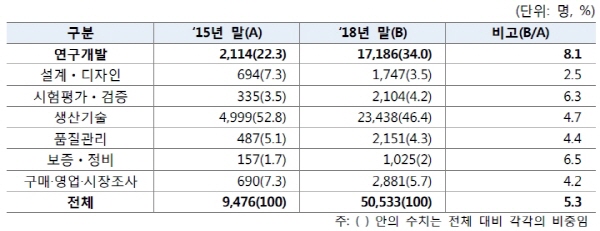
▲ 직무별 현황 <자료=산업통상자원부>
오는 2028년까지 미래형 자동차 산업기술인력 수요는 8만9,069명(연평균증가율 5.8%)에 달할 것으로 예상되는데 지난 2018년 말 기준 부족인원은 1,827명, 부족률은 3.5%(2015년 말 대비 1.6%p 하락)을 기록했다.
부족인원의 경우 인프라·자율주행차 분야, 설계·디자인 및 품질관리 직무, 대졸 학력에서 부족률이 가장 높은 것으로 집계됐다.
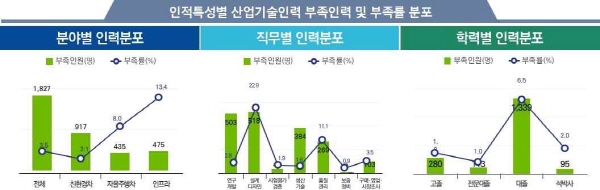
▲인적특성별 산업기술인력 부족인력 및 부족률 분포 <자료=산업통상자원부>
산업기술인력 수요는 ▲자율주행차 1만1,603명 ▲인프라 5,531명으로 비중은 친환경차(80.0%)가 높지만 연평균증가율은 자율주행차(8.7%)가 더 우위에 설 것으로 예상된다.
직무별로는 ▲생산기술 4만2,486명 ▲연구개발 2만9,17명 ▲시험평가·검증 3,393명 순이며 생산 및 보급 확산을 뒷받침할 생산기술 인력이 가장 높은 연평균증가율(6.1%)을 보일 것으로 전망된다.
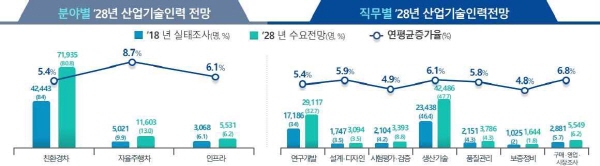
▲분야·직무별 산업기술인력 전망 <자료=산업통상자원부>
미래형 자동차 산업 참여 기업의 구성을 보면 2018년 말 기준 ▲그린카 78% ▲스마트카 12.7% ▲인프라 9.3% 순으로 이들의 매출액도 친환경차가 53.1%로 가장 높았다.
업종별로는 자동차 업종이 50.9%로 가장 많았으며 뒤이어 ▲전자·IT 29.8% ▲화학 9.9% ▲기계 4.7% 등으로 집계됐다. 제품 판매·납품(73.4%) 및 서비스 운영(15.5%) 단계에 있는 참여 기업의 비중은 2015년 말 대비 늘어난 반면 연구기획, 연구개발 등 사업 초기 단계에 있는 기업의 비중은 줄어든 것으로 나타났다.
이번 조사 결과 정부의 전략적 신산업 육성 정책이 민간 투자 활성화와 산업간 융복합 등을 통해 산업 성장 및 고용 확대로 이어지는 것을 확인할 수 있었다. 산업 분포를 보면 자동차 50.9%, 그 외 산업 49.1%로 이종 산업간 활발한 융복합을 통해 산업구조가 내연기관차에서 친환경차로 전환되며 유망 신산업으로 성장하고 있다.
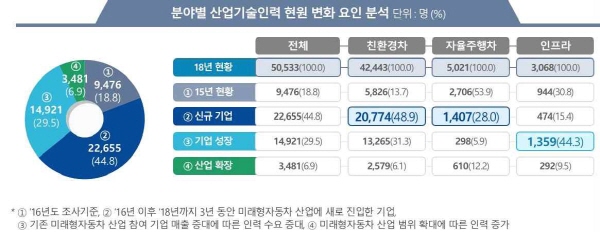
▲ 분야별 산업기술인력 현원 변화 요인 분석 <자료=산업통상자원부>
참여 기업들은 이종 산업간 융합형 교육 확대, 기술주기 대응을 위한 재직자 중심 상시교육 체계 마련, 현장 중심 커리큘럼 운영 확대 등을 요구하는 상황으로 산업부는 이번 조사결과를 토대로 미래형 자동차 산업계의 인력 미스매치 해소와 단계별 인력 양성 정책을 적극 추진할 계획이다.
한편 산업기술인력 실태조사는 신산업의 대표 분야인 전기차, 수소차 등 미래형 자동차 산업의 빠르게 변화하는 인력 구조와 현황 등을 파악하기 위해 지난 2016년부터 산업기술원과 산업연구원이 공동 진행해오고 있다.
Comments
Related news
TOP 9 Key ICT Trends in 2020, Opening a New Decade
As 2020 approaches, various institutions are releasing their outlooks for the new year. ICT has opened new eras on a decade-by-decade cycle. The 2020s are expected to become the AI era, with 2020 being its inaugural year. AI will serve as a new momentum for the global economy, which has been mired in low growth. 5G, which is undergoing commercialization worldwide, will connect the world, and autonomous driving will transform driving culture and logistics formats.
2020.01.13by 이수민 기자

PAVs to be commercialized sooner than fully autonomous vehicles
Personal aerial vehicles, or PAVs, are being presented as a future transportation mode to enhance mobility efficiency in congested urban areas. PAVs generated greater attention at CES 2020 than autonomous vehicles. As partial autonomous driving functions became commercialized, automotive industry interest in autonomous vehicles somewhat cooled, and Level 5 autonomous vehicle development encountered several technical challenges. These challenges are lowering the commercialization potential of fully autonomous vehicles compared to PAVs.
2020.02.18by 이수민 기자
.jpg)
Restructuring of three national land and transportation laws in preparation for autonomous vehicle era
Legislative services have been improved with the aim of institutionalizing platform business systems in the national land and transportation sector, utilizing private sector creativity, and resolving traffic shortage issues in new cities. Rep. Yoon Kwan-seok of the National Assembly's Land, Infrastructure and Transport Committee announced on March 6 that the National Assembly plenary session passed amendments to the Passenger Automobile Transportation Business Act, amendments to the Building Act, and amendments to the Special Act on Metropolitan Area Wide-Area Transportation Management.
2020.03.06by 최인영 기자

[e4ds Tech Day 2026 ⑨] Sim Sang-gyu, Autocrypt CTO: "In the Physical AI Era, Automotive Security Must Extend Beyond the Vehicle"
At e4ds Tech Day 2026, Sim Sang-gyu, CTO of Autocrypt, explained automotive cybersecurity strategies in the era of Physical AI and SDV (Software-Defined Vehicle). Automobiles are evolving as part of an ecosystem connected to AI, cloud, chargers, IoT, and robots, and he emphasized that the scope of security must expand beyond the vehicle interior to the entire connected environment. In particular, AI model tampering, adversarial attacks, OTA updates, and EV charger hacking were identified as major threats. He explained that response measures require zero trust, AI model integrity protection, intrusion detection, Security by Design and Default, and full lifecycle security management, and that proactive security system establishment beyond regulatory compliance is critical for securing future mobility competitiveness.
2026.10.12by 배종인 기자

Practical HIL Construction Strategy for Automotive and Off-Highway Controller Validation
As vehicle E/E architecture transitions to zonal structures and shifts to software-defined vehicles (SDV), the number of controllers (ECUs) requiring validation and software complexity are surging dramatically. Meanwhile, real vehicle testing cannot provide repeated verification under identical conditions and entails lead time and safety concerns. This white paper explains the principles of HIL (Hardware-in-the-Loop) validation and the structure of the NI platform composed of PXI, SLSC, and VeriStand, and through two actual implementation cases—Camera Record & Replay HIL for In-Cabin Monitoring Controller (ICMU) and Forklift Controller (VCU) HILS—describes how controller-level regression testing becomes possible. Additionally, it explicitly states application boundaries and limitations, such as lack of A2B support.
2026.10.12by 편집부











