



ICT service inspection due to increased telecommunications traffic caused by COVID-19
 Published2020.03.24 14:06
Internet traffic in March increased by approximately 13% compared to January, reaching an all-time high.
The Ministry of Science and ICT reviewed the current status of increased telecommunications traffic, including the internet, and discussed support measures for small and medium-sized enterprises and universities struggling due to the increase in remote work and cyber lectures.
Recently, due to the spread of COVID-19, internet usage in overseas regions such as Europe has surged, and in some countries, services have gone down or the government has excessively regulated online services. In response, the Ministry of Science and ICT held a meeting to monitor internet traffic and prepare for ICT service disruptions.
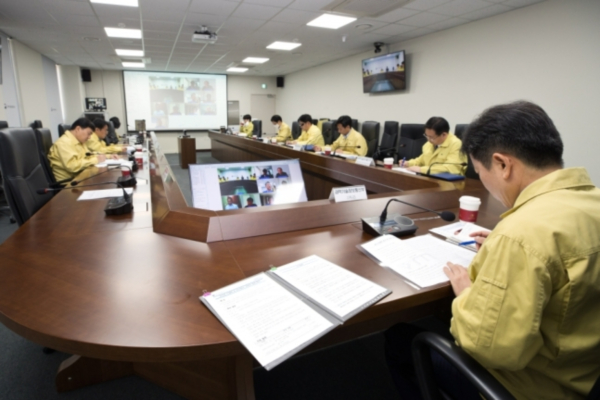
The Ministry of Science and ICT inspected the status of traffic growth.
(Photo = Ministry of Science and ICT)
The meeting was attended by telecommunications operators as well as major search portals, messengers, and cloud service providers that have established themselves as essential services for the public to obtain information, communicate, and work from home.
Attendees shared traffic trends and disaster preparedness status following the COVID-19 pandemic and explored response measures for potential future failures.
Telecommunications operators said that while internet traffic in March increased by about 13% compared to January (an all-time high) due to the increase in streaming service usage, the peak usage is still only 45 to 60% of the capacity held by operators.
In contrast, while the usage of search portals, messengers, and cloud service providers has increased slightly, this represents the highest usage volume.He said that it was because usage time had expanded overall rather than the price having increased, and that there would be no problem providing the service even if traffic increased.
Jang Seok-young, the Second Vice Minister of Science and ICT, stated, “In Korea, telecommunications infrastructure is well-established, so there are unlikely to be any issues with overall network capacity, but localized and temporary increases in traffic could lead to disruptions.” He added, “We will make thorough preparations to ensure there is no disruption to people’s daily lives and economic activities, and at the same time, we will promptly share the situation with the government to respond in the event of a failure.”
Meanwhile, support measures for small and medium-sized enterprises and universities were also discussed at the meeting. Amazon Web Services plans to provide support to public institutions requiring IT solutions to respond to COVID-19, while KT is offering free internet line expansions and technical support for online lectures to universities using its network.
While providing free video conferencing solutions from Google, Naver, and KT, as well as remote work solutions from SK Broadband, Microsoft Korea, and Naver, initiatives are underway to reduce server costs for small and medium-sized enterprises (NBP) and fully support Kakao Pay payment fees.
Comments
Related news
.jpg)
Ministry of Science and ICT Supports SMEs' Overseas Expansion of 5G Networks
The Ministry of Science and ICT held a roundtable discussion with related small and medium-sized enterprises to vitalize 5G network equipment and components, and shared policies including methods for collecting overseas local information, support for 5G equipment testing and verification, and preferential treatment through 5G trade insurance. The Ministry plans to communicate news of supporting SMEs' overseas expansion through the Korea Network Industry Association.
2020.02.04by 최인영 기자

Public-Private Joint Response to Improve 5G Quality Services
The Ministry of Science and Technology will work jointly with mobile carriers, terminal manufacturers, and equipment manufacturers to improve 5G service quality. Telecom operators will enhance service reception environments targeting public buildings and other facilities, while terminal manufacturers will launch mid-range 5G smartphones to expand 5G service adoption, and equipment manufacturers will supply equipment according to the carriers' base station deployment schedules.
2020.03.12by 최인영 기자

Selection of Implementing Agencies for New COVID-19 Response ICT Projects Begins
The Ministry of Science and Technology will conduct evaluations to select implementation organizations for new ICT projects starting March 23rd to support industries facing difficulties due to COVID-19. Approximately 177.1 billion won will be allocated to 27 R&D projects, and approximately 331.4 billion won will be provided to 55 other projects.
2020.03.23by 최인영 기자
European Patent Applications Surpass 200,000 for the First Time… South Korea Maintains 5th Place, Led by Batteries and Telecommunications
According to the European Patent Office (EPO)'s 'Technology Dashboard 2025', European patent applications last year reached 201,974, surpassing 200,000 for the first time. Korean companies and inventors filed 14,355 applications, representing a 9.5% increase from the previous year and maintaining 5th place by country. Battery, digital communication, and semiconductor technologies led the growth, with Samsung ranking as the top EPO applicant for the second consecutive year and LG reaching 3rd place. The presence of major domestic cities such as Seoul, Suwon, and Yongin was also confirmed. It was also revealed that Korea's European patent strategy is expanding beyond individual technologies to span the entire industry.
2026.03.24by 명세환 기자

SK Telecom First Applies AI-Based Network Operations at Gwanghwamun K-Pop Concert
SK Telecom announced that it applied an AI-based network operation system for the first time at a large-scale K-pop concert held in the Gwanghwamun area of Seoul on March 21st, managing communication quality throughout the event. Mobile data usage during the three hours before and after the concert reached 12.15TB, approximately doubling compared to the same time slot the previous weekend. SK Telecom monitored traffic using the AI system 'A-One' in five-minute and 50-meter units to respond to potential overload situations, while also operating temporary communication facilities and on-site personnel in parallel. This case is interpreted as confirmation of the practical applicability of AI-based autonomous network operation in an environment where demand from dense events and foreign users increases simultaneously.
2026.03.23by 명세환 기자











