



"IDC Becomes 8 Times Faster": ETRI Develops 400G Optical Transceiver Engine
 Published2020.03.26 08:37
100,000 simultaneous high-definition YouTube streaming possible
Development of products supporting 1Tbps beyond 400Gbps in the future
Domestic researchers have developed an optical transceiver engine for 400Gbps signal transmission that can be used in ultra-large data centers, mobile communication base stations, etc.
.jpg)
Examining a semiconductor light source chip (Photo = ETRI)
The Electronics and Telecommunications Research Institute (ETRI) announced on the 25th that it has successfully developed 400G optical transceiver engines and optical device technologies for large-area data centers. Existing data centers primarily used 100Gbps optical transceivers containing four laser diode (EML) devices, which could transmit at 25Gbps using four channels.
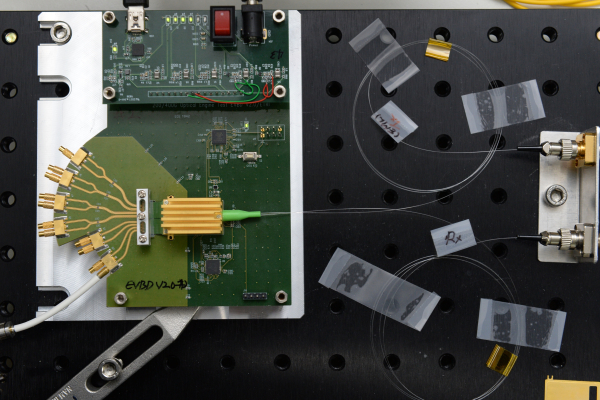
ETRI researchers created an EML device capable of 100Gbps-class transmission per channel by increasing the transmission speed fourfold. Through this, they developed an optical transceiver engine that achieves a total data transmission of 400Gbps by integrating four EML light source devices, a photodetector, an optical transmitter, and an optical receiver. This is a level where 100,000 people can simultaneously stream high-definition YouTube videos.
According to the industry, the optical transceiver market for data centers is expected to reach approximately 8.3 trillion won in 2023, with 100G or higher accounting for 78% of the total.
(Photo = ETRI)
This optical transceiver engine can be mounted on an optical transceiver the size of an adult's finger. Thanks to miniaturization, not only the transmission speed but also the processing capacity has increased. While existing communication equipment is structured to have 32 optical transceivers plugged into the front, the engine developed by the research team can attach up to 64 to the top of the communication equipment's line card.
By attaching twice as many optical transceiver engines, which have a transmission speed four times higher than existing ones, to a single communication device, the total processing capacity has increased by up to eight times. The existing processing capacity was a maximum of 3.2 TB (terabytes), but with the application of the research team's technology, it increases to a maximum of 25.6 TB.
ETRI stated that it achieved this result by utilizing source technologies such as EML technology for creating light sources, ultra-high frequency signal line design and packaging technology, and optical signal coupling and optical detection technology. The research team plans to work on stabilizing this technology in the future and develop an optical transceiver engine capable of 1 Tbps (tera) beyond 400 Gbps.
Comments
Related news

Microchip Launches Space Ethernet Transceivers and MCUs
Microchip announced the VSC8541RT, a space-qualified Ethernet transceiver, and the MCUSAM3X8ERT, an embedded Ethernet MCU. The VSC8541RT and SAM3X8ERT feature identical pinout configurations. Developers can begin development using COTS devices before transitioning to aerospace-grade components, thereby reducing development time and costs.
2020.01.16by 이수민 기자
.jpg)
Pressure display developed to show object surface information
A research team from ETRI and Seoul National University has developed an ultra-high-sensitivity transparent pressure sensor with sensitivity up to 20 times greater than existing products using nano-composite materials. The researchers utilized nano materials as a new sensor material and applied them to a stacked structure of quantum dot light-emitting devices, enabling both enhanced sensitivity and real-time visualization of pressure distribution.
2020.02.13by 이수민 기자

ADI and Marvell Form Technology Partnership to Develop Highly Integrated 5G Wireless Solutions
ADI and Marvell have entered into a strategic partnership to develop next-generation RU solutions for 5G base stations. Under the partnership, the two companies will provide fully integrated 5G DFE ASIC solutions combining RF transceivers. Additionally, they will collaborate on developing next-generation RU solutions that include baseband and RF technologies optimized for various radio access network functional split sets and architectures.
2020.02.26by 이수민 기자

Intel Unveils Next-Generation 'Core Ultra Series 3' and vPro Platform for Enterprise PCs
Intel has officially unveiled the "Intel Core Ultra Series 3" for next-generation enterprise PCs and the latest vPro platform, addressing a wide range of demands from enterprise notebooks to high-performance workstations.
2026.03.26by 배종인 기자

ROHM Launches ESD Protection Diode Compatible with High-Speed Interfaces of 10Gbps or Higher
Semiconductor specialist ROHM has developed the 'RESDxVx series' of ESD (electrostatic discharge) protection diodes capable of responding to next-generation high-speed data communication environments exceeding 10Gbps, simultaneously enhancing both signal quality maintenance required in high-speed interfaces and IC protection performance.
2026.03.26by 배종인 기자











